

Nobody has ever bought a house from a chatbot — but plenty of agents now let AI write the listing, follow up with the lead, and prep the showing notes. The selling is still human; the desk work doesn’t have to be.
AI for Real Estate Professionals: Practical 2026 Guide
AI for real estate has moved past the hype stage into something genuinely useful: agents and brokers are using it daily to write listing descriptions, draft market analysis narratives, follow up with leads, and prepare for showings. The technology doesn’t replace the relationship-driven core of the business — nobody buys a house from a chatbot — but it does compress the hours of desk work that surround every transaction.
This guide covers the highest-value use cases based on how real estate professionals actually deploy these tools, the workflows that produce reliable results, and the compliance boundaries — especially fair housing law — that every agent must respect. It is informational, not legal advice; your broker and your state’s real estate commission are the final word on what your license permits.
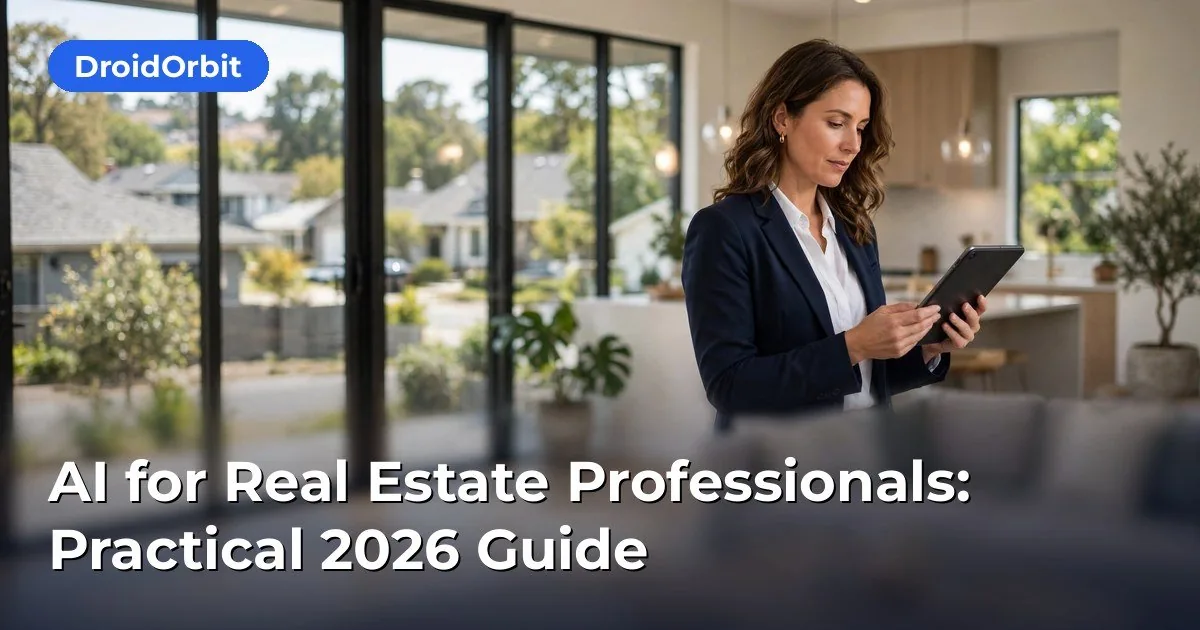
Listing Descriptions That Sell Without Sounding Robotic
Writing listing descriptions is one of the most universally adopted AI use cases in real estate, and for good reason: it’s repetitive, time-sensitive, and formulaic enough that AI drafts are genuinely good starting points.
A workflow that works
- Feed the AI structured facts, not vibes. Provide beds, baths, square footage, lot size, year built, upgrades, school district, and three standout features. The more specific the inputs, the less generic the output.
- Specify the audience and tone. “Young professional couple, warm but not flowery, emphasize commute and kitchen” produces dramatically better copy than “write a listing description.”
- Generate, then humanize. The AI draft is a starting point. Add the sensory details only a showing reveals — the morning light in the kitchen, the quiet street, the smell of the garden. These are what make a listing feel real.
- Verify every claim. AI tools can hallucinate details (“gourmet kitchen” in a house with laminate counters) or exaggerate. Every factual claim in the final listing must be verified against the property. Your license is on the line, not the AI’s.
What to avoid in AI-generated listings
Fair housing law (more below) restricts far more listing language than many agents realize. Beyond that, avoid: unverifiable superlatives (“best neighborhood in the city”), school quality claims (steer buyers to verify independently instead), and any language implying who the “ideal” buyer is.
Market Analysis Drafts and CMAs

Comparative market analyses are data-heavy and narrative-light — an ideal AI assist. The workflow that experienced agents use:
- You pull the comps; AI drafts the narrative. Feed recent comparable sales (addresses, sold prices, dates, key specs, adjustments) into the AI and ask for a draft CMA narrative explaining the pricing rationale.
- AI summarizes market trends for clients. “Summarize the last 90 days of sales in ZIP 90210 for a seller presentation: median price, days on market trend, list-to-sale ratio direction” — with you supplying the underlying MLS data.
- Never let AI invent data. This is the hard rule. AI models can fabricate plausible-looking statistics, comparable sales, and market figures. Every number in a client-facing CMA must come from the MLS or another verified source. An AI-drafted narrative built on real numbers is an efficiency win; an AI-invented comp is a license-threatening error.
Some brokerages now offer proprietary AI tools trained on their own MLS data feeds, which reduces (but does not eliminate) the hallucination risk. Even then, verify before presenting.
Client Follow-Up and Lead Nurturing
The fortune in real estate is famously in the follow-up, and it’s also where most agents’ systems break down. AI helps in three concrete ways:
1. Drafting personalized follow-up messages
After a showing or open house, feed the AI your notes (“The Hendersons liked the kitchen but worried about the commute; two kids, budget $650K, pre-approved”) and get a draft follow-up email or text. The key word is draft — personalize before sending. Recipients can smell fully automated messages, and in a trust business, that’s costly.
2. Long-term nurture sequences
For leads that aren’t ready — the “maybe in six months” crowd — AI can draft a months-long email sequence: market updates, seasonal home tips, neighborhood spotlights. Set it up once, review quarterly. The content stays relevant because you’re feeding it current market data each cycle.
3. Speed-to-lead
When a new inquiry arrives from Zillow, Realtor.com, or your website, AI-assisted CRM tools can draft an immediate personalized response referencing the specific property. Response time is the single biggest factor in lead conversion, and this is where automation earns its keep. Many agents use tools like Follow Up Boss, kvCORE, or LionDesk with AI features, or connect a general AI assistant to their CRM.
Caution: Automated outreach must comply with TCPA rules for texts and CAN-SPAM for email. AI makes it easier to send more messages — which makes compliance more important, not less. Confirm consent before adding anyone to automated sequences.
Virtual Staging Notes and Showing Preparation

AI image tools have made virtual staging dramatically cheaper than physical staging, but this guide focuses on the workflow around it rather than the image generation itself:
- Staging notes: Photograph each room, and use AI to draft a staging punch list — declutter targets, furniture arrangement suggestions, lighting fixes — tailored to the listing’s price point and target buyer.
- Showing prep sheets: Generate one-page briefs for buyers before a showing day: property facts, comparable context, questions to ask, and neighborhood notes. Buyers perceive this as premium service.
- Disclosure discipline for virtual staging: Virtually staged photos must be labeled as such in most MLSs, and some MLSs restrict or prohibit them. AI-edited photos that remove defects (stains, cracks, damage) cross from staging into misrepresentation. Know your MLS rules before publishing anything AI-altered.
Transaction Coordination Assistance
The paperwork side of real estate — deadlines, contingencies, disclosures — is where deals die from inattention. AI uses here are assistive, not autonomous:
- Deadline tracking summaries: Feed in the contract’s key dates and get plain-English timeline summaries for clients (“Here’s what happens in the next 14 days and what we need from you”).
- Document checklists: Generate transaction checklists customized to your state’s requirements and the deal type.
- Email drafting for coordination: Drafts to lenders, inspectors, title companies, and co-brokers — reviewed and sent by you.
The AI never signs, never advises on contract terms (that’s legal advice — see below), and never communicates deadlines to clients without your review. A missed contingency deadline because “the AI was handling it” is not a defense.
The Compliance Section: Fair Housing and AI
This is the most important section of this guide. The Fair Housing Act prohibits discrimination based on race, color, national origin, religion, sex (including sexual orientation and gender identity under current federal interpretation), familial status, and disability — and many states and cities add protected classes.
Why AI raises specific fair housing risks
- Steering by algorithm. An AI tool that recommends neighborhoods, describes areas in coded language (“family-friendly,” “exclusive,” “up-and-coming”), or filters listings by inferred demographics can facilitate steering — directing buyers toward or away from areas based on protected characteristics. HUD has made clear that discriminatory outcomes matter regardless of whether a human or an algorithm produced them.
- Biased language in listings. AI models trained on historical listing data can reproduce the coded language of past discrimination. Always review AI-drafted descriptions for terms that describe people rather than property. Describe the house, never the “ideal” resident.
- Ad targeting. If you use AI-assisted ad tools (including Meta’s ad platform features), be aware that housing ads are a “special ad category” with restricted targeting options. Circumventing these restrictions — manually or via AI — violates platform policy and potentially the law.
Practical compliance rules for AI use
- Human review of everything client-facing. No AI-generated listing, ad, or client communication goes out without agent review. This is your license protection.
- Audit your prompts. If your standard listing prompt includes neighborhood characterizations, rewrite it to focus strictly on property facts and verifiable amenities.
- Document your process. Keep records of AI use in transactions the same way you’d keep other transaction records. If a complaint arises, “the AI wrote it” is not a defense — but a documented review process is.
- Train your team. If you’re a broker, your agents’ AI use is your liability. Set written AI policies: what’s allowed, what requires review, what’s prohibited.
- Watch state law. States like California, Texas, and others have enacted or proposed AI-specific regulations affecting automated decision-making. Your state association’s legal updates are required reading.
What AI must never do in your practice
- Provide legal advice on contracts, contingencies, or disputes (that’s for attorneys).
- Give financial advice on mortgage products, investment returns, or tax implications (refer to licensed professionals).
- Make valuation guarantees or price predictions presented as certainties to clients.
- Communicate with clients as if it were you without disclosure, where your state requires it.
Choosing Tools: Build vs. Buy
Real estate professionals generally take one of three routes:
- General AI assistants (ChatGPT, Claude, Gemini): Maximum flexibility, lowest cost. Best for drafting, brainstorming, and analysis. Requires you to build your own workflows and prompts. Data handling depends on the plan — business tiers typically offer stronger privacy terms.
- Real estate-specific platforms (many CRMs and marketing suites now bundle AI): Less flexible but pre-built for your workflows — listing copy, drip campaigns, CMA narratives. Evaluate based on integration with your existing systems.
- Brokerage-provided tools: Increasingly common at large brokerages. The advantage is compliance pre-vetting and MLS data integration; the tradeoff is less choice.
Whichever route you take, evaluate vendors on: data privacy terms (is your clients’ information used for training?), MLS compliance of outputs, and whether the tool logs activity for your records.
Frequently Asked Questions About AI for Real Estate
Can AI write my entire listing description?
It can draft it, but you should never publish an AI draft unverified. Verify every factual claim against the property, check for fair housing compliance issues in the language, and add the human details that make listings compelling. Think of AI as a fast first-draft assistant, not an author.
Is it legal to use AI for real estate marketing?
Yes, with the same legal obligations as any marketing: truthfulness, fair housing compliance, and adherence to your state’s advertising regulations (including brokerage identification requirements). The law doesn’t give AI-generated content a pass — you’re responsible for everything published under your name.
Can AI help me price a home?
AI can help analyze pricing by summarizing comparable sales and market trends, but automated valuations are estimates with known error margins — not appraisals. Present AI-assisted pricing analysis as what it is: a data-informed starting point for your professional judgment, which is what clients are actually paying for.
Do I need to disclose AI use to clients?
Requirements vary by state and are evolving. At minimum, several states’ real estate commissions have issued guidance that licensees are responsible for AI-generated content. Some brokerages require disclosure policies. Check your state commission’s current guidance and your brokerage policy — and when in doubt, transparency builds trust.
What’s the biggest AI mistake real estate agents make?
Publishing unverified AI output — invented property features, fabricated statistics, or non-compliant language. The second biggest is using AI for client communication without review, which erodes the personal trust that actually closes deals. AI should make you more personal and more accurate, not less.
Can AI replace a real estate agent?
No. Transactions involve negotiation, judgment under uncertainty, fiduciary duties, and human trust — none of which AI can assume. What AI replaces is the busywork around the transaction, freeing agents to spend more time on the relationship work that actually earns commissions.
Check current rules and ethics opinions via the National Association of Realtors before deploying AI in client-facing work.
Keep exploring: If you found this guide to ai for real estate useful, read AI for Sales Teams: Prospecting and Outreach in 2026, Best AI Social Media Management Tools (2026), n8n vs Zapier: Best AI Automation Platform 2026 for more practical ways to use ai for real estate.
How are agents using AI for real estate listings?
Agents use AI for real estate to write listing descriptions in minutes, generate neighborhood guides, and create virtual staging copy. AI for real estate listing tools pull key property features into polished prose, though you should always verify square footage, disclosures, and fair-housing compliance before publishing.
Can AI for real estate help find motivated sellers?
Predictive analytics tools — a growing branch of AI for real estate — score neighborhoods and homeowners by likelihood to sell. Combined with automated outreach, AI for real estate prospecting can surface off-market opportunities, but treat predictions as leads to verify, not guarantees.
Is AI for real estate content compliant with fair housing law?
Only if you review it. AI for real estate copy must avoid language that discriminates by race, religion, family status, or other protected classes. Use AI for real estate drafting for speed, then run every listing through a fair-housing checklist before it goes live.
Conclusion
AI for real estate is at its best when it’s invisible: faster listing drafts, sharper market narratives, follow-up that actually happens, and transactions that stay on track. The agents getting real value aren’t chasing novelty — they’ve built a handful of reliable workflows, they verify everything, and they treat compliance as a feature rather than a burden. Start with one use case (listing descriptions are the easiest win), build the human-review habit from day one, and expand from there. The technology will keep improving; the agents who pair it with judgment and compliance discipline will keep winning regardless.



Join the discussion
Have a question or a perspective to share?