
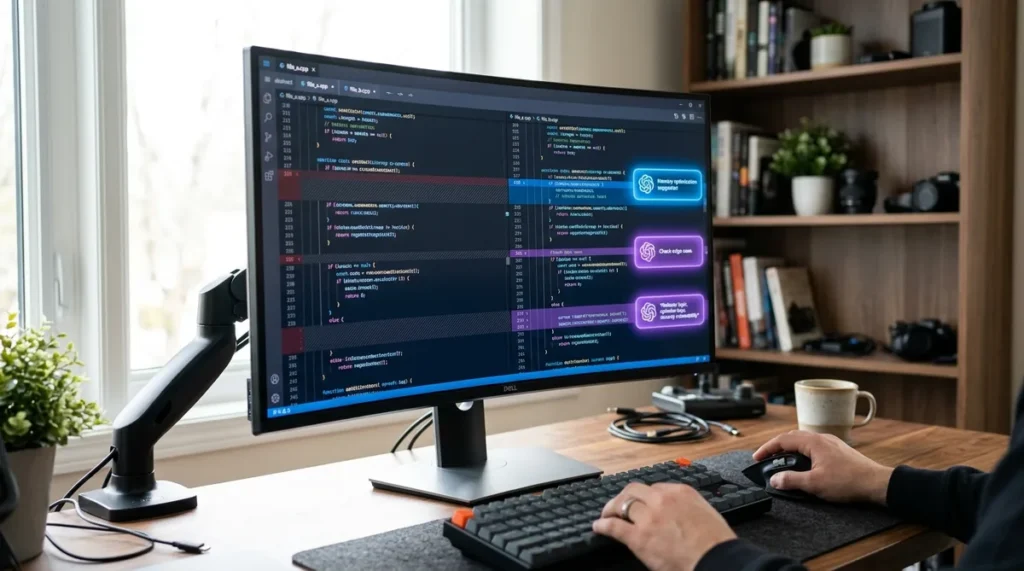
Every developer knows the moment: you open a pull request with 40 changed files, the diff scrolls endlessly, and somewhere inside it a bug is waiting to reach production. Human reviewers are thorough but slow, and in busy teams the review queue becomes a bottleneck. That is exactly the gap AI merge request review tools were built to close. These tools read every line of your pull or merge requests, flag logic errors, security holes, and performance traps, and leave review comments right in GitHub, GitLab, Bitbucket, or Azure DevOps — often within minutes of the PR being opened.
The idea sounds like hype until you see the data. CodeRabbit, one of the most widely used AI reviewers, published a late-2025 report (State of AI vs Human Code Generation) analyzing 470 open-source pull requests, and found that AI co-authored PRs contained roughly 1.7 times as many issues per PR as human-written ones, with the AI-associated problems also rated more severe. Whether you believe every number in that report or not, the takeaway is hard to argue with: more code is being written with AI assistance than ever before, and the review process has to scale with it. An automated reviewer that never gets tired, never skips the boring parts of a diff, and checks every PR with the same discipline is no longer a luxury — for many teams it has become part of the standard pipeline.
In this roundup, we look at six established tools purpose-built for reviewing merge and pull requests: CodeRabbit, Greptile, Qodo, Sourcery, Bito, and GitHub Copilot Code Review. For each one we cover what it actually catches, how it plugs into your Git workflow, and how its pricing works, so you can decide which deserves a trial on your repositories.

What AI Merge Request Review Tools Actually Do
Before comparing names, it helps to be clear about what these products share. An AI merge request review tool is not a linter. Linters match code against fixed rules; they are fast and deterministic but blind to intent. AI reviewers use large language models combined with repository context — the surrounding codebase, commit history, issue tracker threads — to reason about what the code is trying to do and where it goes wrong.
In practice, most of these tools do four things on every pull request. First, they generate a summary: a high-level description of what changed and why, plus often a file-by-file walkthrough that lets a human reviewer get oriented in seconds instead of reading the raw diff cold. Second, they leave inline comments on specific lines, flagging concrete problems: null dereferences, race conditions, SQL injection vectors, leaked secrets, N+1 queries, mishandled edge cases, inconsistent error handling. Third, many can suggest the fix directly, with one-click commit buttons that apply the change from inside the PR interface. Fourth, some go further — running external static-analysis tools as part of the review, checking test coverage impact, or letting you chat with the reviewer (“why did you flag this?”, “show me a safer alternative”) without leaving the conversation.
The best implementations also learn. You can reply to a bot’s comment, explain that your team does things differently, and the tool adjusts its future reviews. Configuration files — like CodeRabbit’s .coderabbit.yaml — let you set the review’s strictness, filter out generated files and vendored code, and give path-specific instructions (“in this directory, always check for proper input validation”). The tool stops being a generic bot and starts behaving like a junior teammate who has memorized your team’s conventions.
It is also worth saying what these tools do not do. They do not replace human reviewers. They catch a different class of mistakes — the ones humans miss at 5 p.m. on a Friday, not the architectural judgment calls about whether a feature should exist at all. Teams that get the most value treat AI review as a first pass that makes the human pass faster and sharper.
How We Evaluated These Tools
We judged each tool on four practical questions. Review quality: does it catch real bugs — logic errors, security issues, performance problems — rather than just nitpicking style? Context depth: does it understand the whole repository, or only the files in the diff? A reviewer that can see how a changed function is called elsewhere catches a different class of bugs than one that cannot. Integration: how cleanly does it fit into GitHub, GitLab, Bitbucket, or Azure DevOps workflows — is it a one-click app install, a CI action, or a manual script? Pricing approach: is there a usable free tier, and does the paid model make sense for small teams as well as enterprises?
We deliberately stuck to tools with a real track record — products with documented integrations and verifiable user bases — rather than promising betas. Six made the cut. One caveat on method: we did not run live, hands-on benchmarks of these tools — our comparison is based on official documentation, published pricing pages, and independent reporting. Pricing approaches reflect publicly listed information as of October 2026 and may change; check each vendor’s current plan page before committing.
1. CodeRabbit — The Most Widely Adopted AI Reviewer
If there is a default choice in this category, it is CodeRabbit. Founded in 2023 and based in San Francisco, the platform has become the reference point for AI-native pull request review, with a large user base drawn in part by its generous free tier for open-source projects. It installs as a GitHub App (with GitLab, Bitbucket, and Azure DevOps support as well), and once installed it reviews every pull request automatically — summaries, walkthroughs, and inline comments appear within a few minutes of the PR being opened, no CI configuration required.
What it catches
CodeRabbit’s reviews go well beyond surface-level feedback. It performs line-by-line analysis that covers logic and correctness errors, security vulnerabilities, and performance inefficiencies, and it runs a battery of external tools as part of its pipeline — linters like Biome, ESLint, Ruff, and Pylint, plus security scanners such as Brakeman, TruffleHog for secret detection, and Trivy. That hybrid approach matters: the deterministic tools catch what they are guaranteed to catch, while the language model reasons about the subtler issues — a flawed retry policy, an authorization check that exists but runs after the sensitive operation, an error message that leaks internal state.
Each review starts with a summary and a technical walkthrough, including file-by-file explanations, which is genuinely useful on large PRs. Suggestions can often be committed directly from the GitHub PR interface with one click, and incremental commits get re-reviewed automatically so late fixes do not introduce new problems unnoticed.
Integrations
CodeRabbit integrates natively with GitHub, GitLab, Bitbucket, and Azure DevOps, and it also offers a VS Code extension for reviewing uncommitted changes inside the editor. Conversational commands — for example, commenting @coderabbitai review — let you trigger re-reviews on demand, and the .coderabbit.yaml configuration file gives teams fine-grained control: review profiles (from relaxed to strict), path filters that exclude generated code, and custom instructions per directory. It also connects with issue trackers like Jira and Linear.
Pricing approach
CodeRabbit follows a per-developer subscription model with a free tier that includes PR summarization; the Pro plan is free forever for public, open-source repositories. Paid plans unlock the full inline review engine, custom rules, and team controls. If you are evaluating AI merge request review tools for the first time, the free open-source tier makes CodeRabbit one of the easiest to try on a real repository without a procurement conversation.
2. Greptile — The Codebase-Aware Reviewer
Greptile’s differentiator is depth of context. Founded in 2023 by Soohoon Choi, Daksh Gupta, and Vaishant Kameswaran — a Y Combinator Winter 2024 company — Greptile builds a full graph of your repository so its reviews consider not just the diff but how the changed code interacts with everything around it. The company frames its product as an AI code review agent with complete context of your codebase, and with a Georgia Tech profile reporting more than 2,000 customers, including Brex, Whoop, and Substack.
What it catches
The codebase-wide awareness shows up in the kinds of bugs Greptile finds. Because it can trace how a modified function is called across the repository, it is well positioned to catch blast-radius problems: a signature change that breaks a distant caller, a schema migration that a forgotten consumer still depends on, a shared utility whose new edge case ripples through three services. Standard fare — security issues, logic errors, performance anti-patterns — is covered too, but the selling point is the cross-file reasoning that diff-only reviewers miss.
Integrations
Greptile integrates via a GitHub App with an API for custom workflows. Reviews arrive as comments on pull requests with explanations grounded in the surrounding code, which makes its feedback easier to trust — you can see that it considered the caller three files away, not just the line it flagged.
Pricing approach
Greptile is a commercial SaaS product with subscription and usage-based plans. It positions itself as a premium option for teams with large or complex codebases, where the cost of a missed cross-file bug justifies paying for deeper analysis. Teams evaluating it should run it on their own most tangled repository during a trial — that is where its advantage is most visible.
3. Qodo (Formerly CodiumAI) — Open-Source Roots, Enterprise Polish
Qodo — previously known as CodiumAI — brings an unusual combination to this list: its PR review agent, Qodo Merge, has an open-source core (the PR-Agent project, which has gathered a five-figure star count on GitHub) alongside a commercial platform with governance and team features. That dual nature makes it interesting for teams that want to inspect the machinery before committing to it.
What it catches
Qodo Merge reviews pull requests with issues ranked by severity, so reviewers see the critical findings first instead of wading through a flat list of nits. Beyond bug-finding, the broader Qodo platform generates tests and suggests improvements, which means the review workflow can extend into test coverage — the reviewer does not just say “this logic looks fragile,” it can help you prove the fragile path is covered. Slash commands let developers ask the agent questions about the diff or request specific analyses, turning the review into a conversation.
Integrations
The open-source PR-Agent supports GitHub, GitLab, and Bitbucket, and the commercial Qodo Merge product extends that with organizational controls, review rules, and reporting. Because the core is open source, teams can self-host or customize the review behavior in ways that closed SaaS tools do not allow.
Pricing approach
Qodo offers free and paid plans: the open-source core is free to run, while the commercial platform adds team management, governance features, and deeper integrations on a subscription basis. For open-source projects and budget-conscious teams, the free tier is genuinely usable rather than a teaser.
4. Sourcery — The Refactoring-Focused Reviewer
Sourcery started life as an automated refactoring tool and has grown into a full AI code reviewer. Its heritage shows in what it emphasizes: while every tool on this list hunts bugs, Sourcery pays unusual attention to code quality, maintainability, and style consistency — the slow rot that makes codebases expensive to work in long after the bugs are fixed.
What it catches
Sourcery’s reviews suggest refactoring improvements alongside bug fixes: duplicated logic that should be extracted, overly complex functions that should be split, inconsistent patterns that should match the rest of the file. Its suggestions adapt to team feedback, so if your team prefers a particular idiom, the reviewer learns to recommend it. It is strongest in Python, where its refactoring engine has the deepest roots, though it supports other languages as well.
Integrations
Sourcery works as a GitHub-integrated reviewer and also ships IDE plugins, so developers can get its suggestions while writing code, not just at PR time. That two-layer setup — in-editor guidance plus PR-time review — helps teams converge on consistent style without turning every review into a style debate.
Pricing approach
Sourcery uses a subscription pricing model with freemium entry points, making it easy for individual developers and small teams to start. Teams mainly interested in the review-quality and consistency angle rather than security scanning will find its pricing approach straightforward to evaluate.

5. Bito — The Context-Rich Code Intelligence Agent
Founded in 2022, Bito positions its product as an AI code review agent that works with full system context: not just the code, but commits, issues, documentation, and even team chat. The idea is that the best review comments come from understanding why a change was made, and that “why” often lives outside the diff — in the linked ticket, the design doc, or the Slack thread where the approach was debated.
What it catches
Bito combines LLM-powered analysis with traditional static analysis, giving multi-angle feedback on each pull request. In practice that means it can flag a change that is technically correct but contradicts the documented intent in the linked issue, or point out that a new API endpoint duplicates one that already exists elsewhere in the system. Its reviews integrate with GitHub, GitLab, and Bitbucket, and the company also offers IDE tooling for explaining complex code and generating documentation.
Integrations
Bito integrates with the major Git platforms for PR review and extends into the IDE for day-to-day assistance. A self-hosted option exists for organizations with strict data controls — a meaningful differentiator for enterprises that cannot send code to third-party SaaS.
Pricing approach
Bito offers free and paid plans, with per-user subscription pricing on its cloud tiers and a lower-priced self-hosted option for teams that want to run it inside their own infrastructure. The self-hosted path is worth noting because few AI reviewers in this category offer it at an accessible price point.
6. GitHub Copilot Code Review — The Native Option
Sometimes the best tool is the one already inside your workflow. GitHub’s own Copilot-powered code review, launched in 2025, brings AI review directly into the pull request interface that GitHub teams already live in. For organizations standardized on GitHub, the friction of adoption is close to zero: no third-party app to install, no new vendor to evaluate, no separate dashboard to check.
What it catches
Copilot Code Review analyzes pull request diffs and leaves inline feedback on bugs, security concerns, and code quality issues, drawing on the same model family that powers Copilot’s code generation. Because it is native, its suggestions integrate tightly with the GitHub review flow — requested changes, conversations, and approvals all happen in one place. Dedicated reviewers still tend to offer deeper configuration and cross-platform support.
Integrations
By definition, integration is GitHub — and only GitHub. There is no GitLab, Bitbucket, or Azure DevOps story here. For GitHub-only shops that is a non-issue; for polyglot-platform organizations it is a dealbreaker.
Pricing approach
Copilot Code Review is included in eligible GitHub Copilot plans rather than sold as a separate product. Teams already paying for Copilot effectively get AI review at no additional cost, which makes it the cheapest credible option on this list for existing Copilot subscribers — and the easiest to pilot, since there is nothing new to procure.
Here is the whole field side by side, so you can compare at a glance.
| Tool | Git platforms | Free tier | Notable strength |
|---|---|---|---|
| CodeRabbit | GitHub, GitLab, Bitbucket, Azure DevOps | Pro free for public open-source repos | Widest adoption; hybrid linter-plus-LLM pipeline |
| Greptile | GitHub (plus API) | Paid plans (subscription/usage) | Codebase-wide context; cross-file bugs |
| Qodo | GitHub, GitLab, Bitbucket | Open-source core free | Open-source PR-Agent; self-hostable |
| Sourcery | GitHub (plus IDE plugins) | Freemium | Refactoring and style consistency |
| Bito | GitHub, GitLab, Bitbucket | Free and paid; self-hosted option | System-wide context; self-hosting |
| GitHub Copilot Code Review | GitHub only | Included in eligible Copilot plans | Zero setup for existing Copilot users |
How to Choose the Right AI Merge Request Review Tool
The honest answer is that the “best” tool depends on your stack and your pain. A practical way to decide: if you are on GitHub and already pay for Copilot, start with Copilot Code Review — it costs you nothing extra and will catch a meaningful share of issues. If you want the most configurable, most widely documented dedicated reviewer, CodeRabbit is the safe default, and its free open-source tier lets you evaluate it on real code. If your codebase is large and your worst bugs are the cross-file kind — a change in one service breaking another — Greptile’s repository-wide context is purpose-built for that. If you value open source and want to self-host or customize, Qodo’s PR-Agent core is the natural fit. If maintainability and style consistency are your chronic problems, Sourcery’s refactoring heritage makes it the specialist. And if your team needs self-hosting for compliance reasons, Bito’s self-hosted option deserves a look.
Whatever you choose, run a structured trial: enable the tool on one active repository for two to four weeks, track how many of its findings your team actually acted on, and survey your reviewers on whether the comments saved time or created noise. A reviewer with a 90% action rate on one repo is worth more than a feature-rich tool your team learns to ignore. Tune the configuration early — exclude generated files, set the strictness to match your team’s tolerance, and give path-specific instructions for your trickiest directories. The teams that get the most from these tools treat the first month as training, for the tool and for themselves.
The Honest Limits of AI Code Review
No roundup of AI merge request review tools would be complete without the caveats, because the failure modes are real. False positives are the most common complaint: an AI reviewer that flags ten questionable issues per PR will train your team to skim its comments, which defeats the purpose. This is why severity ranking and configurability matter more than raw finding counts.
Second, these tools are weakest at the things senior reviewers are best at: architectural judgment, product intent, and the question of whether the change should exist at all. An AI can tell you a query is slow; it cannot tell you the feature is solving the wrong problem. Third, there is a security dimension to the tools themselves — a PR reviewer necessarily processes untrusted code from contributors, and security researchers have documented that the integration model and token scopes of these platforms deserve scrutiny. Prefer vendors that are transparent about data handling, offer self-hosting or zero-retention options, and publish security documentation.
Finally, beware the complacency trap. When a bot reviews every PR, humans can start rubber-stamping. The healthiest teams use AI review to make human review faster and more focused — the bot handles the mechanical sweep, and humans spend their limited attention on design, intent, and the subtle bugs that still need a human brain.

Frequently Asked Questions
Do AI merge request review tools replace human code reviewers?
No. They are best understood as a tireless first pass: they catch mechanical issues — bugs, security flaws, performance traps, missing edge cases — consistently and quickly. Human reviewers remain essential for architectural judgment, product intent, and mentoring. Teams that treat AI review as augmentation rather than replacement get the best results.
Which AI code review tool is best for GitHub?
CodeRabbit is the most widely adopted dedicated option, with a free tier for open-source projects and deep GitHub integration. GitHub Copilot Code Review is the natural choice if your team already uses Copilot, since it is built into eligible plans. Qodo’s open-source PR-Agent is a strong free alternative for teams that want to self-host.
Which AI code review tool is best for GitLab?
CodeRabbit, Qodo, and Bito all support GitLab alongside GitHub. CodeRabbit’s GitLab integration is mature and well documented, making it a common pick for GitLab shops. Evaluate two or three on a real repository before committing, since review quality varies by language and codebase style.
Can AI reviewers catch security vulnerabilities?
Yes, within limits. Most of the tools on this list flag common vulnerability classes — injection flaws, leaked secrets, insecure dependencies, broken access control — and some run dedicated scanners like TruffleHog or Trivy as part of the review. They complement but do not replace dedicated security tooling or manual security review for high-risk changes.
Are there free AI code review tools?
Several. CodeRabbit is free for open-source projects, Qodo’s PR-Agent core is open source and free to run, Bito offers a free tier, and GitHub Copilot Code Review costs nothing extra for teams already on eligible Copilot plans. Paid tiers generally add deeper analysis, team controls, and governance features.
Will AI code review slow down my CI pipeline?
Typically no. Most of these tools operate as GitHub/GitLab apps that comment asynchronously on pull requests rather than as blocking CI steps — reviews appear within minutes while your existing pipeline runs in parallel. You can configure them to block merging on critical findings if your team wants that gate.
Final Thoughts
AI merge request review tools have moved from experiment to infrastructure in a remarkably short time. The six tools in this roundup — CodeRabbit, Greptile, Qodo, Sourcery, Bito, and GitHub Copilot Code Review — each approach the same problem from a different angle: adoption and configurability, codebase-wide context, open-source transparency, refactoring depth, system-wide intelligence, and native platform integration. For a broader look at how these fit into the wider landscape of AI-assisted development, see our guide to AI code review tools for developers.
The through-line is simple: code volume is rising, AI-assisted code contains more defects per pull request than human-written code, and human attention is the scarcest resource in any engineering team. An automated reviewer that catches bugs before humans do does not just find defects earlier — it protects the review culture itself, keeping human reviewers focused, fast, and actually reading the code. Pick one, trial it on a real repository, tune it for a month, and measure what your team acts on. The bugs it catches before your next release will make the case better than any roundup can.





Join the discussion
Have a question or a perspective to share?