

Market research used to mean expensive agencies, months-long studies, and reports nobody read. For small teams, it meant guessing. An AI market research workflow changes the equation decisively in six steps: defining precise research questions, gathering data with AI assistance, analyzing competitors systematically, surveying customers efficiently, synthesizing insights into decisions, and acting on what you learn.
Good market research does not require big budgets — it requires good questions and systematic methods applied consistently. AI handles the labor-intensive parts (data gathering, survey analysis, competitive monitoring), leaving your team the judgment work: asking the right questions and making decisions from the answers.
Why an AI Market Research Workflow Beats Guessing
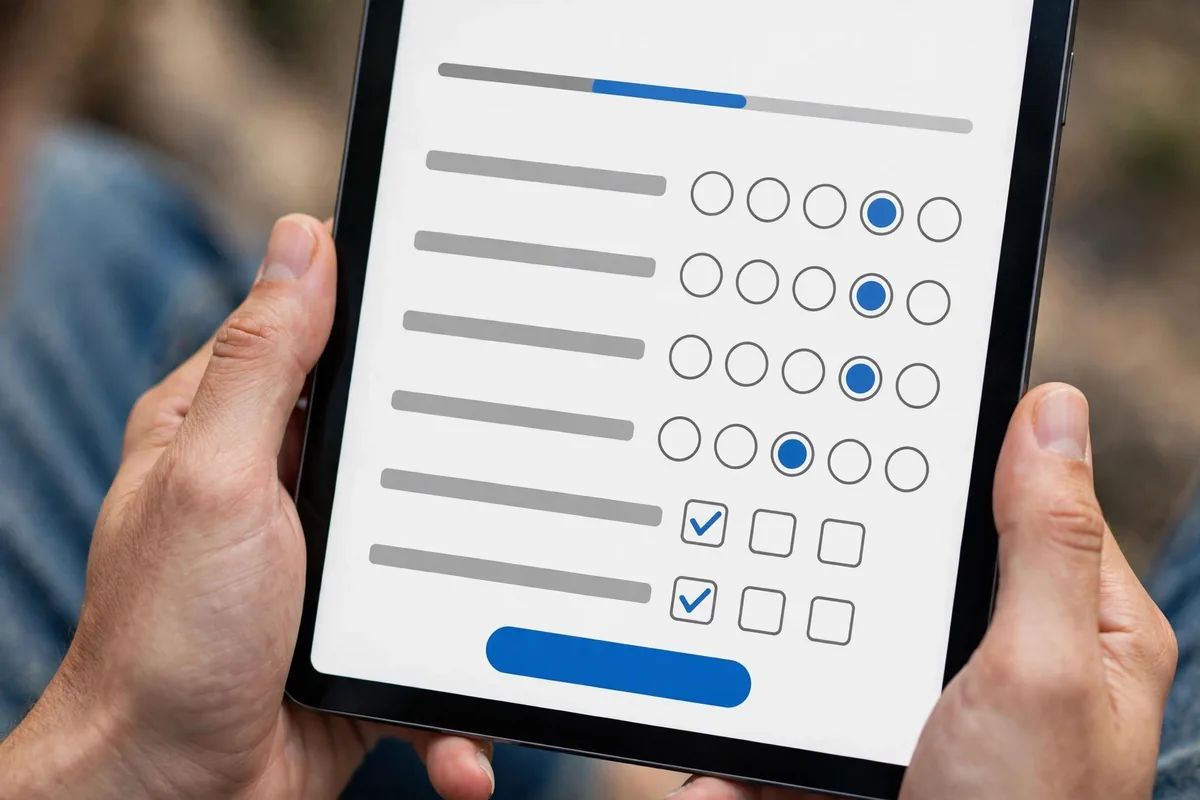
Most small businesses make strategic decisions on anecdotes: “a customer mentioned X,” “our competitor launched Y,” “I feel like the market wants Z.” Sometimes instincts are right; often they are expensive. The cost of wrong market assumptions — building unwanted features, targeting the wrong segment, mispricing — dwarfs the cost of research.
Traditional research was inaccessible: $15,000+ for agency studies, weeks of analyst time for DIY approaches. So small teams skipped it, and the guessing continued. An AI market research workflow collapses the cost: AI gathers and synthesizes public data in hours, surveys deploy in days, and competitive monitoring runs continuously. Research that once required a department now requires a disciplined afternoon.
The result is decisions grounded in evidence: pricing validated by willingness-to-pay data, features prioritized by customer need frequency, positioning differentiated by competitive gap analysis. Not certainty — but dramatically better odds than guessing, and odds are exactly what separate thriving businesses from merely lucky ones.
Step 1: Define Precise Research Questions
Research without questions produces data without answers. Step one is the most important step of all.
Start with the decision
Every research project serves a decision: Should we launch this product? What should we charge? Which segment should we target? How should we position against competitors? Write the decision explicitly — then derive the questions whose answers would change it. Questions that would not change any decision are curiosity, not research.
Frame questions answerably
“What do customers want?” is unanswerable. “What are the top 3 frustrations our target buyers report with current solutions, and what would they pay to solve them?” is answerable. Precise questions dictate methods: frustration questions need surveys and review mining; pricing questions need Van Westendorp or conjoint analysis; competitor questions need systematic monitoring.
Prioritize ruthlessly
List all candidate questions, then rank by decision impact × answerability. Research the top 3–5 deeply rather than 20 superficially. The AI market research workflow concentrates effort where answers move decisions — breadth without depth produces trivia, not insight.
Document assumptions to test
Write down what you currently believe (your hypotheses): “Our buyers are primarily agencies,” “Price sensitivity is high,” “Competitor X is the main alternative.” Research then tests these explicitly — confirmation and contradiction are both valuable. Unstated assumptions evade testing; stated ones get validated or killed.
Step 2: Gather Data With AI Assistance

With questions defined, AI accelerates the gathering dramatically.
Mine public data sources
AI agents can systematically gather: competitor websites and pricing pages, customer reviews (G2, Capterra, Amazon, app stores), forum discussions (Reddit, industry communities), social media sentiment, job postings (revealing competitor priorities and tech stacks), and funding news. This public intelligence — gathered in hours, not weeks — answers a surprising share of research questions.
Review mining at scale
Thousands of competitor reviews contain structured insight: AI extracts complaint themes, feature requests, praise patterns, and sentiment trends. “Competitor X’s users consistently complain about onboarding complexity” is actionable intelligence no survey needed to discover. The AI market research workflow treats review platforms as the world’s largest free focus group.
Survey efficiently
For questions public data cannot answer, deploy targeted surveys: 5–10 questions maximum, incentivized appropriately, distributed to your list or via panels. AI assists with questionnaire design (avoiding leading questions), response analysis (thematic coding of open ends), and statistical summaries. Small samples (100–200 responses) answer most directional questions adequately.
Interview strategically
5–8 deep customer interviews reveal what surveys miss: the why behind behaviors, the language customers use, the workarounds they have built. AI transcription and thematic analysis (per established interview workflows and transcription tools) make interview research fast. Quality over quantity — eight great interviews beat eighty shallow surveys for insight depth.
Step 3: Analyze Competitors Systematically
Competitive intelligence is a research pillar. Step three systematizes it.
Build the competitor matrix
For each key competitor: positioning and messaging, target segments, pricing and packaging, feature comparison, strengths and weaknesses (from review mining), marketing channels, and recent moves. AI populates the matrix from public data; your team validates and interprets. Update quarterly — competitive landscapes shift constantly.
Identify the gaps
Where competitors cluster, opportunity hides in the gaps: underserved segments, unaddressed complaints, missing features, poor experiences. AI gap analysis compares competitor offerings against customer need themes from review mining — the intersections of “customers want” and “nobody provides” are your strategic openings. The AI market research workflow makes gap-finding systematic rather than serendipitous.
Track positioning evolution
Monitor competitor messaging changes: new taglines, repositioned pricing, launched features. Positioning shifts signal strategic pivots — early detection lets you respond proactively rather than reactively. Set up AI monitoring alerts for key competitor pages and announcements.
Benchmark honestly
Compare your offering against competitors on the dimensions customers care about (from your research, not your roadmap). Honest benchmarking reveals whether your differentiation is real or imagined — painful but essential. If the matrix shows parity everywhere, the research is telling you differentiation must be built, not just messaged.
Step 4: Survey Customers and Prospects

Direct voice-of-customer research answers what public data cannot.
Design unbiased surveys
Rules: one question per question (no double-barreled), neutral wording (no leading), balanced scales, “not applicable” options where appropriate, and demographic questions last (to avoid stereotype threat effects). AI reviews draft questionnaires for bias — a second opinion that catches the leading questions you cannot see in your own writing.
Reach the right respondents
Your list (customers, trial users, newsletter subscribers) is the best source — incentivize participation appropriately. For prospects, panels and communities work; for niche B2B, LinkedIn outreach and customer introductions. Response quality beats quantity: 100 thoughtful responses from the right people outperform 1,000 panel-clickers.
Analyze beyond averages
Averages hide segments: analyze by customer type, company size, use case. AI thematic analysis of open-ended responses surfaces patterns human readers miss in volume. Look for the surprising minority — the 15% who love what others hate often reveal positioning opportunities. The AI market research workflow digs past surface statistics to segmented insight.
Validate willingness to pay
Pricing research deserves rigor: Van Westendorp (price sensitivity meter) for acceptable ranges, conjoint for feature-value tradeoffs, or simple A/B tests for directional signals. “Would you pay $X?” surveys overstate; behavioral methods (pre-orders, pilot commitments) reveal truth. Price on evidence, not hope.
Visual presentation of survey findings matters for stakeholder buy-in — AI image tools and avatar generators help create compelling research presentations.
Step 5: Synthesize Insights Into Decisions
Data without synthesis is noise. Step five turns findings into direction.
Build the insight brief
One document per research project: the decision, key findings (5–7 insights maximum, each with evidence), implications (what this means for the decision), recommendations (what to do), and open questions (what remains unknown). Ruthless prioritization — twenty findings mean no findings. The brief should be readable in 10 minutes and referenceable for months.
Run the decision workshop
Present findings to decision-makers, debate implications, and decide — in the same session if possible. Research that does not reach a decision is theater. Structure the workshop: findings presentation (20 min), implication debate (30 min), decision and next steps (10 min). The AI market research workflow ends in decisions, not documents.
Quantify where possible
Attach numbers: market sizes (TAM/SAM/SOM from triangulated sources), willingness-to-pay distributions, segment sizes, competitive win rates. Quantification does not need false precision — ranges and orders of magnitude guide decisions adequately. “The addressable market is $50–100M” beats “the market is large” for decision quality.
Archive for reuse
Store research assets systematically: raw data, analysis files, insight briefs, and decision records. Future projects build on past research — the question asked today may partially answer tomorrow’s. An organized research archive compounds in value; scattered files get lost and re-done.
Step 6: Act and Monitor
Research without action is entertainment. Step six closes the loop.
Translate insights to roadmaps
Each recommendation becomes owned action items: who does what by when. Product implications → roadmap items; pricing findings → pricing tests; positioning insights → messaging updates; segment discoveries → targeting changes. The research brief’s recommendations section becomes the execution checklist — accountability attached.
Set up continuous monitoring
Some research questions need ongoing answers: competitor moves, review sentiment trends, pricing benchmarks, emerging needs. AI monitoring runs continuously — dashboards updated automatically, alerts on significant changes. The AI market research workflow includes this standing intelligence function; periodic deep-dives supplement, not replace, continuous awareness.
Measure decision quality
Track whether research-backed decisions outperformed: did the validated pricing stick? Did the targeted segment convert? Did the differentiated positioning win deals? This meta-measurement improves future research — you learn which methods predict best for your business. Research ROI becomes demonstrable, justifying continued investment.
Schedule the next cycle
Markets evolve; research decays. Annual comprehensive research plus quarterly pulse checks (short surveys, review mining refreshes, competitor matrix updates) keeps intelligence current. Put it on the operating calendar — research that is not scheduled does not happen, and stale assumptions silently rot decisions. Assign clear ownership for each recurring research activity; the AI market research workflow persists only when someone is accountable for running it.
Common Market Research Mistakes
- Vague questions: “what do customers want?” produces nothing actionable
- Confirmation bias: researching to validate rather than to learn
- Analysis paralysis: endless research avoiding the decision it serves
- Ignoring existing data: commissioning new research when reviews and analytics already answer
- No decision link: interesting findings that change nothing
Sizing the Market: TAM, SAM, SOM in Plain English
Market research reports throw around big numbers that mean nothing until you narrow them. TAM is everyone who could theoretically buy, SAM is the slice you can actually reach, and SOM is what you can realistically win in the next few years. AI can pull the top-down numbers fast, but the bottom-up math, your price times your reachable customers, is what investors and lenders trust.
Sanity-check every number against a known anchor. If your SOM implies capturing 40% of a market in year two, your assumptions are wrong. Good market research ends with a one-page summary: the three numbers, the two or three sources behind each, and the one assumption that matters most.
FAQ
How much should small teams budget for market research?
$500–$5,000 per major research project using AI-assisted DIY methods (tool subscriptions, survey incentives, occasional expert interviews). This replaces $15,000+ agency engagements for most directional questions. Invest more only when decisions involve major capital commitments.
How long does AI-assisted market research take?
2–4 weeks for a comprehensive project (question definition through decision workshop); 3–5 days for focused questions (pricing validation, competitor snapshots). The AI market research workflow compresses gathering and analysis; human judgment (questions, synthesis, decisions) sets the pace.
Can AI really replace research agencies?
For directional research (most small-team needs): largely yes. For specialized methods (large-scale conjoint, ethnographic studies, regulated industries): agencies still add value. Use AI workflows for 80% of research needs; engage specialists for the 20% requiring deep methodology.
What is the single most valuable research activity?
Customer interviews — 8 conversations with real buyers reveal more actionable insight per hour than any other method. If you do one thing from this workflow, do interviews. Everything else amplifies; interviews illuminate.
How do I convince leadership to act on research?
Tie findings to decisions and dollars: “research shows segment X will pay 30% more, representing $Y opportunity.” Present the decision, not just data. And involve stakeholders in question definition — people act on research they helped shape.
Conclusion
An AI market research workflow brings evidence to small-team decisions: precise questions, AI-accelerated gathering, systematic competitor analysis, efficient customer research, synthesized insight briefs, and monitored action. Six steps from guessing to knowing.
Start with your most pressing decision: define the 3–5 questions whose answers would change it, then run the AI market research workflow to answer them. That first evidence-backed decision will demonstrate the value concretely — and make research a habit, not an event.





Join the discussion
Have a question or a perspective to share?