
The best AI plagiarism checkers in 2026 do two jobs at once. The classic job — finding text copied from other sources — still matters, but generative AI has added a second one: estimating whether a piece of writing was produced by a human or a machine. If you only need the shortlist: Turnitin remains the standard for schools and universities, Originality.ai and Copyleaks lead for publishers and content teams, and Scribbr is the most practical option for individual students. Every other recommendation in this guide follows from one question — what will you do with the result?
This is a practical, hype-free roundup of the leading AI plagiarism checker tools: what each one actually checks, how results are presented, who each tool is built for, and the honest limitations you should know before trusting any score. Nothing here is based on invented lab tests or made-up accuracy percentages — only on each tool’s publicly documented capabilities and how those capabilities map to real workflows.
Why plagiarism checking matters more in the AI era
Plagiarism used to be a copy-paste problem. A student lifted a paragraph from Wikipedia; a freelancer recycled a competitor’s blog post. Similarity detection handled that well: the technology compares submitted text against databases of web pages, academic papers, and previously submitted work, then shows you the matching passages with their sources. Because every match points to a source you can inspect, the finding is verifiable.
Generative AI changed the shape of the problem. A language model can produce an essay that matches no existing source word-for-word yet contains no original thought — and it can also paraphrase a source so thoroughly that classic similarity detection misses it. That is why the market has converged: most leading tools now pair traditional similarity checking with AI-content detection in a single report. The first tells you “this matches a source”; the second estimates “this reads like machine-generated text.”
The stakes differ by audience, but they are real in every case. Universities need defensible academic-integrity processes. Publishers and agencies need to know whether freelance submissions are original work. Businesses uploading proprietary documents to a checker need to know how their data is handled. Choosing the right tool starts with understanding that these two technologies are not the same thing.
Plagiarism checking vs. AI detection: know the difference
Confusing these two technologies leads to bad decisions, so it is worth being precise.
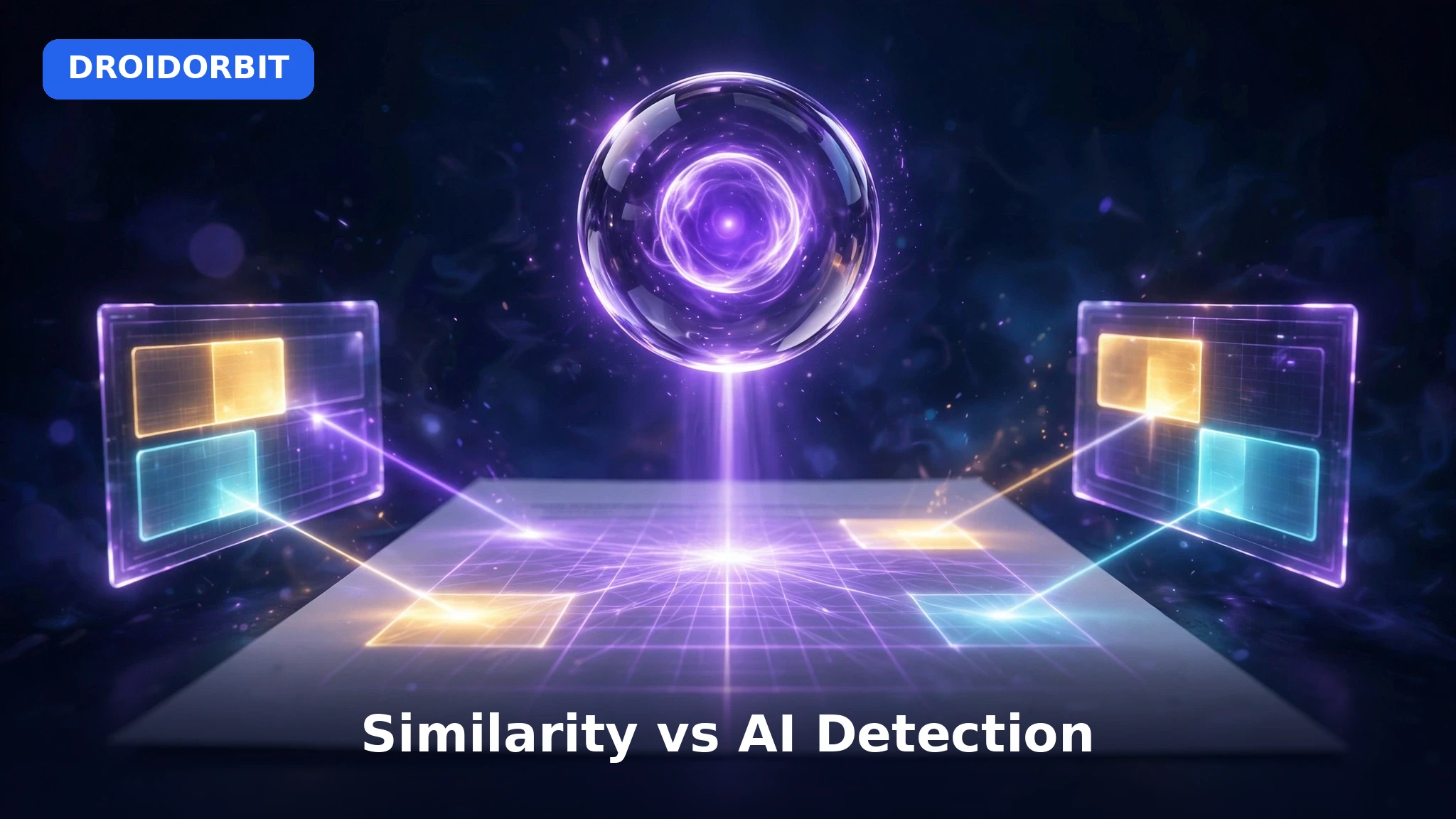
Plagiarism (similarity) detection compares submitted text against a database of sources and reports matching passages with links to those sources. It is a mature technology with decades of refinement. When it flags something, it shows its work — you can open the source and judge for yourself whether the match is a properly cited quote, common phrasing, or genuine copying.
AI-content detection tries to estimate whether text was written by a human or generated by an AI model. It does this by analyzing statistical patterns in the writing, such as how predictable the word choices are. This technology is fundamentally probabilistic and far less reliable. False positives are a documented, widely reported problem: non-native English speakers, writers with very formal or formulaic styles, and even classic human-authored texts have been flagged as “AI-generated” by detectors.
The practical rule: treat similarity reports as evidence to investigate, and treat AI-detection scores as a weak signal — never as proof. Any consequential decision, from an academic-integrity charge to a rejected freelance submission, should rest on human judgment and conversation, not on a detector’s percentage. The best tools on this list present AI scores with appropriate caution; be wary of any tool that presents them as verdicts.
What to look for in an AI plagiarism checker
Before the tool-by-tool reviews, here are the criteria that actually separate good checkers from mediocre ones:
- Database breadth. Similarity detection is only as good as what it can compare against — web content, scholarly publications, and repositories of previously submitted work.
- AI-detection transparency. Does the tool include AI detection, and does it present the uncertainty of its scores honestly?
- Report quality. Side-by-side source comparison, highlighted matches, and downloadable reports you can act on — not just a single number.
- Integrations. LMS plugins for education (Canvas, Moodle, Blackboard), browser or document-editor add-ons, and API access for institutional workflows.
- Privacy and data handling. Whether submitted documents are added to the comparison database (a real concern for unpublished work), data-retention policies, and regulatory compliance for educational use.
- Pricing model and limits. Per-page, per-word, credit-based, or subscription pricing — and how limited the free tier really is.
The 9 best AI plagiarism checkers in 2026
Each tool below is described in terms of what it is designed to do, who it serves best, and where its limits lie. Pricing details change frequently, so treat any pricing notes as a snapshot — check the vendor’s site for current plans.
1. Turnitin — best for schools and universities
Turnitin is the long-established standard in academic integrity, used by institutions around the world. Its similarity engine compares submissions against a vast database of web content, scholarly publications, and previously submitted student papers. In response to generative AI, Turnitin added AI-writing detection that estimates how much of a submission may be AI-generated or AI-paraphrased, presented alongside the traditional similarity report.
Its strengths are institutional: deep integrations with learning management systems, decades of refinement in matching, administrator controls, and classroom-oriented workflows such as draft-coaching tools that let students check their own work before submitting. Turnitin itself has published guidance urging cautious interpretation of its AI scores — a healthy sign.
Limitations: it is sold to institutions rather than individuals, so a student or freelancer generally cannot buy a personal subscription; pricing is typically arranged institutionally rather than published as simple consumer plans. And like every AI detector, its AI-writing scores deserve to be treated as investigative leads, not verdicts.
Best for: schools, colleges, and universities running institution-wide academic-integrity programs.
2. Originality.ai — best for publishers and content teams
Originality.ai was built specifically for the publishing workflow: checking freelance and in-house content for plagiarism, AI-generated text, and paraphrased passages in a single scan. It targets web publishers, content agencies, and marketing teams that screen high volumes of articles and need clear, shareable reports.
Its positioning is distinctive — it markets itself around detecting AI-generated content rather than treating AI detection as an add-on, and it bundles plagiarism checking, AI detection, and readability analysis. For a content manager deciding whether to accept a submission, that combination in one interface is the practical appeal.
Limitations: it is a paid product aimed at professional users, so casual or one-off users may find the commitment heavier than a free spot-check tool. As with all detectors, its AI scores should inform an editorial conversation, not replace one.
Best for: publishers, agencies, and content teams screening submissions at volume.
3. Copyleaks — best for multilingual and enterprise needs
Copyleaks offers both plagiarism detection and AI-content detection, with an emphasis on broad language coverage and enterprise deployment. It is designed to plug into organizational workflows through API access and integrations, which makes it a common choice for institutions and companies that need checking embedded in their own systems rather than in a standalone web app.
Its multilingual support is a genuine differentiator: organizations working across languages get coverage that many competitors do not match. The platform also addresses source-code plagiarism, which matters for computer-science education and technical hiring.
Limitations: enterprise-oriented tooling can mean more setup and higher cost than a simple paste-and-check web tool; smaller users should confirm the plan tiers fit their volume before committing.
Best for: enterprises, multilingual organizations, and institutions needing API-driven workflows.
Limitations of AI detection: what no checker can promise
This section deserves emphasis because it is where most buyers get burned. AI-content detection is a statistical guess, not a measurement. Independent evaluations and vendor disclosures alike acknowledge meaningful false-positive and false-negative rates, and the problem is structural: as language models improve, the statistical gap between “typical AI writing” and “typical human writing” keeps narrowing.
Several limitations are worth internalizing. False positives fall unevenly. Writers whose English is formal, formulaic, or learned as a second language are disproportionately flagged — which means detectors can penalize exactly the students and writers who can least afford a false accusation. Short texts are unreliable. Most detectors need a few hundred words to make even a weak statistical judgment; a single paragraph is noise. Paraphrasing and editing defeat detection. Light human editing of AI-generated text — or AI paraphrasing of human text — scrambles the statistical signals detectors rely on. Scores are not calibrated probabilities. An “87% AI” score does not mean there is an 87% chance the text is AI-generated in any rigorous sense; it is a model output on an arbitrary scale.
None of this makes checkers useless. Similarity detection remains genuinely reliable for its job, and AI scores can be a useful triage signal — a reason to look closer, have a conversation, or request drafts and revision history. The failure mode is treating the score as the verdict. The best practice, endorsed in spirit by the more responsible vendors, is process over percentage: collect drafts, discuss the work, and use the tool as one input among several.
Frequently asked questions
What is the best AI plagiarism checker in 2026?
There is no single best AI plagiarism checker for everyone. Turnitin is the standard for academic institutions, Originality.ai and Copyleaks lead for publishers and enterprises, Scribbr is the most practical choice for students checking their own work, and GPTZero, Winston AI, QuillBot, and Grammarly serve educators and individual writers well. Match the tool to your workflow — classroom, newsroom, or personal writing — rather than chasing the highest claimed accuracy.
Can AI detectors reliably tell if text was written by ChatGPT?
No — not reliably. AI detectors analyze statistical patterns in writing and produce probabilistic estimates, not certainties. They can be wrong in both directions: human-written text gets flagged (false positives) and AI-generated text passes as human (false negatives), especially after light editing or paraphrasing. Treat detector scores as a reason to investigate further, never as proof of authorship.
What is the difference between a plagiarism checker and an AI detector?
A plagiarism checker compares your text against databases of existing sources and shows you matching passages with their sources — the finding is verifiable. An AI detector estimates whether text was machine-generated by analyzing writing patterns — the finding is probabilistic and cannot be independently verified. Many modern tools bundle both, but they remain fundamentally different technologies with different reliability levels.
Are free AI plagiarism checkers worth using?
For quick spot checks, yes — tools like ZeroGPT let you screen a passage in seconds without an account. But free tiers are typically limited in text length, database depth, and report detail. If originality verification matters to your grades, your publication, or your business, a paid tool with a real comparison database and downloadable reports is worth the cost. Free checks are triage; paid checks are evidence.
Do plagiarism checkers store my documents?
It depends on the tool. Some services add submitted documents to their comparison databases, which improves future matching but means your unpublished work becomes reference material for other people’s checks. Others offer opt-outs or do not retain content. If you are submitting unpublished research, proprietary business documents, or anything sensitive, read the privacy policy and data-retention terms before uploading — this is one of the most overlooked steps in choosing a checker.
Can paraphrasing beat a plagiarism checker?
Modern checkers are specifically designed to catch paraphrased plagiarism, and many advertise paraphrase detection as a feature. More importantly, paraphrasing a source without attribution is still plagiarism regardless of whether a tool catches it. If you are a student, the safe approach is proper citation; if you are a writer working with AI assistance, disclose it according to your publisher’s or institution’s policy. For legitimate paraphrasing help, see our guide to free AI paraphrasing tools.
Conclusion
The best AI plagiarism checkers in 2026 reflect a market that grew up fast: similarity detection you can verify, paired with AI detection you should treat cautiously. Start from your role — student, educator, publisher, or enterprise — and choose the tool built for that workflow rather than the one with the boldest marketing claims. Use similarity reports as evidence, AI scores as signals, and human judgment as the final authority. Do that, and whichever checker you pick will serve you well.
If you work with AI writing tools regularly, you may also want our roundups of free AI grammar checkers and AI tools for copywriting to round out your writing stack.
4. GPTZero — best for educators investigating individual documents
GPTZero became widely known as one of the first dedicated AI-text detectors aimed at education, and it has since expanded into a broader writing-analysis platform. It offers AI detection with sentence-level highlighting — showing which sentences look machine-generated inside an otherwise human-written document — along with plagiarism checking on paid tiers and integrations for document workflows such as Google Docs.
The sentence-level view is its most useful feature for educators: instead of a single document-wide percentage, you get pointed evidence you can discuss with a student. Its writing-reports and authorship-related features are designed around the classroom conversation about how a piece of writing came to be.
Limitations: the free tier covers limited scanning; deeper features, including plagiarism checking, sit behind paid plans. And its core AI-detection capability carries the same probabilistic caveats as every detector on this list.
Best for: teachers and professors reviewing individual student submissions.
5. ZeroGPT — best for quick free spot checks
ZeroGPT is a straightforward, no-friction AI detector: paste text into the website and get an assessment without creating an account. That simplicity is the entire value proposition — when you need a fast second opinion on a paragraph, there is nothing to install and nothing to configure.
It also offers premium tiers with higher limits and additional features for heavier users. For casual checks — a suspicious product description, a forum post, a short excerpt — it is one of the fastest options available.
Limitations: free tools with no account requirement typically offer less depth than paid platforms: shorter text limits, simpler reports, and no plagiarism database comparison on the free tier. Treat its verdicts as rough signals, and be aware that independent spot-tests have produced inconsistent results across detectors generally, including this one.
Best for: anyone who needs a quick, free AI check without signing up.
6. Winston AI — best combined checker for mixed content
Winston AI positions itself as a combined plagiarism checker and AI-content detector for educators, writers, publishers, and professional content teams. One of its notable claims is handling scanned documents and image-based content via OCR — useful when the material you need to check is not already in a clean digital text file.
The combination of plagiarism checking, AI detection, and document versatility in one subscription makes it a practical middle-ground option: more capable than a free spot-check site, less institutionally heavyweight than Turnitin or Copyleaks.
Limitations: it is a smaller vendor than the enterprise names on this list, so institutions with strict procurement or compliance requirements should do their own due diligence. AI-detection accuracy claims from any vendor deserve the standard skepticism — look for transparent methodology, not just a headline number.
Best for: educators, writers, and small content teams wanting plagiarism plus AI detection in one tool.
7. Scribbr — best for students checking their own work
Scribbr’s plagiarism checker is built for students: upload your thesis, dissertation, or essay and get a similarity report, powered by Turnitin’s database technology. Because it draws on the same comparison infrastructure used institutionally, a student can see roughly what their university’s own check would find — before submitting.
The student-first framing matters. The reports are designed to help you fix citation problems and accidental matches rather than to build a case against you. For anyone writing a thesis, it is the most direct way to self-check against the standard your institution likely uses.
Limitations: it is a paid per-document service rather than a subscription you would use daily, and it focuses on similarity checking for academic work rather than general AI-content detection. It answers “did I accidentally match a source?” rather than “is my writing original in a broader sense?”
Best for: students who want to check their own academic work before submission.
8. QuillBot’s plagiarism checker — best for everyday writers
QuillBot is best known as a paraphrasing and writing assistant, and its plagiarism checker sits naturally inside that workflow: draft and paraphrase in one place, then verify originality before publishing. For bloggers, students, and freelancers already using QuillBot’s writing tools, the checker removes the need for a separate subscription.
The integration is the selling point. If your process already runs through QuillBot — which many students and content writers use for paraphrasing help (see our roundup of free AI paraphrasing tools) — checking originality in the same session is convenient.
Limitations: the plagiarism checker is a premium feature with usage limits, and it is designed for individual documents rather than institutional or high-volume publishing workflows. It also includes an AI-content detector, subject to the usual reliability caveats.
Best for: individual writers and students already in the QuillBot ecosystem.
9. Grammarly — best for writers who want checks inside the editor
Grammarly’s premium plans include a plagiarism checker that compares your text against web pages and academic databases, running inside the same editor where you write. For the millions of people who already use Grammarly for grammar and style, plagiarism checking arrives with zero workflow change — the check happens where the writing happens. (We cover Grammarly’s free capabilities in our free AI grammar checkers roundup.)
Grammarly has also moved into authorship-related features, including tools that document the writing process — an interesting direction, since a record of how a document was written can be more informative than a detector’s guess about whether it was AI-assisted.
Limitations: plagiarism detection requires a premium plan, the comparison database is geared toward general web and academic sources rather than deep institutional repositories, and it is not a substitute for an institutional system like Turnitin in an academic-integrity context.
Best for: writers who want plagiarism checks built into their everyday editor.
Comparison table: the best AI plagiarism checkers at a glance
| Tool | Plagiarism checking | AI detection | Primary audience | Access model |
|---|---|---|---|---|
| Turnitin | Yes — deep academic database | Yes | Schools, universities | Institutional licensing |
| Originality.ai | Yes | Yes — core focus | Publishers, agencies | Paid plans |
| Copyleaks | Yes | Yes | Enterprise, multilingual orgs | Paid plans, API |
| GPTZero | Yes (paid tiers) | Yes — sentence-level | Educators | Free tier + paid plans |
| ZeroGPT | Limited / paid tiers | Yes | Casual users | Free, no account + premium |
| Winston AI | Yes | Yes | Educators, small teams | Paid plans |
| Scribbr | Yes — Turnitin-powered | Limited | Students | Paid per document |
| QuillBot | Yes (premium) | Yes | Individual writers | Freemium + premium |
| Grammarly | Yes (premium) | Authorship features | Everyday writers | Freemium + premium |
Pricing and feature details change frequently; confirm current plans on each vendor’s website before purchasing.
How to choose: students vs. publishers vs. enterprise
If you are a student
Your most likely scenario is that your institution already runs Turnitin or a similar system — ask your instructor what will be used to evaluate your work, then self-check with Scribbr before submitting, since it draws on the same database technology. Use the report to fix citation gaps and accidental matches. Do not try to “beat” the detector with paraphrasing tricks; rewritten-but-unattributed source material is still plagiarism, and most modern checkers specifically flag paraphrased matches.
If you are a publisher or content-team lead
You need volume handling, clear shareable reports, and both similarity and AI checks in one workflow. Originality.ai is purpose-built for this; Copyleaks adds multilingual coverage and API integration if you are embedding checks in a CMS or editorial pipeline. Build the check into your acceptance workflow — every submission, every time — rather than spot-checking only the pieces that “feel off.” And set a written policy on AI-assisted writing before you start flagging freelancers; a detector score without a policy is just an argument waiting to happen.
If you are an enterprise or institution
Prioritize integrations (LMS, SSO, API), data-handling terms, and administrative controls over headline features. Turnitin dominates education procurement for a reason — decades of institutional workflow fit — while Copyleaks is the flexible enterprise alternative, especially across languages. Run a pilot with your actual document types before signing, and involve your legal or compliance team on data-retention terms: some checkers add submitted documents to their comparison databases, which may be unacceptable for unpublished research or proprietary content.



Join the discussion
Have a question or a perspective to share?