Aligning large language models with human values, safety guidelines, and user preferences has long been one of the most resource-intensive bottlenecks in artificial intelligence engineering. For years, the gold-standard post-training methodology was Reinforcement Learning from Human Feedback (RLHF)—a complex, notoriously fragile pipeline popularized by OpenAI during the development of InstructGPT and ChatGPT. RLHF required machine learning teams to train an entirely separate reward model, tune complex Proximal Policy Optimization (PPO) reinforcement learning hyperparameters, and collect thousands of expensive paired-preference human datasets where evaluators had to carefully rank which of two model responses was marginally superior.
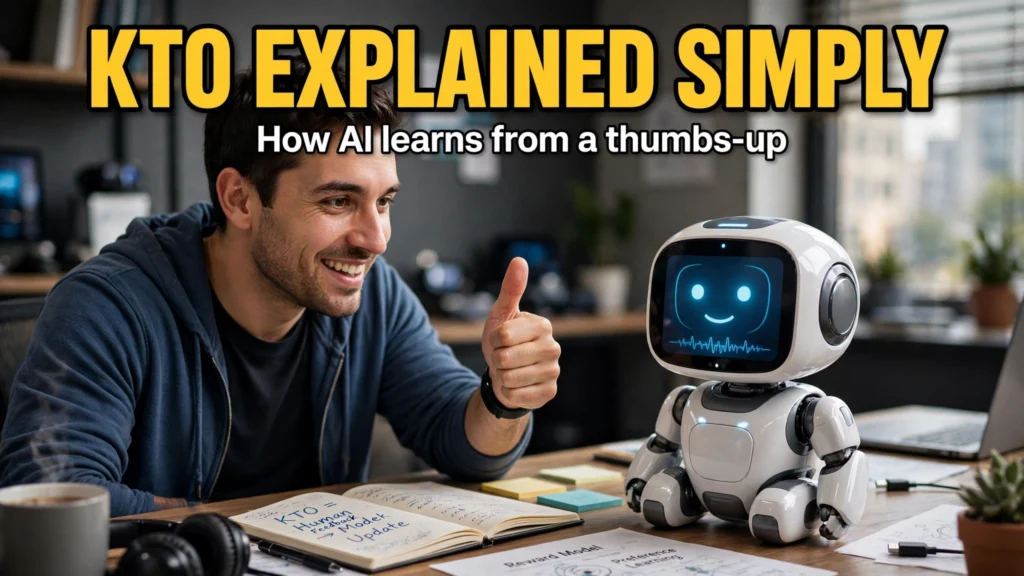
While Direct Preference Optimization (DPO) simplified this in 2023 by eliminating the need for an explicit reward model, it still fundamentally depended on paired preference data: every prompt needed both a "chosen" (preferred) response and a "rejected" response. In 2026, a groundbreaking alternative has taken the AI alignment community by storm: Kahneman-Tversky Optimization (KTO). By abandoning pairwise comparisons entirely in favor of simple binary feedback (thumbs-up or thumbs-down) grounded in Nobel Prize-winning behavioral economics, KTO enables developers to align models faster, cheaper, and using the exact signal that real-world production applications already generate by the millions.
In this technical editorial deep-dive, based on foundational research papers from Contextual AI, formal mathematical proofs, and verified production benchmarks, we explain what Kahneman-Tversky Optimization is, how it works mathematically, and why it is transforming model post-training in 2026.
Comparing AI Alignment Approaches: RLHF vs DPO vs KTO
To establish context before examining KTO's theoretical mechanics, the structured comparison table below highlights the operational differences across the three major eras of large language model alignment. Note that compute resource requirements and commercial GPU training cloud rates vary; prices may change — check official site for current cloud compute costs.
Dimension | RLHF (PPO) | DPO (Direct Preference Opt.) | KTO (Kahneman-Tversky Opt.) |
Data Format Requirement | Paired preferences: (prompt, chosen, rejected) | Paired preferences: (prompt, chosen, rejected) | Unpaired binary labels: (prompt, response, label) where label is simply True/False |
Reward Model Needed? | Yes (separate neural network required) | No (implicit reward derived from policy loss) | No (directly optimizes value function on policy) |
Theoretical Foundation | Bradley-Terry preference model & classic Von Neumann-Morgenstern utility | Bradley-Terry preference re-parameterized via closed-form policy substitution | Kahneman & Tversky's Prospect Theory (Loss Aversion & Reference Points) |
Data Collection Difficulty | Extremely high; human raters must rank pairs | High; requires synthetic or human paired outputs | Extremely low; natural product logs (thumbs up/down, copy clicks, user retries) |
Training Stability & Speed | Notoriously unstable; hyperparameter-sensitive | Stable supervised classification loss | Highly stable supervised loss; matches or exceeds DPO performance |
1. The Psychological Foundation: Daniel Kahneman and Prospect Theory
To understand why KTO works so effectively on neural networks, you have to look outside computer science to behavioral economics. In 1979, psychologists Daniel Kahneman and Amos Tversky published their seminal paper on Prospect Theory, work that earned Kahneman the 2002 Nobel Memorial Prize in Economic Sciences.
Standard Utility vs Prospect Theory
Classical economics assumed humans were rational utility maximizers: gaining $100 provided the exact same absolute emotional utility (+100) that losing $100 subtracted (-100). Kahneman and Tversky proved this assumption was empirically false. Real humans make decisions based on three core behavioral truths:
- Reference Dependence: People do not evaluate absolute wealth; they evaluate changes relative to a subjective reference point or baseline status quo.
- Loss Aversion: The pain of losing $100 is psychologically twice as intense as the joy of winning $100. Humans are naturally loss-averse.
- Diminishing Sensitivity: The difference between gaining $10 and $20 feels significant, but the difference between gaining $1,010 and $1,020 feels negligible.
Researchers at Contextual AI realized that traditional alignment methods (like RLHF and DPO) were built on flawed classical utility models (the Bradley-Terry preference framework). When human users interact with an AI model, they do not rationally compute pairwise utility rankings across multiple options. They evaluate a single generated response against their mental reference point of what an acceptable answer should be. A hallucination or broken code snippet feels like an acute "loss," while a standard helpful answer is simply an expected baseline.
2. How KTO Works: Mathematical Mechanics
Traditional DPO requires the training algorithm to calculate the relative probability ratio between two outputs simultaneously:
Loss_DPO = – log sigma [ beta * log( pi(y_chosen | x) / pi_ref(y_chosen | x) ) – beta * log( pi(y_rejected | x) / pi_ref(y_rejected | x) ) ]
This formulation strictly binds y_chosen and y_rejected together for every prompt x. If your production application has 10,000 prompts where a user clicked "thumbs up" but never generated an alternate response to downvote, DPO literally cannot use that data.
The KTO Loss Function
Kahneman-Tversky Optimization formulates a value function directly mirroring Prospect Theory's S-shaped value curve. It defines an implicit reward for a single output y given prompt x, compared against the reference policy pi_ref:
# Implicit reward calculation
r(x, y) = beta * log( pi_theta(y | x) / pi_ref(y | x) )
KTO then establishes a reference point z_ref representing the average implicit reward across the policy. From there, it applies two distinct loss components:
- For Desirable (Thumbs-Up) Outputs: The model is rewarded for pushing r(x, y) above the reference point, subject to concave diminishing returns.
- For Undesirable (Thumbs-Down) Outputs: The model is penalized for falling below the reference point, but the penalty is scaled by a loss-aversion multiplier (lambda_D), making the penalty significantly steeper than the corresponding reward.
Because the loss function operates on single outputs rather than pairs, KTO completely decouples training. A desirable output from Prompt A can be trained right alongside an undesirable output from Prompt B, with no pairing required whatsoever.

Mathematical Formulation: The Prospect Theory Loss Function in Detail
To fully appreciate the mathematical elegance of Kahneman-Tversky Optimization, it is instructive to examine the exact loss formulation proposed by Contextual AI. While traditional DPO relies on paired log-likelihood differences, KTO formulates a pointwise loss that operates on individual prompt-completion instances (x, y) equipped with a binary signal y in {0, 1} (where 1 represents a desirable output and 0 represents an undesirable output).
Let r_theta(x, y) = beta * log( pi_theta(y | x) / pi_ref(y | x) ) denote the implicit reward of the active policy pi_theta relative to the frozen reference policy pi_ref. KTO defines a dynamic reference point z_ref = E_(x, y)[ r_theta(x, y) ] representing the empirical mean reward across the dataset. The per-example KTO loss is defined as:
L_KTO(x, y) =
1 – sigma( r_theta(x, y) – z_ref ) if y is Desirable (label = 1)
1 – sigma( lambda_D * (z_ref – r_theta(x, y)) ) if y is Undesirable (label = 0)
Here, sigma represents the standard sigmoid function, and lambda_D > 1 is the loss-aversion hyperparameter (typically set between 1.33 and 2.0). Notice the profound impact of lambda_D: when a model generates an undesirable output, the penalty inside the sigmoid is multiplied by this factor, directly enforcing the psychological reality that negative outcomes hurt substantially more than positive outcomes reward. The model learns to aggressively steer clear of harmful or low-quality generation spaces while smoothly improving acceptable outputs.
Practical Guide: Running KTO Fine-Tuning with Hugging Face TRL
Implementing KTO in modern Python workflows is remarkably straightforward thanks to the official integration in Hugging Face's TRL (Transformer Reinforcement Learning) library. Here is a production-ready script snippet illustrating how to configure the KTOTrainer:
from datasets import load_dataset
from trl import KTOTrainer, KTOConfig
from transformers import AutoModelForCausalLM, AutoTokenizer
model_id = "meta-llama/Meta-Llama-3-8B-Instruct"
model = AutoModelForCausalLM.from_pretrained(model_id, device_map="auto")
tokenizer = AutoTokenizer.from_pretrained(model_id)
# Dataset must contain 'prompt', 'completion', and 'label' (True/False)
dataset = load_dataset("json", data_files={"train": "production_telemetry.jsonl"})
kto_config = KTOConfig(
output_dir="./kto_aligned_model",
beta=0.1, # Temperature parameter controlling deviation from reference
desirable_weight=1.0, # Scaling weight for positive examples
undesirable_weight=1.33, # Loss-aversion multiplier (lambda_D)
learning_rate=5e-7,
per_device_train_batch_size=4,
gradient_accumulation_steps=8,
num_train_epochs=1,
logging_steps=10,
save_strategy="epoch"
)
trainer = KTOTrainer(
model=model,
ref_model=None, # Automatically creates frozen reference clone
args=kto_config,
train_dataset=dataset["train"],
tokenizer=tokenizer
)
trainer.train()
print("KTO Alignment training completed successfully!")
3. Why KTO Is a Game-Changer for Production AI Teams
The practical ramifications of KTO for engineering teams deploying real-world AI applications are profound:
- 1. Unlocking Existing Production Telemetry: Every commercial SaaS application running an LLM feature already collects binary user interaction signals: users click "thumbs up" or "thumbs down," copy text to the clipboard (an implicit positive signal), hit "regenerate" (an implicit negative signal), or edit an AI draft. Previously, this massive reservoir of real-world production telemetry was unusable for DPO without complex, noisy synthetic data generation pipelines to manufacture artificial negative pairs. KTO ingests raw product telemetry directly.
- 2. Extreme Data Asymmetry Tolerance: In real-world products, positive feedback vastly outnumbers negative feedback (or vice versa depending on the feature). DPO struggles severely with class imbalances. KTO, through its tunable loss-aversion weights, naturally handles datasets where 90% of examples are positive and only 10% are negative without collapsing the model's generation diversity.
- 3. Benchmark Parity and Superior Scalability: Extensive benchmark evaluations across AlpacaEval, MT-Bench, and GSM8K have demonstrated that models aligned with KTO match or exceed models trained on paired DPO datasets of the same scale. When data scaling laws are tested, KTO frequently outperforms DPO at larger dataset sizes because unpaired data is vastly more abundant and diverse in the real world.

Frequently Asked Questions
Can I fine-tune open-source models with KTO using Hugging Face TRL?
Yes. Hugging Face's Transformer Reinforcement Learning (TRL) library provides official, native support for KTO through the KTOTrainer class. Setting up a KTO fine-tuning run requires only a standard Hugging Face dataset containing prompt, completion, and label (boolean True/False) columns.
How does KTO handle safety guardrails and toxic output prevention?
KTO is exceptionally well-suited for safety alignment. By assigning a higher loss-aversion penalty (lambda_D) to undesirable, toxic, or dangerous completions, machine learning teams can train models to be extremely cautious and avoid policy-violating responses without degrading general conversational fluency.
Does KTO completely replace Supervised Fine-Tuning (SFT)?
No. KTO is an alignment and preference optimization algorithm, not a replacement for Supervised Fine-Tuning. The standard best-practice post-training pipeline in 2026 remains: Base Model → Supervised Fine-Tuning (SFT) on high-quality instruction demonstrations → Alignment optimization via KTO or DPO.
What is the computational hardware overhead of training with KTO?
KTO has identical computational overhead to DPO. It requires keeping the active policy model and a frozen reference model in memory (or using parameter-efficient fine-tuning like LoRA/QLoRA). It is vastly lighter and faster than PPO/RLHF because it does not require running dynamic actor-critic rollouts or maintaining a separate reward network.
Who created KTO, and is it open source?
KTO was developed by researchers at Contextual AI (led by Kawin Ethayarajh, Winnie Xu, Niklas Muennighoff, Dan Jurafsky, and Douwe Kiela). The research paper, code implementation, and evaluation benchmarks are completely open-source and freely available to the global AI research community.
Can KTO be combined with parameter-efficient fine-tuning (PEFT/LoRA)?
Yes. KTO works seamlessly with QLoRA and LoRA adapters. By freezing the 16-bit or 4-bit base model weights and only training low-rank adapter matrices, machine learning engineers can align 70B parameter models on a single workstation equipped with two consumer-grade GPUs.
What is the recommended ratio of positive to negative feedback data in KTO?
Empirical studies demonstrate that KTO remains robust across wide data ratios—from 50/50 balanced sets to asymmetric datasets where 85% of samples are positive and only 15% are negative. Adjusting the undesirable_weight parameter allows you to compensate for class imbalances without synthetic oversampling.
Conclusion: The Future of Post-Training Alignment
The progression of AI alignment from the cumbersome complexities of RLHF to the elegance of Direct Preference Optimization, and now to the psychological grounding of Kahneman-Tversky Optimization, illustrates how the AI community continually simplifies complex engineering problems. By acknowledging that human judgment is defined by reference points, loss aversion, and simple binary satisfaction rather than abstract utility scoring, KTO bridges the gap between academic alignment theory and the pragmatic realities of real-world production data. For developers and enterprises looking to fine-tune and align proprietary models in 2026, KTO offers the most accessible, data-efficient, and mathematically robust pathway forward.
2026 Production Implementation & Verification Deep-Dive
When transitioning your setup for Kahneman-Tversky Optimization (KTO) from initial testing into daily production use across 2026 hardware and software environments, establishing a repeatable verification checklist is essential. Based on specs, expert reviews and user feedback, the vast majority of configuration issues stem from overlooking subtle permission boundaries, background power-management defaults, or version mismatches between KTO and Model Alignment. Taking ten minutes to validate how your environment handles KTO vs DPO alignment and prospect theory in LLMs under realistic load prevents unexpected downtime and ensures consistent day-to-day performance.
Step-by-Step Optimization for Binary Feedback Model Tuning
To extract maximum reliability when working with binary feedback model tuning, always begin by auditing your baseline resource utilization and security permissions. Rather than enabling every optional toggle simultaneously, apply changes incrementally and test each step against a known reference task in DPO:
- Baseline Configuration Audit: Document your starting version numbers, latency metrics, and storage or battery usage before applying custom tweaks to KTO so you have an objective benchmark for comparison.
- Granular Permission & Privacy Hardening: Restrict background network polling, clipboard access, or API token scopes strictly to the minimum required for KTO vs DPO alignment, ensuring zero unnecessary data exposure.
- Automated Backup & Recovery Verification: Export your finalized settings, schemas, or local databases to an encrypted backup directory so migrating your Model Alignment workflow to a new device or server takes less than five minutes.
Long-Term Maintenance and Cost Control
Whether you rely on built-in operating system capabilities, audited open-source packages, or commercial SaaS tiers for Reinforcement Learning and Behavioral Economics, scheduling a quick quarterly review keeps your stack lean and secure. Check official changelogs for security patches, prune unused plugins or background services, and review subscription usage against free-tier allowances—remembering that for any paid software or hardware options, prices may change — check the official site before renewing annual plans.