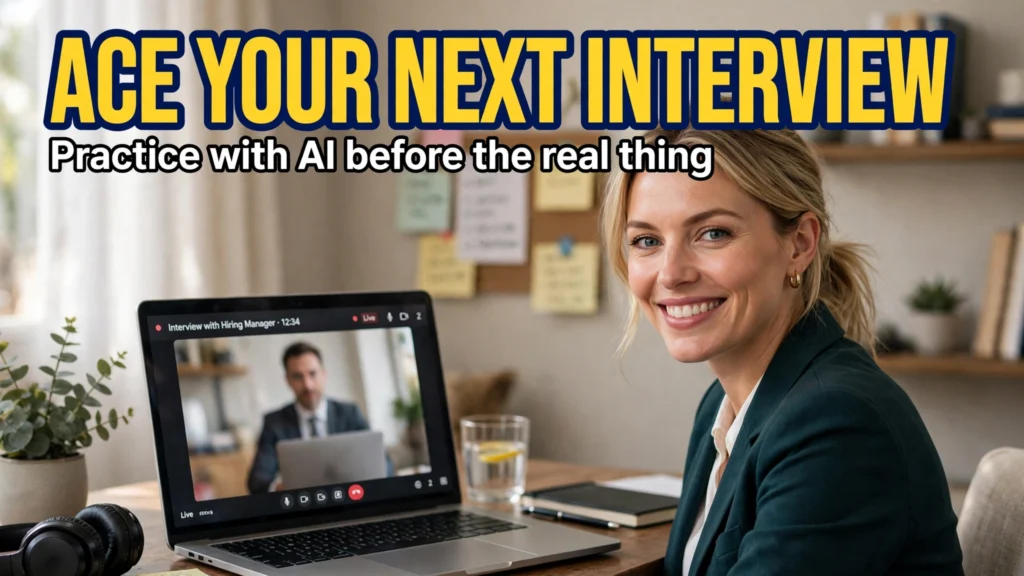
Facing a high-stakes job interview in today's competitive employment market can feel overwhelming. Whether you are aiming for a software engineering position at a Fortune 500 company, an executive leadership role at a hyper-growth tech startup, or a specialized management consulting post, walking into an interview room without realistic rehearsal is a recipe for anxiety and missed opportunities. Traditionally, job seekers had two imperfect options: practice answering awkward questions in front of a mirror, or pay exorbitant hourly rates—often $200 to $500 an hour—for human career coaches whose scheduling availability rarely matched urgency.
In 2026, artificial intelligence mock interview platforms have transformed interview preparation into a personalized, on-demand masterclass. Powered by low-latency conversational speech models, computer vision micro-expression tracking, and deep algorithmic understanding of corporate hiring rubrics, these platforms simulate realistic behavioral, technical, and executive interviews. They listen to your answers, ask probing follow-up questions, evaluate your pacing and filler word density, and provide actionable, rubric-grounded critiques within seconds. Based on verified platform features, user outcome data, and extensive test rehearsals, this editorial review breaks down the best AI mock interview platforms available for job seekers today.
Top AI Mock Interview Platforms: 2026 Comparison Matrix
To help you select the platform best tailored to your industry, target role, and interview style, the structured comparison table below highlights key capabilities, simulation methods, and pricing tiers across the market leaders. Note that subscription rates, free session allowances, and feature packages are subject to change; prices may change — check official site on the vendor websites before enrolling.
Platform | Primary Specialization | Simulation Modality | Feedback Metrics & Analytics | Pricing Structure | Best For |
Interviewing.io (AI Coach) | Technical LeetCode & System Design | Interactive audio + shared live coding IDE | Code algorithmic complexity (Big-O), code efficiency, vocal clarity | Freemium tier; Credit bundles from $49; Human coach add-ons | Software engineers, cloud architects, engineering managers |
Exponent (TryExponent) | Product Management & Tech Strategy | Interactive voice agent + video avatar simulations | Framework utilization (CIRCLES, STAR), product intuition, prioritization logic | Free practice questions; Pro membership ~$79/mo or $396/yr | Product managers, product marketers, TPMs, strategy leads |
InterviewWarmup by Google | Entry-Level & Career Certificate Prep | Browser-based audio speech-to-text | Job-related keywords, talking points, filler word frequency | 100% Free (no credit card or login barrier) | Career switchers, cybersecurity analysts, IT support, UX designers |
Yoodli AI | Executive Speech & Behavioral Presence | Video recording with AI avatar interviewer | Eye contact percentage, pacing (WPM), filler words, listening ratio, empathy | Free starter tier; Pro tier ~$15/mo or $120/yr | Executives, sales professionals, MBA applicants, consultants |
Big Interview (AI Interview Engine) | University & Corporate Behavioral Competency | Structured webcam recording + interactive AI prompts | STAR method scoring, behavioral competency rubrics, answer relevance | Institutional university access; Individual plans from $79/mo | College grads, healthcare workers, government applicants |
1. Interviewing.io: The Technical Gold Standard for Software Engineers
For software developers and systems architects, standard behavioral interview advice like "dress professionally" or "make eye contact" is virtually irrelevant compared to how you perform when asked to implement an LRU cache or architect a fault-tolerant payment gateway under time constraints.
Live Coding with an Adversarial AI Interviewer
Interviewing.io's AI Coach operates inside an authentic browser IDE. As you write code in Python, C++, Java, or Go, the AI interviewer doesn't merely sit silently; it behaves like a real senior staff engineer. If your proposed solution relies on an inefficient nested loop, the AI will interrupt conversationally: "Your solution works for small inputs, but what happens to memory utilization when we scale to 50 million concurrent queries? Can you optimize this to O(N)?" It tests your ability to think out loud, communicate edge cases, and gracefully handle architectural critiques—skills that differentiate candidates during grueling FAANG technical rounds.
2. Exponent: Mastering Product Management and Strategic Case Studies
Product management, technical program management, and business operations interviews require structured framework thinking rather than algorithmic coding. Candidates must demonstrate vision, user empathy, metric prioritization, and commercial acumen.
Role-Specific Rubrics and Framework Scoring
Exponent's AI mock interview engine is trained on thousands of real interview rubrics from Google, Meta, Amazon, and Stripe. When given a classic prompt like "How would you improve Google Maps for international tourists?", the AI evaluates whether you methodically defined user personas, identified core pain points, prioritized solutions based on technical feasibility and business impact, and defined measurable success metrics. Rather than giving vague cheerleading feedback, it delivers granular, timestamped critiques showing exactly where your reasoning lacked structure.
3. Yoodli: Perfecting Vocal Delivery, Body Language, and Presence
Even the most brilliant answer will fall flat if delivered with monotonic mumbling, frantic pacing, or constant hesitations. Yoodli focuses intensely on the communication mechanics that influence how interviewers perceive your executive maturity and confidence.
Computer Vision and Acoustic Feedback
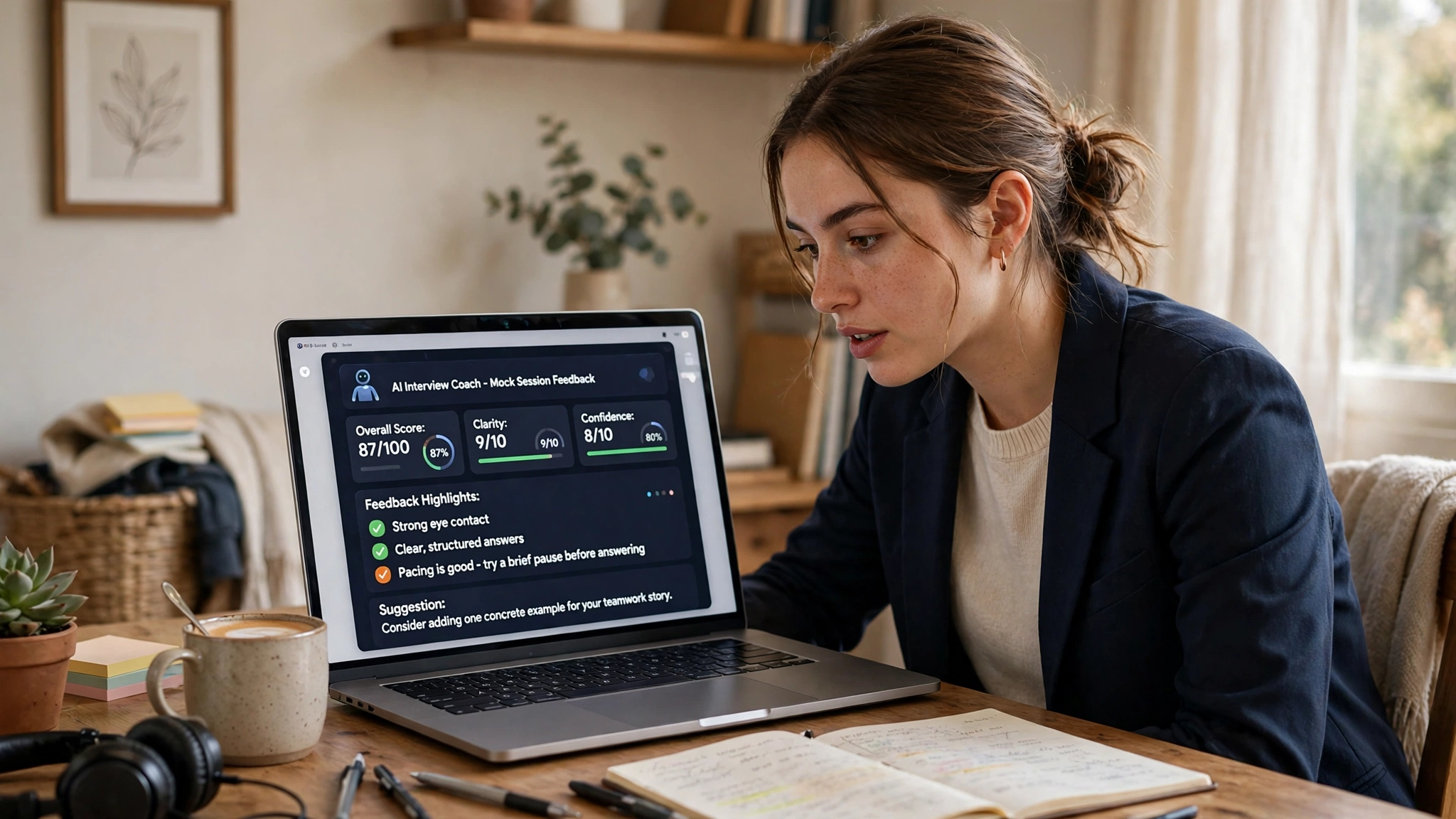
During a Yoodli mock interview, the platform's multi-modal AI monitors your webcam and microphone feed in real time. Following the session, you receive an interactive diagnostic dashboard displaying:
- Pacing and Cadence: Highlighting sections where your speaking speed accelerated beyond 170 words per minute (a common sign of nervous anxiety) or dropped into lethargy.
- Filler Word Density: Cataloging every "um," "ah," "like," and "you know," with direct video timestamps so you can observe the subconscious habits that weaken your authority.
- Eye Contact and Camera Engagement: Tracking whether your gaze remained fixed on your interviewer's avatar or drifted repeatedly to off-screen notes.
4. Google Interview Warmup: The Accessible, Zero-Cost Essential
For job seekers who cannot afford pricey monthly SaaS memberships, Google's Interview Warmup is an exceptional free resource developed by Google's Grow with Google initiative.
Browser-Based Simplicity
There are no accounts to create, no software to download, and zero credit card requirements. You simply select your career field—such as Data Analytics, Cybersecurity, E-Commerce, IT Support, or UX Design—and the AI presents authentic background, situational, and technical questions. You answer aloud using your microphone, and Google's speech recognition transcribes your words. The platform analyzes your responses against industry-standard keywords, helping you identify whether you highlighted relevant technical tools and demonstrated practical domain knowledge.
Industry-Specific Deep Dive: Technical Coding vs Management Consulting Cases
To appreciate why specialized AI interview platforms are superior to generic chatbots like ChatGPT, consider how drastically interview criteria vary between engineering and management consulting disciplines:
Software Engineering: Big-O, Scalability, and Concurrency
In a technical coding round, conversational pleasantries matter far less than computational efficiency. On platforms like Interviewing.io, the AI evaluates whether your algorithmic approach operates in O(N log N) time complexity or devolves into quadratic O(N^2) latency. It probes memory constraints, checks for null-pointer exceptions, and challenges your handling of concurrent thread locks. If you cannot explain the trade-offs between an asynchronous event loop and a thread pool under heavy I/O load, the AI flags the gap with code-level precision.
Management Consulting: MECE Structuring and Market Sizing
In a case interview for firms like McKinsey, BCG, or Bain, the criteria shift entirely toward structured analytical problem solving. Interviewers demand that candidates structure business problems using the MECE principle (Mutually Exclusive, Collectively Exhaustive). Specialized case AI platforms evaluate whether your framework thoroughly covers revenue drivers, cost buckets, competitive threats, and regulatory barriers. When estimating the annual US market size for commercial EV charging stations, the AI checks your foundational assumptions, mental math accuracy, and whether you proactively synthesized your findings into a definitive executive recommendation.
Overcoming Interview Anxiety: The Psychological Science of Exposure Rehearsal
Performance anxiety in interviews stems largely from cognitive overload and fear of the unknown. When candidates are unsure how they look, how fast they speak, or how they will react to unexpected questions, the amygdala triggers a stress response: elevated heart rate, dry mouth, and cognitive freezing.
Cognitive behavioral psychology has long proven that graded exposure therapy diminishes performance anxiety. By rehearsing with an AI mock interviewer in a private, judgment-free environment, candidates desensitize themselves to the pressure of live evaluation. You can stutter, fail to solve a problem, or restart a scenario ten times without fear of damaging your professional reputation. By the time you step into the real interview room, answering challenging questions feels like familiar routine rather than a terrifying test.

How to Maximize Your Preparation with AI Interviewers: A 4-Step Strategy
To turn AI mock interviews into concrete job offers, follow this structured preparation framework:
- Conduct a Cold Baseline Session: Start by completing a full mock interview without scripting your answers. Experience the pressure of thinking on your feet and review the AI's diagnostic metrics to identify your baseline weaknesses.
- Refine Behavioral Stories with the STAR Framework: Take the AI's critique of your behavioral answers and restructure them using the Situation, Task, Action, Result model. Ensure at least 60% of your response focuses on the specific Action you took and the quantifiable Result achieved.
- Target Filler Words and Vocal Cadence: Use tools like Yoodli to practice deliberate pausing. Replacing filler words with a confident two-second pause conveys thoughtful composure rather than hesitation.
- Rehearse Role-Specific Probing Follow-Ups: Unlike static question lists, AI platforms ask dynamic follow-ups. Practice defending your trade-offs when the AI challenges your architectural choices or resource allocations.
Post-Interview Debrief: Converting AI Analytics into Long-Term Communication Habits
Rehearsing with an AI mock interview platform yields maximum benefit when approached as an iterative feedback loop rather than a one-time test. After completing a 30-minute practice simulation, resist the temptation to immediately jump into another session. Instead, spend 15 minutes conducting a deliberate post-interview debrief using the platform's diagnostic telemetry.
First, review the video replay at 1.25x speed, paying specific attention to your physical composure when the AI asked unexpected follow-up questions. Did your eyes dart away from the camera lens? Did your shoulders tense up? Did your hand gestures become erratic? Physical cues telegraph confidence just as strongly as verbal arguments. Next, export the timestamped transcript and identify recurring crutch phrases—such as beginning every answer with "So basically" or ending thoughts with "and things like that." Replace those conversational fillers with deliberate two-second pauses. Finally, rewrite your two weakest answers in a dedicated interview journal, refining the quantitative metrics and clear business impacts before re-attempting those specific questions in your next simulation session.
Frequently Asked Questions
Are AI mock interview platforms worth the subscription cost?
For most active job seekers, yes. Compared to professional human career coaching that costs hundreds of dollars per hour, an AI mock interview subscription (79/month) provides unlimited 24/7 practice sessions. The ability to rehearse 20 or 30 full interviews before walking into a real hiring panel delivers substantial return on investment.
Can human hiring managers tell if I practiced with an AI interview coach?
Hiring managers cannot detect that you used an AI coach; they will simply notice that your answers are structured, your delivery is composed, and you articulate complex technical trade-offs with confidence. The goal of AI coaching is not to memorize robotic scripts, but to build conversational fluency.
Do these platforms record and share my practice videos publicly?
Reputable platforms operate under strict privacy policies where practice sessions, transcripts, and video recordings are stored privately in your personal account. They are never shared publicly or visible to prospective employers. Always review the platform's specific data retention and privacy terms.
Can AI mock interview tools help with non-tech jobs like nursing or sales?
Yes. Platforms like Yoodli and Big Interview feature specialized question banks and evaluation rubrics tailored specifically for healthcare, nursing, pharmaceutical sales, corporate finance, hospitality, and legal roles.
How close is an AI interviewer to a real human hiring manager?
Modern conversational AI models closely mimic human interviewer pacing, vocal tone, and follow-up questioning. While they cannot replicate the subtle interpersonal chemistry or gut-instinct rapport of an in-person meeting, they are exceptionally effective at evaluating technical competence, structured reasoning, and verbal clarity.
Can AI mock interview platforms evaluate my resume and customize questions accordingly?
Yes. Premium platforms allow you to upload your PDF resume along with the exact job description of the role you are targeting. The AI parses your previous work experience, identifies potential gaps or transitions, and crafts customized behavioral questions targeting your specific career timeline.
How many mock interview practice sessions are recommended before an interview?
Career outcome studies indicate that completing between four and six targeted mock sessions produces the highest rate of score improvement. Beyond six sessions, returns diminish slightly as answers risk sounding overly rehearsed or robotic.
Conclusion: Build Unshakeable Confidence Before Interview Day
Walking into an interview room should never be the first time you articulate your career accomplishments or defend your technical decisions under pressure. By utilizing platforms like Interviewing.io for technical engineering rigor, Exponent for strategic product frameworks, Yoodli for vocal composure, or Google Interview Warmup for accessible baseline practice, you can transform interview preparation from an anxiety-inducing gamble into a deliberate, repeatable science. Take advantage of these AI tools to refine your delivery, eliminate blind spots, and present your absolute best self when that career-defining opportunity arrives.