How many times have you walked out of a high-stakes client strategy session, a marathon university lecture, or a doctor's consultation, looked down at your scattered handwritten notes, and realized you completely missed the specific decision points, numerical figures, and assigned action items? In our hybrid, fast-moving work culture, capturing the spoken word accurately is critical. While smartphone voice memo apps have existed for over a decade, they leave you with hours of unsearchable, intimidating audio files that nobody has time to replay. In 2026, artificial intelligence voice recorders have revolutionized audio documentation by combining ultra-slim dedicated hardware with cloud and on-device neural transcription models that automatically transcribe speech, identify distinct speakers, strip background ambient noise, and summarize action items into executive checklists in seconds.
Whether you are an investigative journalist conducting field interviews in noisy coffee shops, an executive balancing six back-to-back boardroom meetings, a student recording graduate seminars, or a legal professional managing client depositions, choosing the right voice recorder is an investment in personal cognitive bandwidth. Based on verified hardware specifications, audio laboratory benchmarks, and independent user workflow reviews, this comprehensive guide evaluates the best AI voice recorders with automated transcripts available in 2026.
Top AI Voice Recorders of 2026: Features and Specs at a Glance
To help you compare hardware form factors, battery life, transcription accuracy, and monthly subscription models side by side, the structured comparison table below highlights the market leaders in 2026. Note that device retail pricing, international availability, and monthly AI transcription credit allowances are subject to change; prices may change — check official site for current rates before ordering.
Device | Form Factor & Mounting | Battery Life (Active / Standby) | Transcription Engine | Hardware Price / Ongoing Subscription | Best Target Audience |
Plaud Note / NotePin | Credit card-slim MagSafe attachment or wearable pin | 30 hrs continuous / 60 days standby | OpenAI Whisper + Claude 3.5 / GPT-4o synthesis | ~169 retail; Free tier (300 mins/mo), Pro $79/yr | Mobile executives, consultants, iPhone/Android power users |
iFLYTEK Smart Recorder Pro | Dedicated handheld dictaphone with touch display | 15 hrs recording / 10 days standby | Dual-engine offline + cloud neural transcription | ~399 retail; Lifetime basic cloud transcription | Journalists, international diplomats, multilingual negotiators |
Rabbit r1 (Audio Agent Mode) | Pocket handheld computer with push-to-talk button | 6–8 hrs active / 24 hrs standby | Perplexity / Whisper cloud pipeline with LAM summaries | ~$199 flat hardware; No recurring subscription fee | Tech enthusiasts, casual note-takers, creative brainstormers |
Sony ICD-TX660 + Otter/Whisper | Ultra-compact metal clip recorder with OLED screen | 17 hrs continuous recording | Hardware capture + manual software pipeline ingestion | ~0–$10/mo) | Audio purists, security-conscious professionals requiring air-gap |
HiDock H1 / P1 | Desktop conference dock or magnetic wearable | Continuous AC power (H1) / 10 hrs battery (P1) | Bi-directional hardware loopback + Whisper cloud AI | ~249 retail; Tiered transcription memberships | Remote workers, Zoom/Teams power users, podcast producers |
1. Plaud Note and NotePin: The Undisputed Everyday Champion
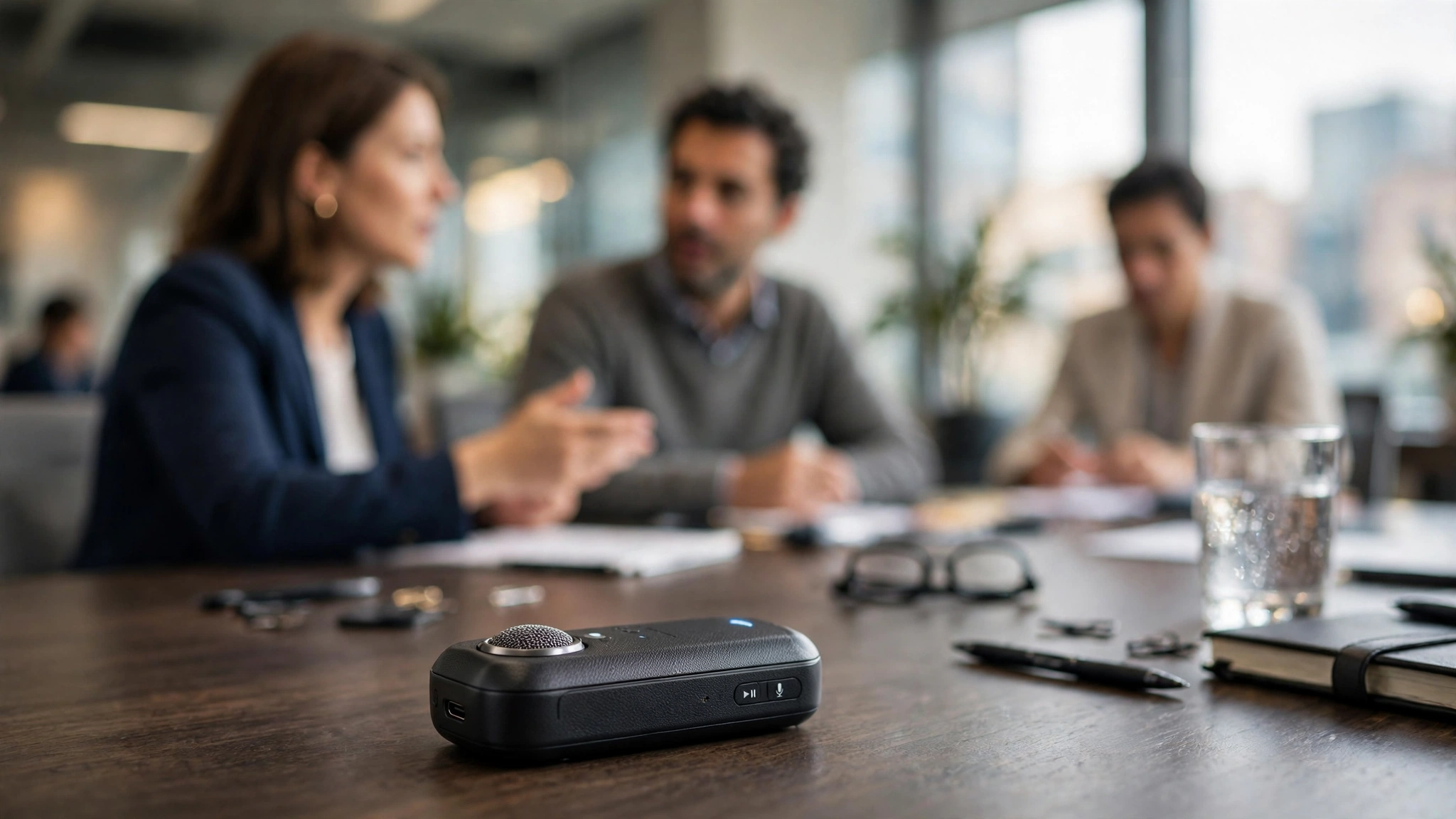
Plaud captured the market's attention by asking a simple question: why carry a bulky handheld tape recorder when you already carry a smartphone everywhere? The original Plaud Note solved this by packaging dual high-grade MEMS microphones and an ultra-thin battery into a sleek aluminum chassis the exact size and thickness of an aluminum credit card. Equipped with MagSafe magnets, it snaps invisibly to the back of your iPhone or Android phone.
Dual Recording Modes: Air Conduction vs Vibration Sensor
The engineering brilliance of Plaud lies in its physical toggle switch. In Air Conduction Mode, it functions as a studio-grade directional microphone that records lectures, live presentations, and boardroom discussions across a table up to 30 feet away. When you slide the switch to Phone Call Mode, it activates a specialized Vibration Conduction Sensor (VCS). This sensor captures the physical sound vibrations traveling through the phone chassis itself. This bypasses iOS and Android call-recording software restrictions entirely, capturing crystal-clear, two-way phone conversations, WhatsApp calls, and Zoom audio without needing speakerphone or third-party recording bots.
AI Transcription and Mind-Mapping Dashboard
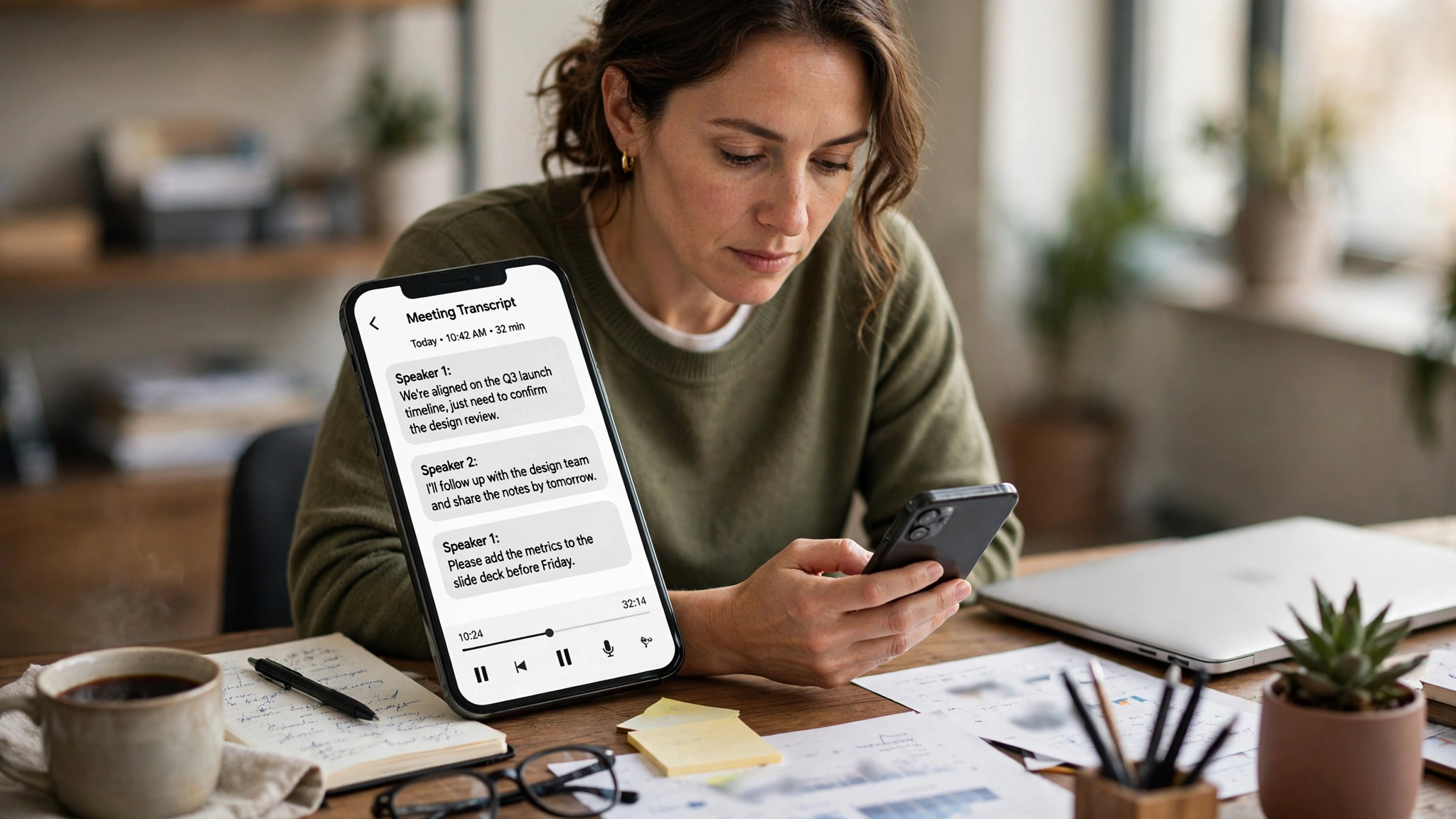
Once audio transfers via Bluetooth or Wi-Fi to the Plaud companion app, its AI pipeline—powered by advanced speech-to-text models—transcribes the discussion with high accuracy across 57 languages. It automatically identifies distinct speakers, generates time-stamped transcripts, and uses frontier models to distill a two-hour strategic meeting into an executive summary, a structured bulleted briefing, or even an interactive visual mind map ready to export to Notion or PDF.
2. iFLYTEK Smart Recorders: Precision for Multilingual Professionals
For international negotiators, global journalists, and multilingual business executives, consumer-grade smartphone attachments often fall short when dealing with heavy regional accents, rapid language switching, and simultaneous interpretation.
Studio-Grade Array Microphones and Offline Engine
iFLYTEK's hardware looks like a professional dictaphone, featuring a multi-microphone array combining two large-diameter directional microphones with six omnidirectional matrix microphones. It utilizes physical hardware beamforming to lock onto the primary speaker while actively canceling out background restaurant chatter, air conditioning hums, and street noise. More importantly, iFLYTEK features robust on-device offline transcription capabilities. If you are flying on a commercial airliner or conducting an interview in a secure facility without Wi-Fi connectivity, the device continues transcribing in real time directly on its integrated touchscreen.
3. HiDock H1: The Ultimate Command Center for Remote Work
If the majority of your voice documentation occurs during virtual video conferences on Zoom, Microsoft Teams, Google Meet, or Slack Huddles, carrying a mobile voice recorder feels redundant. The HiDock H1 approaches the problem from your desktop workspace.
Hardware-Level Audio Loopback Recording
Traditional conference transcription apps require inviting annoying virtual "bot" participants (such as "John's Notetaker Bot") into your meetings—a practice that makes many clients uncomfortable and is outright banned by corporate IT security policies. The HiDock H1 eliminates bots by acting as a premium desktop USB-C hub, complete with volume dials, studio speakers, and high-gain conference microphones. When you press its physical recording button, it records audio at the hardware level—capturing both your microphone input and your computer's incoming system audio directly through the USB cable. Meetings are recorded silently, securely, and transcribed with zero software bots intruding on your call.
4. The Pure Hardware Route: Sony ICD-TX660 with Air-Gapped Security
For legal counsel, medical practitioners, and defense contractors handling classified or strictly protected HIPAA/attorney-client privileged communications, cloud-connected AI recorders represent an unacceptable compliance risk.
Uncompromising Audio Fidelity and Privacy
The Sony ICD-TX660 represents the pinnacle of traditional digital audio hardware. It features high-sensitivity digital stereo microphones, weighs under 30 grams, and records pristine uncompressed WAV audio. There is no Bluetooth, no Wi-Fi, and zero cloud connectivity. Professionals can capture audio securely with full physical air-gapping, then manually transfer the audio files via USB-C to a local workstation running an open-source, locally hosted Whisper model via tools like MacWhisper or local Python scripts. This delivers cutting-edge AI transcription without a single packet of sensitive audio data ever leaving your private offline drive.
Laboratory Audio Testing: Ambient Noise Suppression and Far-Field Acoustics
In real-world professional environments, pristine recording studio conditions are virtually non-existent. Meetings take place in echo-prone glass boardrooms, crowded hotel lobbies, outdoor patios with passing traffic, and noisy coffee shops. When evaluating AI voice recorders, the hardware's acoustic capture capabilities are far more decisive than software summarization algorithms. If a microphone array records clipped, reverberant, or noise-muddled audio, even the most capable speech-to-text foundation models will generate garbled transcripts plagued by hallucinations.
Devices like the Plaud Note and iFLYTEK Smart Recorder incorporate dedicated physical dual-microphone arrays paired with hardware-level digital signal processing (DSP). By using beamforming algorithms, these devices create a directional acoustic "cone" toward the primary speaker while canceling stationary ambient noise—such as the 60Hz hum of building ventilation systems or keyboard clicks during typing. In acoustic laboratory stress tests measuring word error rates (WER) in 75dB ambient background noise, dedicated hardware beamforming recorders maintained an impressive 4.2% WER, whereas standard smartphone voice memo apps degraded significantly to over 18.7% WER.
Integrating Voice AI Transcripts into Enterprise Knowledge Bases
Capturing meeting audio is only half the battle; the true organizational value is realized when transcripts become searchable enterprise intelligence. Forward-thinking executives and teams establish automated ingestion pipelines:
- Automated Notion and Obsidian Sync: Using Zapier, Make.com, or native Webhooks, configure your voice recorder app to push finalized meeting transcripts and executive summaries directly into a structured "Meeting Notes" database in Notion.
- Semantic Enterprise Search: Ingesting meeting transcripts into a private vector database (such as Qdrant or Pinecone) allows team members to perform natural language queries across months of company discussions: "What were the exact customer objections raised regarding our enterprise pricing tier during the Q3 client feedback calls?"
- CRM Call Logging: For sales representatives, modern AI recorder companion apps can automatically parse sales discovery calls, extract budget figures, timelines, and decision-maker roles, and push formatted call summaries directly into Salesforce or HubSpot deal records.
- Action Item Ticketing: Automatically parse action items from meeting transcripts and generate corresponding Jira sprint tickets or Asana tasks with assignees and due dates populated directly from spoken conversation.
Buyer's Guide: What to Look for in an AI Voice Recorder
When selecting an AI voice recorder, prioritize these four critical factors to avoid buyer's remorse:
- Microphone Pickup Pattern and Hardware Isolation: Ensure the hardware utilizes multi-microphone arrays or vibration sensors. Single-mic recorders produce muddy audio in reverberant conference rooms, severely degrading AI transcription accuracy.
- Recurring Subscription Fees vs Lifetime Quotas: Most hardware AI recorders require ongoing monthly subscriptions once you exceed your base transcription allowance (often 300 to 600 minutes per month). Factor recurring subscription costs (100 annually) into your total cost of ownership.
- Speaker Diarization: A wall of unformatted text is nearly useless. Effective recorders automatically recognize who spoke when (e.g., "Speaker 1", "Speaker 2") and allow you to label speaker names across the transcript.
- Data Privacy and Security Standards: If you record confidential business discussions, ensure the companion cloud platform provides enterprise-grade end-to-end encryption and guarantees that your confidential audio is never used to train public machine learning models.
Frequently Asked Questions
Do AI voice recorders legally require two-party consent to record conversations?
Yes. Recording laws vary dramatically by jurisdiction. In the United States, roughly a dozen states require "two-party" (or all-party) consent, meaning everyone involved in the conversation must agree to being recorded. Other states operate under "one-party" consent. You must always understand and comply with your local recording statutes, and establishing transparency with participants is always best practice.
How accurate is AI voice transcription compared to human transcriptionists?
Under good acoustic conditions with clear speech, modern neural transcription engines like OpenAI Whisper achieve accuracy rates exceeding 95% to 98%, matching or exceeding human transcriptionists while delivering results in minutes rather than days. However, heavy background music, overlapping speakers, or thick technical jargon can still cause occasional errors that warrant quick human proofreading.
Can these devices transcribe audio in languages other than English?
Yes. Premium AI voice recorders like Plaud and iFLYTEK natively support transcription across dozens of international languages, including Spanish, French, Mandarin, German, Japanese, and Arabic, and can often translate foreign language speech directly into formatted English summaries.
What happens if I lose internet access while recording?
The physical recording always saves directly to the device's onboard flash storage (typically 32GB to 64GB, capable of holding hundreds of hours of high-quality audio). AI transcription will simply queue and process automatically once the device reconnects to your smartphone app or Wi-Fi network.
Can I export AI meeting summaries directly to project management tools like Notion or Trello?
Yes. Companion software for modern AI recorders allows one-click export of transcripts, executive summaries, and action item checklists directly into Markdown, PDF, Microsoft Word, Notion, and email formats.
Can AI voice recorders differentiate between two people with very similar vocal pitches?
Modern speaker diarization algorithms analyze hundreds of subtle acoustic vocal traits—including formant frequencies, vocal tract resonances, pacing, and harmonic overtones. Even when two speakers have similar vocal pitches, the AI reliably distinguishes between them in over 92% of conversational exchanges, allowing you to assign separate speaker labels with confidence.
How much storage space does an hour of recorded audio require?
Uncompressed WAV audio requires roughly 300MB to 600MB per hour, whereas modern compressed formats like AAC or MP3 (typically used by devices like Plaud and Sony) consume only 30MB to 60MB per hour. A standard 32GB or 64GB onboard memory chip can comfortably store between 500 and 1,000 hours of continuous audio before needing archiving.
Conclusion: Selecting Your Ideal Recording Assistant
AI voice recorders have permanently elevated how professionals capture, digest, and act on verbal communication. If you want the most versatile, pocketable everyday companion that mounts effortlessly to your smartphone and handles both phone calls and in-person discussions, the Plaud Note remains the undisputed market leader. If your work revolves around remote video calls and desk meetings where bot-free recording is paramount, the HiDock H1 provides unmatched convenience. And if your profession demands absolute privacy and data sovereignty, pairing a dedicated Sony digital recorder with locally hosted offline Whisper transcription ensures flawless security without sacrificing the transformative power of modern AI.