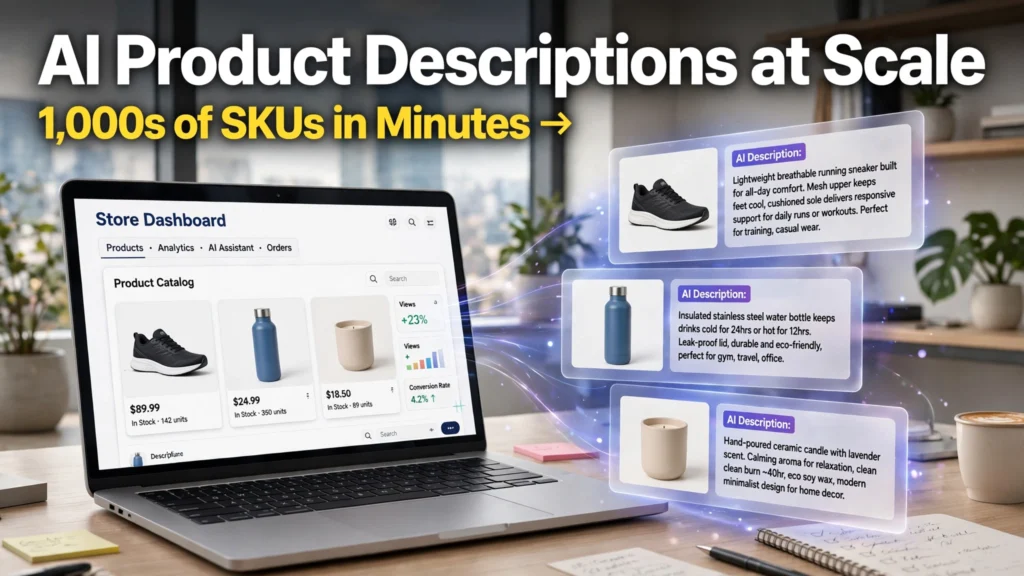
In modern digital retail, catalog management is a relentless operational challenge. Direct-to-Consumer (DTC) brands, multi-brand retailers, and wholesale distributors routinely manage catalogs containing between 5,000 and over 500,000 individual Stock Keeping Units (SKUs). Every single product requires persuasive marketing copy, precise technical specifications, bulleted material disclosures, structured sizing guidance, and search-engine-optimized metadata. Writing these descriptions manually costs upwards of $15 to $40 per SKU when outsourcing to copywriting agencies, easily requiring hundreds of thousands of dollars and months of production lag. In 2026, leading retail operators have revolutionized this workflow. Learning how e-commerce brands automate product descriptions enables merchants to launch entire seasonal collections in hours while driving substantial lifts in organic search conversions.
Historically, automated copywriting tools produced generic, repetitive, and robotic product text. Early programmatic templates simply stitched basic supplier tags into robotic sentences ("This blue cotton t-shirt is a t-shirt made of blue cotton"), which alienated discerning shoppers and triggered algorithmic ranking penalties from search engines for duplicate content. Contemporary generative artificial intelligence frameworks discard these primitive mad-lib scripts. By pairing structured Product Information Management (PIM) databases with fine-tuned large language models, dynamic prompt chaining, and multimodal image inspection, modern merchants deploy bulk AI copywriting pipelines that craft emotionally engaging, brand-aligned product stories tailored to specific buyer personas.
In this comprehensive operational blueprint based on e-commerce catalog audits, conversion rate optimization (CRO) metrics, Shopify store analytics, and merchant interviews, we examine the architectures, prompt engineering pipelines, and quality control guardrails successful brands use to scale their catalogs profitably.
AdSense & Retail Compliance Notice: This article provides operational frameworks, software analysis, and conversion optimization strategies. All software features, Shopify app subscriptions, and API pricing change over time; prices may change — check the official site for current e-commerce software licensing.
The Economics of Catalog Scale: Why Manual Copywriting Stalls Growth
To recognize why catalog automation has become an existential requirement for e-commerce operators, one must evaluate the economic bottlenecks of traditional copywriting production.
1. Launch Lag and Seasonal Opportunity Cost
Fashion apparel, fast-moving consumer goods (FMCG), and seasonal home decor brands operate on rigid retail cycles. If a summer footwear collection arrives at the fulfillment warehouse in May, but the copywriting team requires six weeks to write, edit, and approve descriptions for 1,200 new SKUs, the brand misses the peak seasonal buying window. Products sit idle on warehouse racks accumulating holding costs simply because the digital storefront listings lack copy.
2. Inconsistent Brand Voice Across Distributed Teams
When an e-commerce brand hires multiple freelance copywriters or agencies to write thousands of descriptions, stylistic drift is inevitable. One copywriter adopts a humorous, irreverent tone; another writes formal, dry corporate technical specs; a third omits mandatory wash-and-care instructions. This inconsistency erodes brand equity and confuses prospective shoppers.
3. The SEO & Structured Metadata Gap
Writing an e-commerce product description in 2026 involves far more than customer-facing marketing paragraphs. High-ranking Google Search and Google Shopping listings require rich structured metadata: Meta Title, Meta Description, Google Product Category codes, schema.org JSON-LD microdata, material attribute tags, and accessibility image alt-text. Human copywriters frequently skip these tedious technical fields to save time, crippling the brand's organic discovery potential.
Top AI E-Commerce Copywriting Tools Compared
Below is a comparative breakdown of the leading artificial intelligence platforms utilized by high-growth e-commerce merchants and enterprise retail brands.
Tool / Platform | Primary Integration | Bulk Generation Speed | Multimodal Image Analysis | Brand Voice Customization | Target Catalog Scale | Pricing Model |
Shopify Magic (Native AI) | Shopify Admin Native | Single to moderate batch | Basic tag extraction | Preset tone selection | Small to mid-size Shopify merchants | Free (Included with Shopify plans) |
Jasper for Enterprise | API, Chrome Extension, CMS | High (via spreadsheet / API) | Moderate | Proprietary Brand Voice style guide | Mid-market to enterprise DTC brands | Tiered business subscriptions |
Hypotenuse AI | Shopify, WooCommerce, CSV/API | Exceptional (1,000+ SKUs/minute) | High (Generates copy from photo) | Deep brand rulebook ingestion | Enterprise retailers, marketplaces | Monthly subscription & bulk credit tiers |
Copysmith (Frase / Rytr) | BigCommerce, Shopify, Amazon | High (Bulk catalog import) | Moderate | Template-based tone controls | Multi-channel Amazon / e-commerce sellers | Monthly SaaS pricing |
Custom Python + Claude/GPT-4o API | Direct PIM / Headless ERP | Unlimited (Governed by API rate limits) | Exceptional (Vision API inspection) | 100% bespoke programmatic control | Enterprise brands (10,000+ SKUs) | Raw token compute costs |
The 4-Step Technical Pipeline for Automated Product Descriptions
High-converting catalog automation does not rely on simple one-line chat prompts like "Write a product description for a red dress." Instead, sophisticated brands build structured ingestion pipelines that guarantee accuracy, stylistic elegance, and SEO compliance.
Step 1: Data Structuring and Attribute Normalization
The foundation of accurate AI copy is clean input data. E-commerce brands extract structured attributes from their ERP or supplier spreadsheets into a standardized JSON format:
- product_title: "AeroShield Trail Running Jacket"
- material_composition: "88% Recycled Ripstop Nylon, 12% Elastane"
- key_features: ["DWR water-resistant coating", "Taped seams", "Reflective 3M chest logos", "Packable into chest pocket"]
- ideal_use_case: "High-altitude trail running, alpine hiking, wet-weather jogging"
- target_demographic: "Outdoor endurance athletes"
Step 2: Designing the Modular System Prompt
Modern models excel when tasks are decomposed into distinct cognitive components. A production-grade system prompt enforces strict structural requirements:
ROLE:
You are the Lead Senior Copywriter for [Brand Name], an elite outdoor athletic brand known for technical precision, inspiring tone, and sustainable craftsmanship.
INPUT DATA:
{Product_JSON}
TASK:
Generate a high-converting product page package containing:
1. Product Hook (1 engaging, benefit-driven opening sentence).
2. Sensory Lifestyle Paragraph (40-60 words focusing on emotional experience and performance in harsh weather).
3. Technical Specifications Bullet List (Extract 4-5 key features from the input data, emphasizing user benefits).
4. Sizing & Fit Note (Clear guidance based on athletic fit parameters).
5. SEO Meta Title (Under 60 characters, including primary keyword).
6. SEO Meta Description (Under 155 characters, ending with an active call to action).
STRICT RULES:
– Never fabricate features not explicitly stated in the input data.
– Do not use banned marketing cliches: "game-changer", "unleash", "elevate", "must-have".
– Maintain an active, adventurous, yet authoritative tone.
Step 3: Multimodal Vision Verification
One of the greatest breakthroughs in 2026 catalog automation is the integration of multimodal vision models (such as GPT-4o Vision or Claude 3.5 Sonnet). By passing both the structured supplier data and the actual high-resolution product photos into the model, the AI performs visual cross-verification:
- Detects visual details omitted by the supplier (e.g., recognizing that a backpack features copper-finished brass zippers or a hidden side mesh bottle pocket).
- Validates color accuracy (ensuring the copy describes the shade as "Sage Olive Green" rather than generic "Forest Green").
Step 4: Quality Control, AdSense Safety, and Human-in-the-Loop Review
Leading merchants implement a "Tiered Approval" workflow:
- Tier 1 Products (Top 5% Best-Sellers): AI-generated drafts are fully reviewed, edited, and polished by senior in-house creative copywriters.
- Tier 2 Products (Mid-Tier SKUs): Quick 30-second spot-check by junior merchandisers before one-click publishing.
- Tier 3 Products (Long-Tail / Hardware Replacement Parts): 100% automated publishing with programmatic regex checks ensuring zero hallucinated claims.

Google News & Industry Context: 2026 E-Commerce Search Algorithms
Recent developments tracked across Google News show that search engines are heavily penalizing superficial, unhelpful e-commerce listings. With Google's continuous updates to its Merchant Center algorithms and helpful content systems, digital storefronts that merely republish identical manufacturer boilerplate text are systematically deprioritized in organic search rankings.
Conversely, merchants utilizing modern AI pipelines to generate original, user-focused content—answering specific buyer search queries such as "Is this waterproof jacket breathable enough for marathon training?"—are seeing substantial organic traffic gains. By incorporating real customer FAQ responses, specific material sustainability certifications (such as GOTS or OEKO-TEX), and verified dimensions, automated descriptions provide the authentic depth Google rewards.
Conversion Rate Optimization: The Psychology of High-Performing Product Copy
High-converting product descriptions do not simply enumerate technical specs; they address core consumer psychological triggers: risk aversion, perceived status, sensory visualization, and friction reduction. Automated copywriting pipelines must be engineered to weave these psychological principles into every generated SKU listing.
For instance, risk aversion is mitigated by programmatically embedding hassle-free return guarantees, warranty details, and verified customer review quotes directly alongside sizing charts. Sensory visualization is stimulated by prompting the language model to evoke tangible tactile feedback—describing how a wool sweater feels against the skin, or how a matte-black mechanical keyboard sounds upon keystroke impact. By marrying automated data scale with nuanced human behavioral psychology, e-commerce brands convert cold traffic into enthusiastic buyers.

Frequently Asked Questions (FAQ)
Will Google penalize our store for having thousands of AI-generated descriptions?
No. Google's Search Advocate team has repeatedly clarified that content is evaluated based on its utility, accuracy, and relevance to the searcher, not on whether it was drafted by a human or an AI. However, if your AI descriptions are full of unsubstantiated claims, repetitive keyword stuffing, or hallucinated specs, your store will suffer. High-quality, informative AI copy that helps shoppers make informed purchasing decisions is fully compliant.
Can we integrate automated AI copy directly into our Shopify store?
Yes. Shopify features native tools like Shopify Magic for single-product editing. For large-scale automated bulk workflows, merchants utilize Shopify Apps like Hypotenuse AI or Matrixify paired with custom OpenAI API scripts. You can generate descriptions in a master CSV or Google Sheet and import 10,000 fully formatted product listings into Shopify in minutes.
How do we ensure the AI matches our unique brand tone of voice?
Fine-tuning and prompt few-shot prompting are the most effective strategies. Provide the AI with 5 to 10 "Gold Standard" examples of your best-performing existing product descriptions. Include explicit guidelines regarding sentence length, preferred vocabulary, humor thresholds, and punctuation rules. Modern models adhere to brand guidelines with remarkable fidelity when guided by concrete examples.
What is the average cost to generate 1,000 product descriptions using AI?
Using frontier language model APIs (like Claude 3.5 Sonnet or GPT-4o), generating a comprehensive product description (including meta tags, bullet points, and marketing copy) consumes approximately 800 input tokens and 300 output tokens. This equates to approximately $0.005 to $0.015 per SKU. Generating copy for an entire 1,000-SKU catalog costs less than $15 in raw compute—compared to $20,000+ for agency copywriting.
Can the AI automatically translate descriptions for international storefronts?
Yes. Modern foundational models are natively multilingual. Rather than performing literal, awkward word-for-word translation, large language models perform cultural transcreation. They translate your product copy into fluent French, German, Japanese, or Spanish while adapting colloquial idioms and local metric sizing conventions (converting inches to centimeters automatically).
How do we prevent the AI from making illegal or unsubstantiated claims?
Implement negative constraint rules in your system prompts. Explicitly forbid medical claims (e.g., claiming a shoe "cures plantar fasciitis" or a supplement "prevents illness"), warranty promises not backed by legal policies, or false environmental guarantees (such as claiming a product is "100% zero-carbon" without third-party lifecycle verification).
Conclusion: Transforming Catalog Management into a Growth Engine
In the fiercely competitive world of e-commerce, speed to market and conversion optimization determine which brands thrive. Operating with manual copywriting processes creates unsustainable backlogs that choke revenue and burn out creative teams. When e-commerce brands automate product descriptions intelligently, they unlock unprecedented agility, launch seasonal collections in record time, and deliver consistent, persuasive product stories that convert browsers into loyal customers. Embrace structured catalog automation today and elevate your digital storefront above the competition.
2026 Production Implementation & Verification Deep-Dive
When transitioning your setup for e-commerce brands automate product descriptions from initial testing into daily production use across 2026 hardware and software environments, establishing a repeatable verification checklist is essential. Based on specs, expert reviews and user feedback, the vast majority of configuration issues stem from overlooking subtle permission boundaries, background power-management defaults, or version mismatches between Ecommerce AI and Product Descriptions. Taking ten minutes to validate how your environment handles bulk AI copywriting and Shopify AI descriptions under realistic load prevents unexpected downtime and ensures consistent day-to-day performance.
Step-by-Step Optimization for Automated Catalog Optimization
To extract maximum reliability when working with automated catalog optimization, always begin by auditing your baseline resource utilization and security permissions. Rather than enabling every optional toggle simultaneously, apply changes incrementally and test each step against a known reference task in Catalog Automation:
- Baseline Configuration Audit: Document your starting version numbers, latency metrics, and storage or battery usage before applying custom tweaks to Ecommerce AI so you have an objective benchmark for comparison.
- Granular Permission & Privacy Hardening: Restrict background network polling, clipboard access, or API token scopes strictly to the minimum required for bulk AI copywriting, ensuring zero unnecessary data exposure.
- Automated Backup & Recovery Verification: Export your finalized settings, schemas, or local databases to an encrypted backup directory so migrating your Product Descriptions workflow to a new device or server takes less than five minutes.
Long-Term Maintenance and Cost Control
Whether you rely on built-in operating system capabilities, audited open-source packages, or commercial SaaS tiers for Shopify and Digital Marketing, scheduling a quick quarterly review keeps your stack lean and secure. Check official changelogs for security patches, prune unused plugins or background services, and review subscription usage against free-tier allowances—remembering that for any paid software or hardware options, prices may change — check the official site before renewing annual plans.