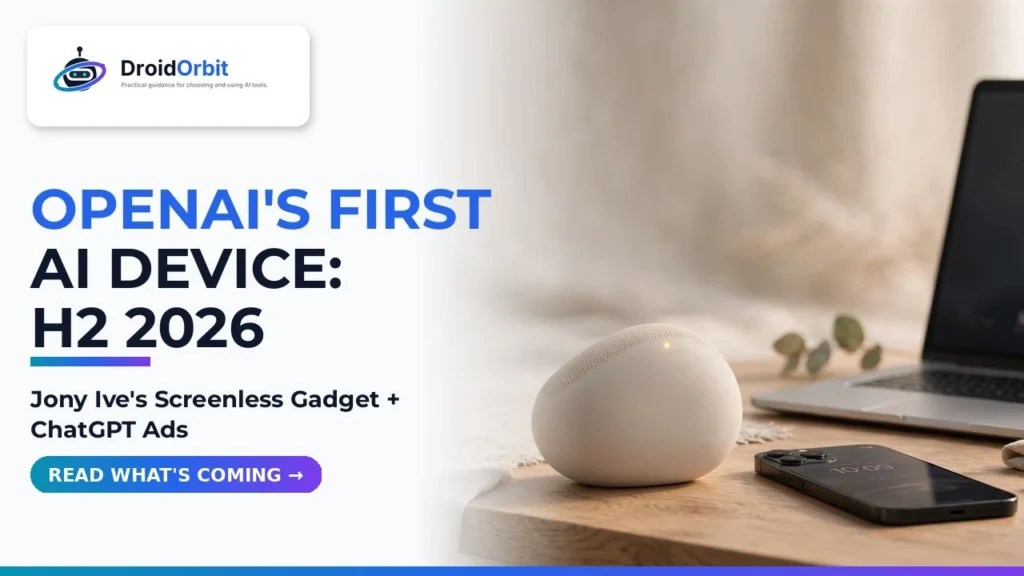
OpenAI is on track to unveil its first hardware device in the second half of 2026, according to the company’s global affairs chief Chris Lehane, speaking to Axios. The announcement would mark the ChatGPT maker’s biggest leap yet beyond software — and it comes alongside a second major shift: OpenAI is preparing to test advertising inside the free and low-cost tiers of ChatGPT. Together, the two moves sketch out how the world’s most prominent AI lab plans to turn its technology into everyday products — and into a business that can pay for the enormous computing power behind it.
What OpenAI Actually Said
Lehane described the device as one of OpenAI’s major innovations for 2026, while cautioning that it remains unclear whether it will be available to buy this year. That framing matters: an unveiling in late 2026 does not guarantee a 2026 release date. The device has been in development since May 2025, when OpenAI announced the acquisition of io, the hardware startup led by former Apple design chief Jony Ive. At the same time, CEO Sam Altman gave employees a preliminary overview of the gadget he is building with Ive, outlining plans to release 100 million so-called “AI companions” that he hopes will become part of daily life.
The device is designed to fully understand its user’s environment and surroundings, according to reporting on Altman’s internal remarks. It is deliberately unobtrusive — small enough to fit in a pocket or sit on a desk — and Altman has positioned it as a potential “third primary device” after the MacBook Pro and iPhone. Both Ive and Altman have stressed what the device is not: it will not be a phone, a pair of glasses, or a wearable in the conventional sense. The pair reportedly want to wean people off screens, and have described the project as a “new design movement” rather than another gadget category.
The Jony Ive Connection
Ive’s involvement is the single biggest reason this device commands attention. As Apple’s former chief design officer, Ive shaped the iPhone, iPad, MacBook, and Apple Watch — products that defined entire categories. His studio’s work with OpenAI is the first time that design pedigree has been applied to a dedicated AI device from scratch, rather than to a phone or computer running AI features.
The May 2025 io acquisition gave OpenAI an experienced hardware team overnight. Since then, the company has said little officially, which is why Lehane’s “on track” comment carries weight: it is the first public timetable from a senior OpenAI executive. It also fits a broader pattern — Altman has said a whole line of devices is planned, comparing the ambition to Apple’s ecosystem rather than to a single product launch.
What Kind of Device Could It Be?
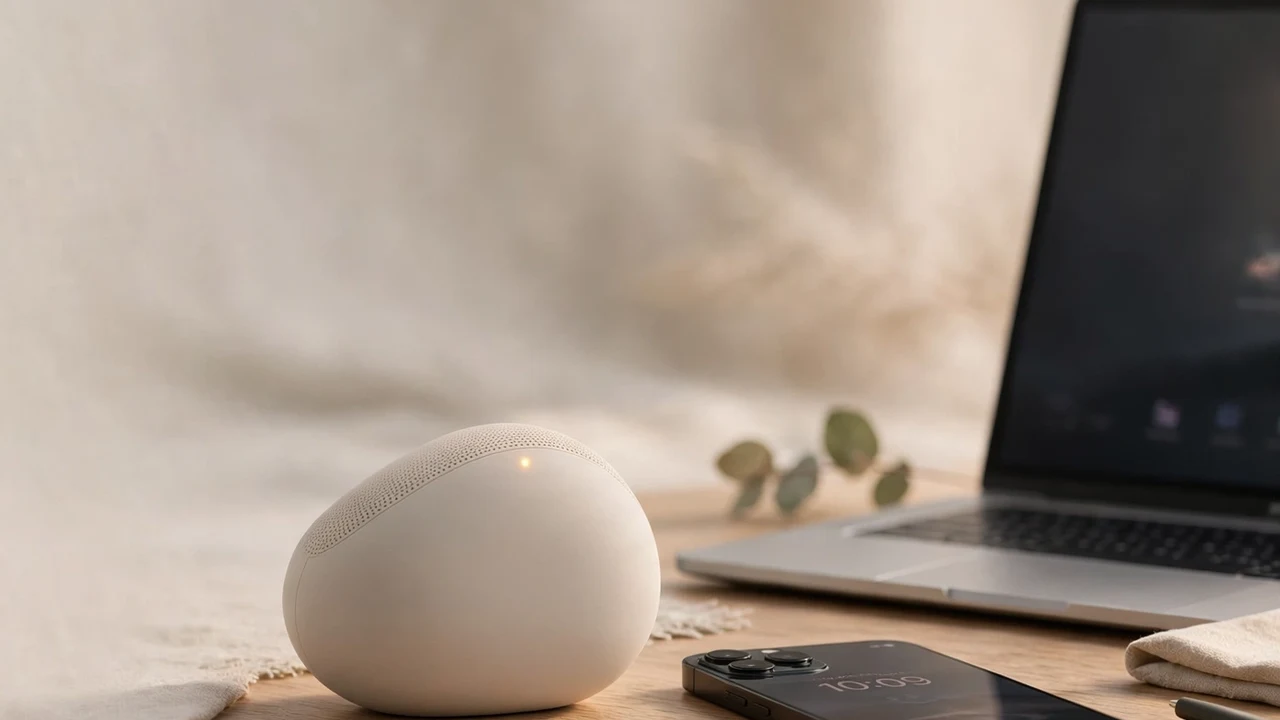
OpenAI has not shown the device or confirmed its form factor, so the honest answer is that nobody outside the company knows for sure. What can be said is what it is designed to do: understand the user’s environment and life, respond without demanding screen attention, and sit naturally in a pocket or on a desk. Reports from October 2025, attributed to the Financial Times, described OpenAI working on a screenless device roughly the size of a palm that “receives audio and visual signals and responds to user requests” — a description consistent with a smart-speaker-like product, though OpenAI has not confirmed that characterization.
Separately, a January 2026 leak from the Weibo tipster known as Smart Pikachu claimed OpenAI is developing an audio product to replace AirPods, internally codenamed “Sweetpea,” with an egg-shaped case and two capsules worn behind the ear, powered by a smartphone-class chip. That report should be treated as rumor, not confirmation: it comes from a single leaker, and OpenAI has not acknowledged the project. It is also possible that multiple device efforts exist in parallel — the same leak claimed Foxconn had been told to prepare for five devices by the fourth quarter of 2028. The safest reading is that OpenAI’s hardware ambitions extend well beyond one product, whatever form the first one takes.
Why “Not a Phone” Matters
The insistence that the device is not a phone, glasses, or wearable is a deliberate positioning choice. The graveyard of AI hardware is crowded: the Humane AI Pin and the Rabbit R1 both launched to enormous hype in 2024 and both stumbled, largely because they duplicated what a smartphone already does, poorly. By promising something that is not a phone replacement, OpenAI is trying to avoid that trap — the device must earn its place by doing something a phone cannot, or by doing it so unobtrusively that the phone stays in the pocket.
Whether that is achievable is the open question. A device that “fully understands the user’s environment and life” raises obvious privacy questions: always-on audio and visual sensing is a far bigger ask than a voice assistant that wakes on a keyword. OpenAI will need to answer those questions convincingly — on-device processing, clear indicators, and user control — before mainstream buyers trust a screenless companion in their homes and pockets.
OpenAI’s First Device vs. Past AI Gadgets
| OpenAI device (planned) | Humane AI Pin | Rabbit R1 | |
|---|---|---|---|
| Announced / launched | Unveil planned H2 2026 | 2024 | 2024 |
| Form factor | Not a phone, glasses, or wearable; pocket/desk-sized | Clip-on pin with laser projector | Handheld pocket gadget |
| Design lead | Jony Ive (ex-Apple) | Ex-Apple designers | Teenage Engineering |
| Core pitch | Ambient AI that understands your environment | Screenless AI assistant | AI that operates apps for you |
| Price model | Unknown | $699 + $24/month subscription | $199, no subscription |
| Outcome so far | Not yet unveiled | Discontinued; assets sold to HP | Niche product, limited traction |
| Key lesson for OpenAI | Must do something a phone cannot | Subscription + weak performance killed it | Novelty wore off fast |
Ads Are Coming to ChatGPT, Too
The device news arrived alongside a second monetization shift. On January 16, 2026, OpenAI announced it would begin testing ads in the free ChatGPT tier and the low-cost Go tier in the coming weeks. The company published principles for the experiment: responses will not be influenced by commercial content, ads will always be placed separately and clearly labeled, and conversations will not be accessible to advertisers. There will be no ads in the Plus, Pro, Business, or Enterprise plans, and Altman has said he wants paid messages to be genuinely useful rather than intrusive.
The logic is straightforward. OpenAI’s chief financial officer, Sarah Friar, wrote in a 2026 blog post that the year would be one of “practical implementation” — bridging the gap between what AI can do and how people, companies, and countries actually use it. The company’s computing capacity grew from 0.2 gigawatts in 2023 to 1.9 gigawatts in 2025, while annual revenue rose from $2 billion to over $20 billion. That growth is unprecedented, Friar argued, but it is also expensive: “Ensuring computational capacity requires commitments made years in advance.” Ads in the free tier and a hardware line are two ways to pay for that capacity without raising prices on paying users.
Skeptics, meanwhile, note that despite revenue above $20 billion, OpenAI remains unprofitable, and that the industry’s massive data-center investments are drawing bubble warnings. The device and ads bets are therefore not just product decisions — they are tests of whether the AI business model can scale beyond subscriptions and API fees.
What to Watch Next
Three things will define how this story develops. First, the unveiling itself: the form factor, the price, and above all the privacy story. If the device requires always-on sensing, OpenAI’s explanation of what stays on-device will matter more than any spec sheet. Second, availability: Lehane’s wording leaves open whether buyers can actually purchase the device in 2026 or whether the unveiling is a preview of a 2027 product. Third, the ads experiment: if free-tier users tolerate clearly labeled, separated ads, OpenAI gains a revenue stream that subsidizes free access; if users revolt, the company may have to rethink the balance between growth and trust.
For now, the most important fact is the timetable. After more than a year of silence since the io acquisition, OpenAI has put a date range on its first device: the second half of 2026. The AI hardware race — quiet since the failures of 2024 — is about to get its most serious entrant yet.
The Privacy Question OpenAI Must Answer
Every ambient AI device faces the same hurdle: trust. A gadget designed to understand your environment must, by definition, sense it — through microphones, cameras, or both. Past attempts handled this poorly or opaquely, and consumers noticed. The Humane AI Pin’s always-available assistant raised immediate questions about when it was listening; the Rabbit R1’s reliance on cloud processing for basic tasks raised questions about where data went. OpenAI’s device will face sharper scrutiny than either, because OpenAI’s products are used by hundreds of millions of people and because the device is explicitly pitched as understanding “your environment and life.”
What a convincing answer looks like is fairly well established by now: on-device processing for routine sensing, with cloud processing only for tasks the user explicitly requests; a physical, unambiguous indicator when sensors are active; a hardware mute that cannot be overridden by software; and plain-language data controls that let users review and delete what was captured. Apple set a useful precedent with on-device Siri processing and the orange and green indicator dots on iPhones. OpenAI will need something at least that clear — and ideally better, since a screenless device cannot show an indicator dot at all. Expect the unveiling to spend significant time on this topic; if it does not, that silence will itself be the story.
The Business Case: Why Hardware, Why Now
OpenAI’s timing is not accidental. The company sits at an unusual intersection: enormous user growth, revenue above $20 billion, and persistent unprofitability driven by compute costs. Subscriptions alone may not close that gap, especially while a huge free tier consumes expensive inference. Two new revenue paths change the math. Advertising in the free tier monetizes users who will never pay, following the playbook that funded the consumer internet. Hardware monetizes the most engaged users directly, and — crucially — gives OpenAI a distribution channel it controls, rather than one rented from Apple and Google.
That distribution point is easily underestimated. Today, ChatGPT reaches most users through apps running on Apple and Google platforms, both of which take a cut and set the rules. A successful OpenAI device would be the company’s first direct relationship with users at the hardware layer, similar to how the iPhone secured Apple’s platform position or how the Echo secured Amazon’s place in the home. The ambition Altman described — a line of devices comparable to an ecosystem — only makes sense in that light. The risk is equally large: hardware is brutally unforgiving, with inventory, returns, and support costs that software companies routinely underestimate. Google’s own uneven hardware history is a cautionary tale.
Timeline: How OpenAI Got Here
| Date | Milestone |
|---|---|
| May 2025 | OpenAI acquires io, Jony Ive’s hardware startup; Altman previews device plans to employees, including a 100-million-unit ambition |
| October 2025 | Reports describe a palm-sized screenless device receiving audio and visual signals |
| January 2026 | OpenAI announces ads testing in free and Go tiers; Smart Pikachu leak claims an audio “Sweetpea” product and five Foxconn devices by Q4 2028 |
| 2026 | CFO Sarah Friar calls 2026 a year of “practical implementation”; compute grows to 1.9 GW, revenue passes $20 billion |
| H2 2026 | First device unveiling planned, per Chris Lehane to Axios; purchase availability unconfirmed |
Frequently Asked Questions
When will OpenAI’s first device launch?
OpenAI is “on track” to unveil its first device in the second half of 2026, according to global affairs chief Chris Lehane in a conversation with Axios. It is not yet clear whether the device will be available to purchase in 2026.
What will OpenAI’s device look like?
OpenAI has not shown the device. It is described as unobtrusive, able to fit in a pocket or sit on a desk, and designed to understand the user’s environment and life. It will not be a phone, glasses, or a conventional wearable, according to Altman and Jony Ive.
Who is designing OpenAI’s device?
Former Apple design chief Jony Ive, through the startup io, which OpenAI acquired in May 2025. Altman has said a whole line of devices is planned, comparable to Apple’s ecosystem.
Will ChatGPT have ads?
Yes, in testing: OpenAI announced on January 16, 2026 that it would test ads in the free and Go tiers. Ads will be separate, clearly labeled, and will not influence responses or expose conversations to advertisers. Plus, Pro, Business, and Enterprise plans remain ad-free.
Why is OpenAI making hardware at all?
To create a new kind of ambient AI product beyond the phone, and to diversify revenue as computing costs scale. OpenAI’s compute capacity grew from 0.2 GW in 2023 to 1.9 GW in 2025, while revenue passed $20 billion — but the company remains unprofitable, making new revenue streams strategically important.