
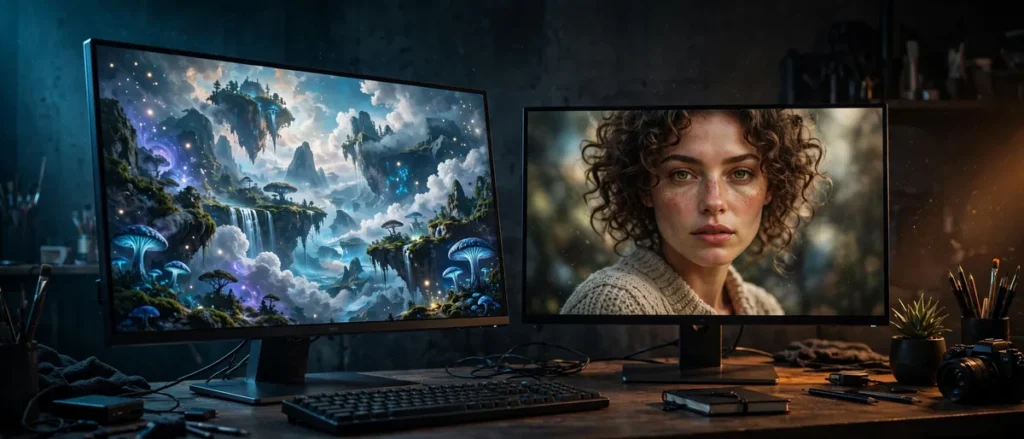
The AI image wars entered a new phase when Flux arrived. Midjourney had owned the aesthetic crown for years — its dreamlike, cinematic images defined what “AI art” looked like. Then Black Forest Labs’ Flux models showed up with a different superpower: stunning photorealism, excellent prompt adherence, and — shockingly — readable text inside images. The Midjourney vs Flux debate is now the central question in AI image generation: beauty or accuracy?
Midjourney remains the artist’s choice: an aesthetic engine that turns prompts into gallery-worthy images with a distinctive, coveted style. Flux is the technician’s choice: open-weights models (runnable locally!) that follow prompts literally, render text correctly, and produce photorealistic images that fool professionals.
We generated 150 images on each — portraits, landscapes, text-heavy designs, photorealistic scenes, and artistic experiments — scoring beauty, accuracy, and usability. Here is the complete Midjourney vs Flux verdict.
Midjourney vs Flux at a Glance
| Midjourney | Flux | |
|---|---|---|
| Core strength | Unmatched aesthetic beauty | Photorealism + prompt accuracy |
| Artistic style | Distinctive, cinematic, coveted | Versatile, neutral, realistic |
| Text in images | Improved, still unreliable | Excellent — readable text |
| Photorealism | Good (stylized) | Best in class |
| Open weights | No (proprietary) | Yes (run locally) |
| Ease of use | Web app, moderate learning curve | Via apps/APIs (varied UX) |
| Starting price | ~$10/month | Free options; ~$10/month via apps |
| Best for | Artistic/hero images | Realistic images, text graphics |
Bottom line: pick Midjourney for the most beautiful AI images. Pick Flux for photorealism, accurate text, and literal prompt following.
How We Tested Midjourney vs Flux
Our Midjourney vs Flux protocol stressed both beauty and accuracy:
- 150 images per platform across five categories: portraits (30), landscapes (30), text-in-image designs (30), photorealistic scenes (30), artistic experiments (30).
- Blind beauty panel: 12 evaluators rated randomized pairs on visual appeal.
- Accuracy audit: for 50 complex prompts, scored whether requested elements, text, and compositions actually appeared.
- Photorealism test: 20 Flux/Midjourney “photos” shown to 15 people — “real or AI?” with confidence ratings.
- Workflow test: generating, iterating, and exporting finished assets, timed.
Flux was tested via leading hosted apps and API interfaces at top quality settings; Midjourney via its web app.
Round 1: Pure Beauty — The Blind Test
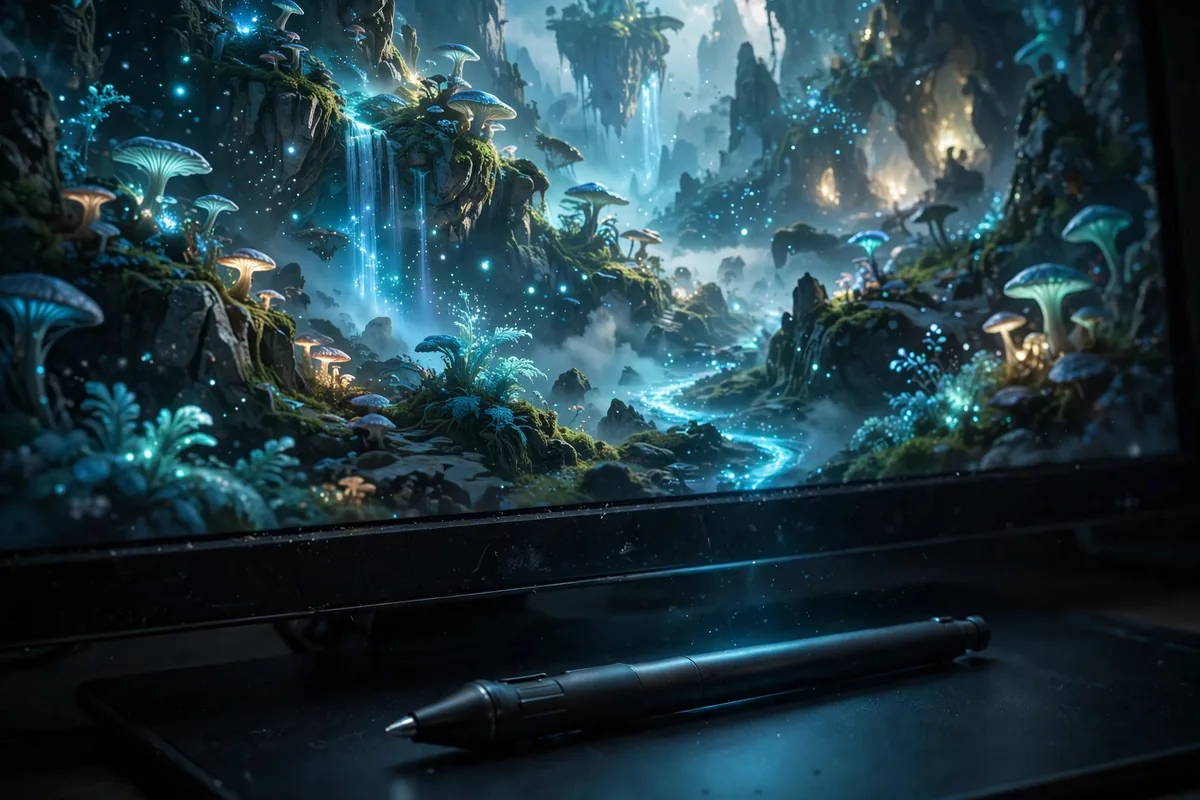
The classic Midjourney vs Flux question: which makes more beautiful images?
Midjourney won the blind beauty panel: preferred in 64% of matchups. Its images have a quality evaluators struggled to articulate but consistently recognized — richer color grading, more dramatic light, compositions that feel intentional. For artistic, fantasy, and stylized imagery, Midjourney’s aesthetic engine remains unmatched. One evaluator, a professional photographer, said Midjourney’s best landscapes “look like they were shot by someone with taste.”
Flux’s images are beautiful too — preferred in 36% of matchups — but beautiful in a different way: clean, accurate, realistic rather than dreamy. Where Midjourney paints, Flux photographs. For evaluators who preferred realism, Flux won; for those who preferred artistry, Midjourney dominated.
Round 1 winner: Midjourney. Still the beauty champion.
Round 2: Photorealism — Fooling the Eye
The Midjourney vs Flux photorealism test had a clear winner.
We showed 20 AI “photos” (10 per platform) to 15 people, asking “real or AI?” Flux fooled them dramatically better: its images were judged “real” 58% of the time, versus 31% for Midjourney. Flux’s skin textures, natural lighting, and photographic imperfections (slight noise, realistic depth of field) read as authentic. Midjourney’s images, while gorgeous, have a tell — a certain polished perfection, overly smooth skin, and cinematic grading that signals “generated” to experienced eyes.
For thumbnails needing “real photo” energy, product mockups, and realistic scenes, Flux is in a different league. This is also why Flux dominates AI influencer and virtual photography workflows — its output passes casual inspection.
Round 2 winner: Flux, decisively. The photorealism king.
Round 3: Text Rendering — Words Inside Images
The Midjourney vs Flux text test was the most lopsided round.
We prompted 30 text-heavy designs: logos with taglines, posters with headlines, memes, infographics, book covers. Flux rendered the requested text correctly in 26 of 30 — including multi-word phrases, varied fonts suggested by style prompts, and correct spelling. This capability unlocks entire use cases (ad creatives, thumbnails with titles, social graphics) that were impossible with earlier image models.
Midjourney managed correct text in 11 of 30 — dramatically improved from its early gibberish days, but still unreliable for production text work. Short words often work; phrases usually do not. For any design where the words matter, Midjourney remains a gamble.
Round 3 winner: Flux, by a landslide. Readable text changes what AI images are for.
Creators making text-heavy thumbnails should also see our ChatGPT vs Claude writing comparison for pairing great copy with Flux’s text rendering.
Round 4: Prompt Adherence
“a red bicycle leaning against a blue door, cat sleeping in the basket, sunset” — the Midjourney vs Flux literalism test across 50 complex prompts.
Flux scored 41 of 50 — exceptional adherence. Requested elements appeared, colors matched, compositions followed instructions. Its literalism makes it predictable: what you prompt is what you get, which is exactly what production work needs.
Midjourney scored 33 of 50 — but again with the artistic asterisk. Its deviations were often gorgeous: the bicycle became a vintage racer, the scene gained cinematic fog nobody asked for. Artists love this; art directors specifying exact compositions do not.
Round 4 winner: Flux. Literal, predictable, production-friendly.
Round 5: Open Weights and Flexibility
The Midjourney vs Flux philosophical divide: proprietary service versus open ecosystem.
Flux’s open weights are revolutionary: download the models, run them locally (with sufficient GPU), fine-tune on your style, integrate into your pipeline via API, and never pay per image. For developers, studios, and privacy-conscious users, this is transformative — your image generation is infrastructure you own. The ecosystem of Flux fine-tunes (LoRAs for styles, characters, products) is enormous and growing.
Midjourney is a polished proprietary service: no local running, no fine-tuning, generations metered by subscription. What you lose in flexibility you gain in simplicity — it just works, beautifully, with zero setup. For most creators, the service model is fine; for builders, Flux’s openness wins.
Round 5 winner: Flux. Open weights change the economics and possibilities.
Round 6: Ease of Use and Pricing
The practical Midjourney vs Flux round:
Ease of use: Midjourney’s web app is polished and unified — one interface, consistent experience, growing editing tools. Flux’s UX depends on where you access it: hosted apps range from excellent to confusing, and local running demands technical skill. For pure simplicity, Midjourney wins; for flexibility, Flux’s ecosystem offers more options.
Pricing:
| Midjourney | Flux | |
|---|---|---|
| Free options | None | Yes (local running, free tiers on apps) |
| Entry paid | ~$10/month | ~$10/month via hosted apps |
| High volume | Tiered plans | Local running = free unlimited |
Flux can be genuinely free forever if you run it locally — unmatched value for high-volume users with GPUs. Midjourney’s $10 entry is fair for its quality, but there is no free path.
Round 6 winner: Split. Midjourney for simplicity; Flux for free/local value.
Business document creators should check our AI business documents guide — Flux’s text rendering is a secret weapon for visual business content.
Midjourney vs Flux: Side-by-Side Comparison
| Feature | Midjourney | Flux |
|---|---|---|
| Blind beauty preference | 64% | 36% |
| “Fooled as real photo” rate | 31% | 58% |
| Text rendering accuracy | 11/30 | 26/30 |
| Prompt adherence | 33/50 (artistic) | 41/50 (literal) |
| Open weights | No | Yes |
| Free option | No | Yes (local/free tiers) |
| Ease of use | Polished, unified | Varies by app |
| Entry price | ~$10/mo | ~$10/mo (or free) |
| Best for | Artistic beauty | Realism, text, accuracy |
Who Should Pick Midjourney?
Choose Midjourney if:
- Beauty is the goal. Art prints, hero images, and portfolio pieces deserve its aesthetic.
- You want simplicity. One polished app, zero setup, gorgeous results.
- You create artistic content. Fantasy, stylized, and cinematic imagery is its domain.
- You value curation. Its community and style ecosystem inspire.
Midjourney is at midjourney.com — the web app onboards in minutes.
Who Should Pick Flux?
Choose Flux if:
- You need photorealism. Virtual photography, realistic mockups, and believable scenes.
- Text matters. Thumbnails, ads, and graphics with readable words.
- You want control. Literal prompt following for production work.
- You build. Open weights, local running, and API integration for developers.
- You want free. Local Flux costs nothing per image.
The Final Score
- Beauty: Midjourney
- Photorealism: Flux
- Text rendering: Flux
- Prompt adherence: Flux
- Open weights: Flux
- Ease/pricing: Split
Overall winner: Flux — 4 to 1 with one split. On capabilities that matter for production — realism, text, accuracy, openness, and cost — Flux wins decisively in 2026.
But Midjourney’s beauty crown is real and valuable: for artistic work where the image itself is the product, nothing touches it. The Midjourney vs Flux choice, like all mature tool decisions, is about the job: Flux for production reality, Midjourney for artistic transcendence. Most serious creators now use both — and the combination is unstoppable.
Midjourney vs Flux: Speed, Iteration, and the Creative Loop
An underrated Midjourney vs Flux dimension is iteration velocity — how fast you go from vague idea to finished image. Midjourney’s interface is optimized for exploration: generate four variations, pick the best direction, vary and refine, all in a tight loop that feels like collaborating with an art director. The variation system is its secret weapon for creative discovery — you often find a better image than the one you imagined, three variations deep.
Flux’s iteration depends on the host app, but the best ones offer inpainting, outpainting, and img-to-img refinement that Midjourney’s variation system cannot match for precision. Need to fix just the hands? Inpaint them. Extend the background? Outpaint it. This surgical iteration suits production work where the tenth version must match the brief exactly.
The creative loop difference reflects the philosophy split: Midjourney optimizes for happy accidents and aesthetic discovery, Flux for deliberate execution. Exploratory artists iterate faster in Midjourney; production designers iterate more precisely in Flux. Neither loop is universally better — but knowing which one your task needs saves hours. The fastest creators we observed used Midjourney’s variations for concepting, then Flux’s inpainting for final polish — the hybrid loop again proving stronger than either alone.
FAQ
Is Midjourney or Flux better for beginners?
Midjourney — one polished app, no setup decisions, and a community that teaches prompt craft. Flux’s best experiences require choosing a host app (or local setup), which confuses newcomers. Start with Midjourney to learn what great AI imagery looks like; explore Flux when you need its specific strengths like photorealism or text rendering. Both reward experimentation, so the real beginner advice is simple: generate a hundred images on whichever you try first, study what worked, and iterate deliberately.
Can Flux really run on my computer?
With a decent GPU (16GB+ VRAM for full quality, less for quantized versions), yes — the open weights run locally via tools like ComfyUI. It is technical but well-documented, and the payoff is free unlimited generation.
Which is better for YouTube thumbnails: Midjourney vs Flux?
Flux, for most thumbnails — readable title text and photorealistic faces win clicks. Midjourney for artistic/gaming thumbnails where stylized beauty stands out. Many top creators use Flux for text-heavy thumbs, Midjourney for cinematic ones.
Do I own images I generate with Midjourney vs Flux?
Paid Midjourney plans grant commercial rights (check current terms). Flux’s open weights generally allow commercial use, with terms varying by specific model version — verify the license for your use case.
Midjourney vs Flux for print-on-demand merch?
Flux — text rendering makes it viable for typography-based designs, and local running keeps per-design costs at zero. Midjourney for artistic designs where its aesthetic commands premium prices.
Conclusion
The Midjourney vs Flux verdict for 2026: Flux wins on the capabilities reshaping the industry — photorealism that fools professionals, text rendering that unlocks design work, literal prompt following, and open weights that democratize everything. It is the technician’s triumph, and its momentum is undeniable.
Midjourney wins on beauty — still, undeniably, the most gorgeous images AI can produce, with an aesthetic that moves people and defines the medium’s visual culture. In the Midjourney vs Flux era, the wise creator does not choose sides: Flux for the work, Midjourney for the art, and an output that neither could achieve alone.





Join the discussion
Have a question or a perspective to share?