

AI Language Learning Apps: Which Actually Works? (2026)
Language learning apps have promised fluency from your phone for over a decade, and most learners know the familiar arc: enthusiasm for the first two weeks, a growing streak, then a slow fade into abandoned notifications. The new generation of AI language learning apps claims to break that pattern with adaptive lessons, conversational AI tutors, and feedback that responds to your actual mistakes rather than a fixed curriculum. Some of those claims hold up. Many do not. This guide looks honestly at how AI language learning apps work, what “works” actually means for language acquisition, which apps serve which goals, and how to structure your practice so the app becomes a genuine path to progress instead of another streak you eventually ignore.
The short version: AI has meaningfully improved two things — personalized feedback and conversational practice — but no app replaces the hard, unglamorous work of regular exposure and real conversation. The app that works is the one matched to your goal and used consistently. Everything below is designed to help you find that match.
How AI Language Learning Apps Actually Work
Traditional language apps followed a fixed path: every learner saw the same lessons in the same order. AI language learning apps differ in a few specific, important ways:
- Adaptive difficulty. The app tracks which words, grammar points, and sounds you struggle with and serves more practice where you are weak, easing off where you are strong. This is the most widespread AI feature and the most consistently useful.
- Conversational practice. Instead of only tapping multiple-choice answers, you can hold a written or spoken conversation with an AI tutor that corrects mistakes, suggests more natural phrasing, and role-plays scenarios like ordering food or a job interview.
- Speech recognition and pronunciation feedback. You speak into the app, it transcribes and scores your pronunciation, and it highlights specific sounds to fix. Quality varies widely between apps and between languages.
- Personalized review scheduling. Spaced-repetition systems — showing you a word right before you would forget it — are far more efficient than random review. AI refines the timing based on your individual forgetting curve.
- Content generation on demand. Some apps generate practice sentences, dialogues, and quizzes around topics you choose, so practice material never runs out and stays relevant to your interests.
None of this is magic. It is applied cognitive science — spaced repetition, retrieval practice, and corrective feedback — delivered at scale. The apps that work best are the ones that implement these principles well, not the ones with the flashiest marketing.
What “Actually Works” Means in Language Learning

Before comparing apps, it helps to define the target. Language learning research consistently points to a few principles that separate methods that work from methods that merely feel productive:
- Active recall beats passive review. Producing the language from memory — saying or writing the answer yourself — builds far stronger memory than recognizing a correct answer among options.
- Spaced repetition beats cramming. Reviewing material at increasing intervals locks it into long-term memory far better than massed practice.
- Comprehensible input matters. You acquire language by understanding messages slightly above your current level — reading and listening to material you mostly understand.
- Output and feedback close the loop. Speaking and writing, with correction, is what turns passive knowledge into usable skill.
- Consistency beats intensity. Twenty focused minutes daily outperforms a three-hour weekend binge, nearly every time.
Judge every app against these principles. An app can have beautiful design and a charming mascot, but if your sessions are mostly tapping the obviously-correct answer while half-distracted, you are not learning much — and that is true regardless of how much AI is under the hood.
AI Language Learning Apps Compared
The table below compares the main categories and well-known options. Specific features and pricing change frequently, so treat this as a map of the landscape rather than a price list — always check the current offering before subscribing.
| App / approach | Strongest AI feature | Best for | Limitation to know |
|---|---|---|---|
| Gamified course apps with AI tiers | Adaptive practice paths and AI conversation role-play | Beginners building vocabulary and basic grammar habits | Can stay shallow; conversation features may cost extra |
| Structured course apps (Babbel-style) | Speech recognition with pronunciation scoring | Learners who want organized, real-life dialogues | Less open-ended conversation than AI-tutor apps |
| AI tutor and conversation apps | Open-ended spoken and written conversation with corrections | Intermediate learners who need speaking practice | Quality depends on the language; less structured curriculum |
| Flashcard and SRS apps with AI | Optimized review scheduling and auto-generated cards | Vocabulary building at any level | Vocabulary alone does not make you conversational |
| Immersion and audio-first programs | Adaptive listening exercises and shadowing practice | Listening comprehension and accent | Slower visible progress; demands patience |
| Video and media-based apps | AI-generated quizzes from real video content | Learners who want authentic, interesting input | Better as a supplement than a core method |
What the table tells you
No single category wins. Gamified apps are excellent at getting beginners started and keeping a daily habit alive — habit formation is genuinely half the battle. But learners who stay too long in multiple-choice mode often discover they can read reasonably well while being unable to hold a basic conversation. That gap is exactly where AI conversation features help: they force output, which is the skill most apps historically neglected.
The practical takeaway: your primary app should include real speaking or writing practice with feedback, not just recognition exercises. If your current app does not offer that, add a second tool that does rather than abandoning a habit that is working.
Which AI Language Learning App Works Best for Your Goal
Different goals demand different tools. Here is how to match the app to the outcome you actually want:
If you are a complete beginner
Start with a structured, gamified course app that teaches the writing system, core vocabulary, and basic grammar in small daily sessions. At this stage, consistency matters more than method — the best app is the one you will open every day. Aim for a streak of at least a month before judging whether the method suits you.
If you can read but cannot speak
This is the most common plateau, and it is where AI conversation features earn their keep. Add an AI tutor app for spoken practice: short daily conversations about real topics, with corrections on grammar and word choice. Expect it to feel uncomfortable for the first week — that discomfort is the learning happening.
If you need the language for work or travel
Choose apps with scenario-based content: meetings, presentations, ordering, directions, small talk. Generate or request dialogues around your specific situations — a nurse learning Spanish for patients needs very different vocabulary than a tourist. Supplement with media in the target language: podcasts, shows with subtitles, and news at your level.
If you are preparing for an exam
Use the app for vocabulary and grammar drilling, but get exam-specific practice from materials designed for that test — its format, timing, and scoring quirks. AI can generate practice prompts in the exam’s style, which is genuinely useful, but it cannot replicate test-day pressure. Timed mock sections remain essential.
If you are maintaining rather than learning
Advanced learners often need input more than instruction: podcasts, books, shows, and conversation. An AI tutor for occasional conversation practice plus a flashcard app for new vocabulary encountered in the wild is usually enough. The enemy at this stage is not difficulty but drift — schedule the habit or it quietly disappears.
How to Get Real Results: A Practical System
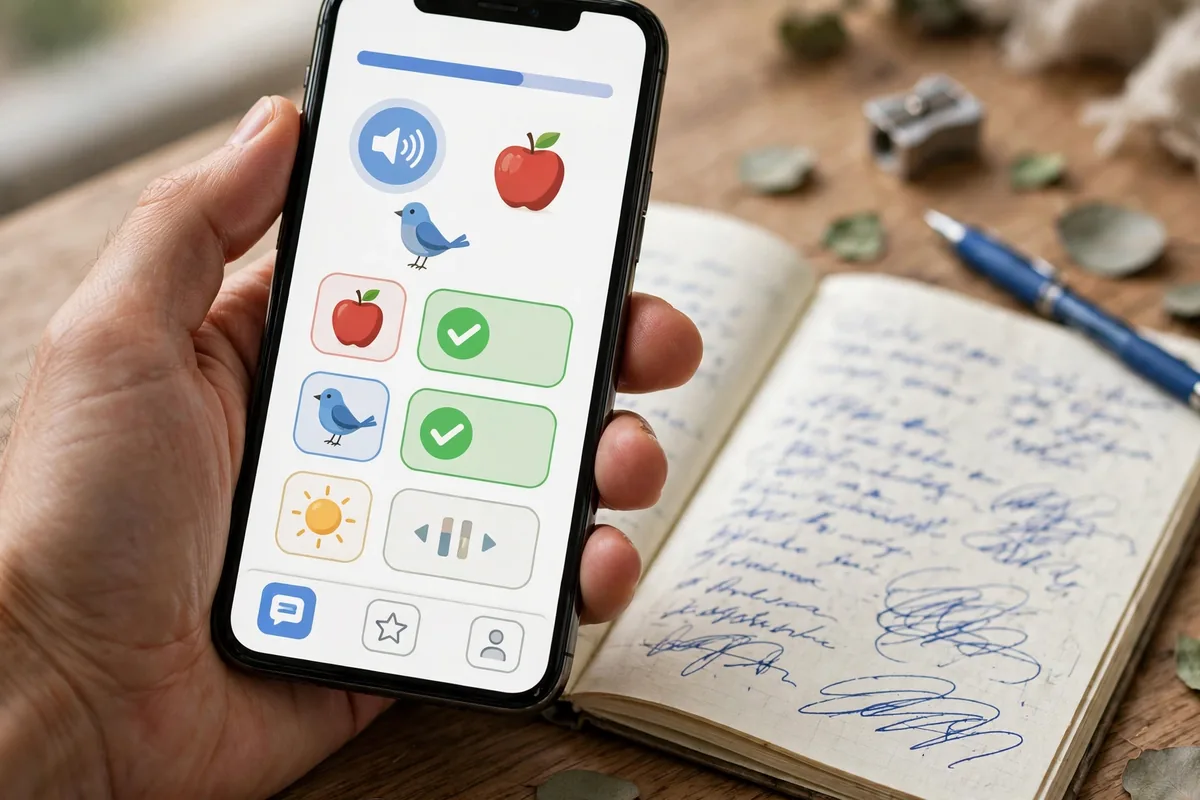
Apps do not teach languages; systems do. Here is a weekly structure that applies the research principles above, using AI language learning apps as components rather than the whole plan:
- Set a concrete, time-bound goal. “Learn Spanish” is a wish. “Hold a five-minute conversation about my weekend in Spanish by June” is a goal. Write it down and tell someone.
- Do twenty to thirty focused minutes daily. Same time each day if possible. Phone on silent, full attention. Half-distracted tapping barely counts.
- Prioritize output from week one. Speak or write something in the language every session, even if it is just three sentences. Use the app’s conversation or speaking features; if it lacks them, talk to yourself out loud describing what you see.
- Review with spaced repetition. Let the app’s SRS handle vocabulary scheduling, and actually do the reviews when they are due. Skipped reviews are the number-one silent killer of progress.
- Add real input weekly. One podcast episode, one video, or a few pages of graded reading in the target language. Input is where vocabulary becomes understanding.
- Get human feedback monthly. AI correction is good; a human tutor or language-exchange partner catches things AI misses — especially naturalness, cultural nuance, and your fossilized errors. Even one session a month helps enormously.
- Measure something real every month. Record yourself speaking for two minutes on the same topic each month and compare. Or retake the app’s placement check. Visible progress sustains motivation through plateaus.
Honest Limitations of AI Language Learning Apps
A balanced view requires acknowledging what these apps still do poorly:
- They can make you feel fluent without making you fluent. Recognition-based exercises create an illusion of competence. If you can only perform inside the app’s exercises, you have app skill, not language skill. Regular real-world testing — actual conversations — is the antidote.
- AI conversation partners are patient in ways humans are not. Real conversation involves interruption, slang, mumbling, and cultural references. AI tutors are excellent practice wheels, not the road.
- Less-common languages get less quality. AI features are typically strongest for widely spoken languages like Spanish, French, and German, and noticeably weaker for languages with fewer digital resources. Check reviews from learners of your specific language.
- Pronunciation feedback has limits. Automated scoring catches clear errors but can miss subtle issues and occasionally penalizes acceptable regional accents. It is a useful guide, not a final judge.
- Subscriptions add up. Premium AI features usually sit behind paywalls, and stacking two or three subscriptions gets expensive. Start with free tiers, upgrade only the one app you use daily, and cancel ruthlessly.
Free vs. Paid: What Is Worth Paying For
Most AI language learning apps follow a familiar model: a genuinely usable free tier, with AI conversation features, unlimited practice, or ad-free experience behind a subscription. The free tier is usually enough to evaluate whether the method suits you — give it two to three weeks of real use before deciding.
What tends to be worth paying for: the specific feature you use every day. If you do AI conversation practice daily, paying for the tier that unlocks it is reasonable. What is not worth paying for: premium features in an app you open twice a week. Be honest about your usage before subscribing, set a calendar reminder before any free trial converts, and remember that one well-used subscription beats three neglected ones.
Frequently Asked Questions

Can AI language learning apps make you fluent?
They can take you a long way — particularly to a solid intermediate level — but fluency in the full sense requires real human interaction and extensive input (reading, listening) beyond what apps provide. Think of apps as the most efficient available training ground, not the entire journey.
How long does it take to learn a language with an app?
It depends on the language’s difficulty, your starting point, and daily time invested. With thirty focused minutes a day, many learners reach basic conversational ability in a widely spoken language within several months, and comfortable intermediate ability within a year or two. Anyone promising fluency in weeks is selling something.
Are AI tutors better than human tutors?
They are better at availability, patience, and price — an AI tutor is there at midnight and never gets tired. Human tutors are better at cultural nuance, naturalness, motivation, and diagnosing your specific fossilized errors. The strongest setup uses AI for daily practice volume and a human for periodic deep correction.
Which AI language learning app is best for speaking practice?
Look specifically for apps built around open-ended conversation with speech input and corrective feedback, rather than apps where speaking means repeating a sentence for a score. Try the conversation feature in a free trial and judge it by one criterion: does it push you to produce original sentences, or just to recognize correct ones?
Do I need more than one app?
Often, yes — but keep it to two. One primary app for your structured daily habit, plus one specialist: a flashcard app for vocabulary, an AI tutor for conversation, or media for input. More than two apps usually means divided attention and abandoned subscriptions.
Is Duolingo’s AI good enough, or should I switch apps?
Gamified apps with AI features are genuinely good at building and sustaining a beginner habit, which has real value. If you have plateaued — you can read but cannot speak, or lessons feel too easy — that is the signal to add or switch to a tool with serious conversation practice, not a signal that apps in general have failed you.
So which AI language learning apps actually work? The honest answer is that several of them work — for the right goal, used with the right system. Pick the app that matches where you are and where you want to go, make output and consistency non-negotiable, test yourself against real conversation regularly, and give it months, not days. The technology has genuinely improved; the deciding factor was never really the app. It is the daily twenty minutes.



Join the discussion
Have a question or a perspective to share?