
For most of history, learning a language meant finding a class, a tutor, or a patient native speaker. AI language learning changes that equation: a tireless conversation partner, a grammar coach, and a vocabulary system available any time you have ten minutes. This guide builds your complete AI language learning routine — practice, grammar, vocabulary, pronunciation, and a daily plan that builds consistency.
How AI Changes the Way Languages Are Learned
Traditional language learning has three persistent bottlenecks. First, speaking practice requires another human, which makes it expensive and scheduling-dependent. Second, feedback is delayed — you write an essay, wait days for corrections, and the learning moment has passed. Third, materials are one-size-fits-all, pitched at an imaginary average learner rather than your actual level and interests.
AI tutors address all three. A conversational AI can roleplay a restaurant order in Spanish at 6 a.m., correct your French subjunctive instantly, and generate reading passages about your actual hobbies at your exact level. Language-learning apps have noticed: Duolingo’s published product updates describe features like Roleplay conversations and Explain My Answer, which use generative AI to simulate dialogue and unpack mistakes. Chat-based AI assistants add open-ended voice conversation in dozens of languages.
The research framing matters here. Second-language-acquisition studies have long emphasized comprehensible input, output practice, and timely corrective feedback as drivers of progress. AI does not replace these principles — it makes them cheaper and more available. Your job is to aim the technology at the right activities, consistently, which is what the rest of this guide is about.
Conversation Practice: Your Always-Available Speaking Partner
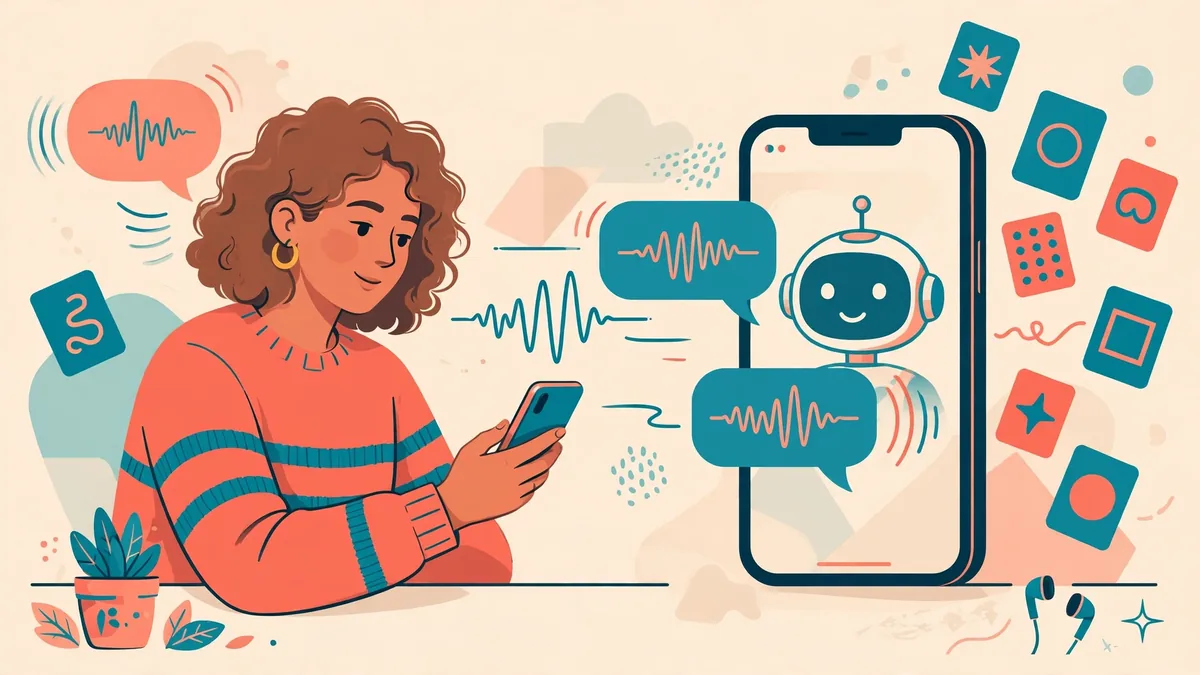
The conversation setup that works: tell the AI your level, your goal, and one rule — “correct me after each response, briefly.” This single instruction turns generic AI language learning chat into deliberate practice. Most AI language learning sessions fail from vagueness, not from bad models.
Speaking is the skill most learners neglect and the one AI improves most dramatically, because it removes the scheduling and embarrassment barriers.
Roleplay Scenarios That Build Real Skills
Generic “chat with me in Spanish” sessions drift. Structured roleplays build transferable skill. Effective scenarios mirror situations you will actually face:
- Transactional: ordering food, checking into a hotel, asking for directions, returning an item.
- Social: small talk at a party, introducing yourself at work, making weekend plans.
- Professional: a job interview, a client call, presenting a project update.
- Problem-solving: a missed flight, a medical appointment, negotiating a bill.
Set the scene explicitly before you start: name your level (“I am an A2 Spanish learner”), assign the AI a role (“you are a hotel receptionist in Mexico City”), and define the goal (“help me check in; correct my major errors afterward, not during”). The last instruction matters — constant mid-conversation correction kills fluency practice. Ask for corrections in a batch at the end, grouped by type.
Voice mode, available in several major AI assistants, is worth using for at least part of your practice. Typing a language and speaking it are different skills; learners who only type are often shocked by how halting their speech is. Even ten minutes of spoken roleplay per session builds the mouth-muscle memory that typing never will.
Setting Up Correction the Right Way
Not all correction is equal. Research on corrective feedback suggests that overwhelming learners with every minor error is counterproductive, while targeted correction of patterns sticks. Configure your AI tutor accordingly:
- Ask it to correct only errors that block understanding, plus one grammar pattern you are currently studying.
- Request the correction format that helps you most: many learners retain more from “here is what you said, here is the natural version, here is why” than from a bare fix.
- Periodically ask for a summary of your recurring mistakes across sessions — this turns scattered corrections into a curriculum.
One more technique: ask the AI to rephrase your correct-but-awkward sentences into what a native speaker would actually say. Textbooks teach grammatical sentences; AI can teach natural ones, including idioms and collocations (“make a decision” rather than “do a decision”) that mark the difference between competent and fluent.
Grammar Explanations on Demand
Grammar is where AI tutors genuinely outperform static resources. A textbook gives one explanation; an AI gives infinite explanations, tuned to your confusion.
The key is asking contrastive questions rather than accepting the first answer. Instead of “explain the Spanish subjunctive,” try “I wrote ‘espero que vienes’ — why is that wrong, and give me three everyday situations where I would need the subjunctive instead of the indicative.” Concrete errors beat abstract requests every time.
Other high-value grammar workflows:
- Minimal pairs: “Show me five sentence pairs where the French imparfait and passé composé change the meaning, with English glosses.”
- Error autopsies: paste a corrected paragraph and ask why each change was made, in plain language.
- Pattern drills: “Give me 15 short sentences using the German dative case after two-way prepositions, increasing in difficulty, and quiz me on them one at a time.”
- Cross-language comparison: “I am an English speaker — what about Japanese particles will feel most alien, and what mental model helps?”
A caveat worth stating plainly: AI grammar explanations are usually right but not always right, especially for less commonly taught languages with smaller training footprints. For high-stakes writing — a thesis, a job application — verify tricky points against a reference grammar or a human teacher. For daily practice, the occasional imperfect explanation is a fair trade for instant, unlimited coaching.
Building a Vocabulary System That Sticks
Vocabulary that sticks: ask for new words in sentences about your life, not generic examples. AI language learning shines at personalization — “give me 10 kitchen words I will actually use” beats any premade deck. Review with spaced repetition, and let AI language learning generate the quizzes.
Vocabulary is a numbers game with a memory problem: adult learners need thousands of words, and most study methods leak. AI helps on both the acquisition and retention sides.
Thematic Word Lists with Example Sentences
Forget alphabetical lists. Ask for vocabulary organized by the situations you care about: “the 40 most useful words for a doctor’s appointment in German, grouped by symptom, body part, and polite phrases, each with an example sentence.” Thematic grouping mirrors how memory works — words learned together in a meaningful context are recalled together.
Always demand example sentences, and always demand them at your level. A beginner needs “I have an appointment tomorrow”; an advanced learner needs “I would like to reschedule my follow-up.” Specify the register too: formal vs. casual variants of the same idea teach you the social dimension most apps ignore.
Spaced Repetition, AI-Assisted
Spaced repetition systems (SRS) like Anki remain the gold standard for retention, and AI makes them dramatically easier to feed. The workflow:
- During reading or conversation practice, flag unknown words instead of stopping to memorize them.
- At session end, ask the AI to build flashcards: target word, your-level example sentence, and — crucially — the sentence you originally saw it in.
- Import into your SRS app of choice and review daily; five to ten minutes beats occasional hour-long cramming.
AI can also generate the sentences your flashcards need. A card with “serendipity — the occurrence of happy discoveries by chance” is forgettable; a card with a vivid, personalized sentence (“Finding that corner bakery on a wrong turn was pure serendipity”) sticks. Ask for memorable, slightly unusual example sentences — the von Restorff effect is real.
Pronunciation and Listening Feedback Workflows
Pronunciation is AI’s weakest area relative to a human tutor, but the workflows below still move the needle — especially for languages with consistent sound-to-spelling rules.
Shadowing with transcripts: have the AI generate a short paragraph at your level on a topic you like, then use text-to-speech (built into most AI assistants and language apps) to hear it. Listen, repeat simultaneously while reading, then repeat from memory. Shadowing trains rhythm and intonation, not just individual sounds.
Minimal-pair drilling: ask for word pairs that differ by one sound (“ship/sheep,” “pain/pen” for English learners) and practice distinguishing and producing them. For tonal languages, ask for tone-pair drills with the AI describing the pitch contour in words before you attempt them.
Dictation practice: play AI-generated audio one sentence at a time and transcribe it. This trains the ear-to-brain pipeline that classroom learners often underdevelop. Start slow, increase speed as accuracy improves.
Recording comparisons: record yourself reading a passage, then ask the AI (in text) to explain which sounds learners from your native language typically struggle with in the target language. This does not replace acoustic analysis, but knowing that English speakers devoice final consonants in German, for example, tells your ear what to listen for in your own recordings.
Be realistic: current AI cannot hear your accent the way a trained phonetician can, though multimodal models are improving. For accent-critical goals (acting, interpreting), budget for human coaching; for everyday intelligibility, these workflows suffice.
AI Language Learning: A Daily Routine That Builds Consistency
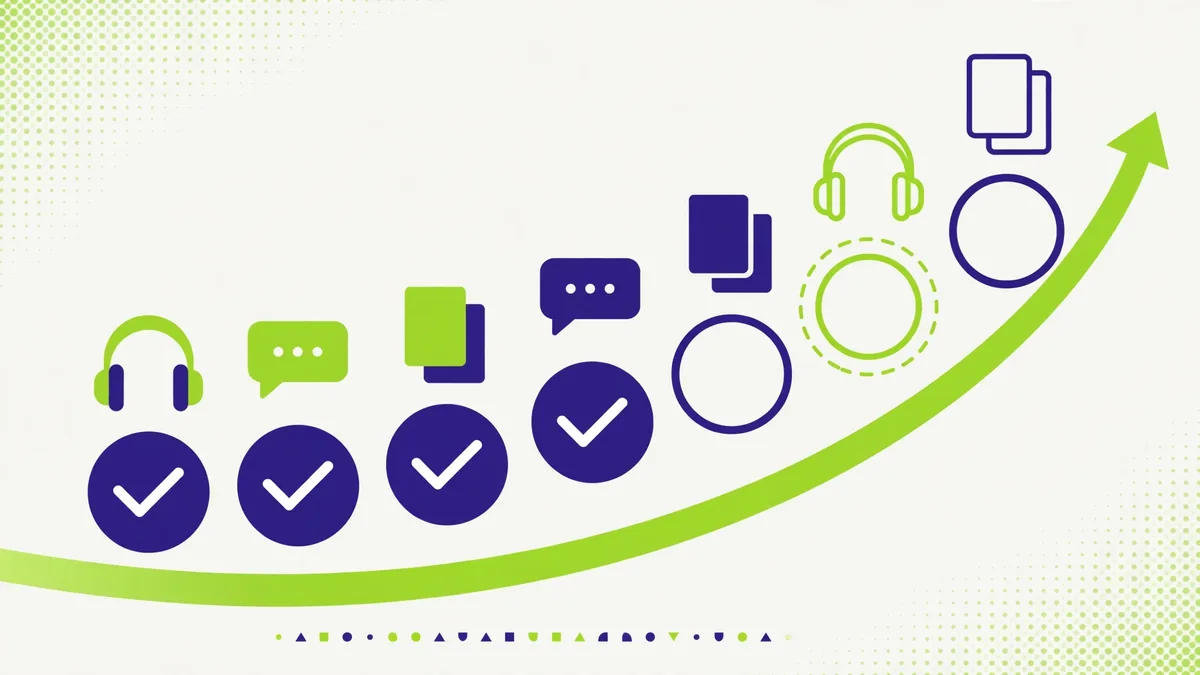
The 20-minute daily minimum: consistency beats intensity in AI language learning. Ten minutes of conversation plus ten minutes of review, every day, outperforms a weekly three-hour cram. Set a recurring reminder — AI language learning only works if you actually show up.
The best method is the one you actually do. Language acquisition research consistently finds that distributed daily practice outperforms intensive bursts. Here is a sustainable template:
The 20-Minute Daily Template
- Minutes 0–5: SRS review. Clear your flashcard queue. Non-negotiable — this protects everything you have learned.
- Minutes 5–12: Output practice. One spoken roleplay or three written sentences using today’s grammar target. Produce language, do not just consume it.
- Minutes 12–17: Input. Read or listen to AI-generated material slightly above your comfort level — the “i+1” sweet spot where you understand most but stretch a little.
- Minutes 17–20: Capture. Log new words for tomorrow’s flashcards and note one recurring error to watch.
A Sample Weekly Plan
- Monday–Friday: the 20-minute template, rotating the roleplay scenario daily.
- Saturday: a longer 45-minute session — a deep roleplay, a grammar deep-dive on your weakest pattern, and a writing task (a journal entry or email) with full correction.
- Sunday: light input only — a podcast, a show, or an article. Rest is part of training.
Track streaks if they motivate you, but track output volume if you want honesty: minutes spoken per week is the metric most correlated with speaking gains, and it is the metric most learners avoid measuring.
Limits: What AI Cannot Do for You
Honesty requires stating the boundaries. AI cannot give you the cultural intuition that comes from real human interaction — humor, irony, and social calibration are learned from people. It cannot replicate the pressure of a real conversation where misunderstanding has consequences, which is why periodic human practice (tutors, language exchanges, travel) remains irreplaceable.
AI also inherits training-data biases: it is strongest in widely spoken languages and weakest in low-resource ones. If you are learning a language with limited digital presence, expect thinner explanations, fewer idioms, and more errors — and lean harder on human speakers and published materials.
Finally, AI cannot supply motivation. It will happily drill you at 6 a.m., but it will never make you open the app. Pair the technology with a real goal — a trip, a relationship, a job — because “someday fluent” sustains nobody.
Keep Exploring These Guides
If you found this ai language learning walkthrough useful, these related guides go deeper on adjacent workflows:
- AI for Teachers: A Practical Classroom Guide
- What Are the Best AI Tools? A Use-Case-First Guide for 2026
Frequently Asked Questions
Can AI replace a human language tutor?
For structured practice, grammar explanation, and vocabulary building, AI now covers a remarkable amount of what tutors traditionally did — at a fraction of the cost. It cannot replace humans for cultural nuance, accent coaching at advanced levels, or the motivational accountability of a real relationship. The strongest setup for most learners is AI for daily volume plus periodic human sessions for calibration.
How much time per day should I spend practicing with AI?
Twenty to thirty focused minutes daily beats two hours once a week — distributed practice is one of the most robust findings in learning science. If you have more time, add input (reading, listening) rather than more drilling; comprehension fuels production.
Which languages work best with AI tutors?
Widely spoken languages with large digital footprints — Spanish, French, German, Mandarin, Japanese, English — get the most accurate corrections, the richest idioms, and the best voice support. Less commonly taught languages work for structured practice but deserve extra verification of grammar explanations against published references.
How accurate are AI grammar corrections?
For major languages at beginner-to-intermediate levels, corrections are generally reliable for common patterns. Accuracy degrades with rare constructions, highly idiomatic usage, and low-resource languages. Treat AI as a first-pass editor: excellent for practice, insufficient as the sole authority for high-stakes writing.
Should beginners use AI, or wait until intermediate level?
Beginners benefit enormously — arguably more than anyone — because AI supplies the patient, judgment-free repetition that early stages demand. The key is constraining the AI to your level: explicitly state “I am a complete beginner” and ask for simple sentences and English explanations. Unconstrained, AI defaults to complexity that overwhelms newcomers.
Can AI language learning make you fluent alone?
It can take you far — to solid conversational ability — but real fluency still needs human interaction. AI language learning handles the 80%: daily practice, corrections, and vocabulary. The final 20% — cultural nuance, slang, thinking in the language — comes from real conversations. Use AI language learning as your daily training ground, not your only one.
Conclusion
AI for language learning works best as a system, not a novelty: structured roleplays for speaking, contrastive questions for grammar, SRS-fed vocabulary from real encounters, shadowing and dictation for the ear, and a short daily routine that compounds. Respect the limits — verify tricky grammar, seek human interaction for culture and pressure, and anchor everything to a goal that matters to you. Do that, and the always-available tutor in your pocket becomes what no app alone can be: a genuine path to fluency. Start your AI language learning 7-day plan tomorrow morning — day one takes twenty minutes.





Join the discussion
Have a question or a perspective to share?