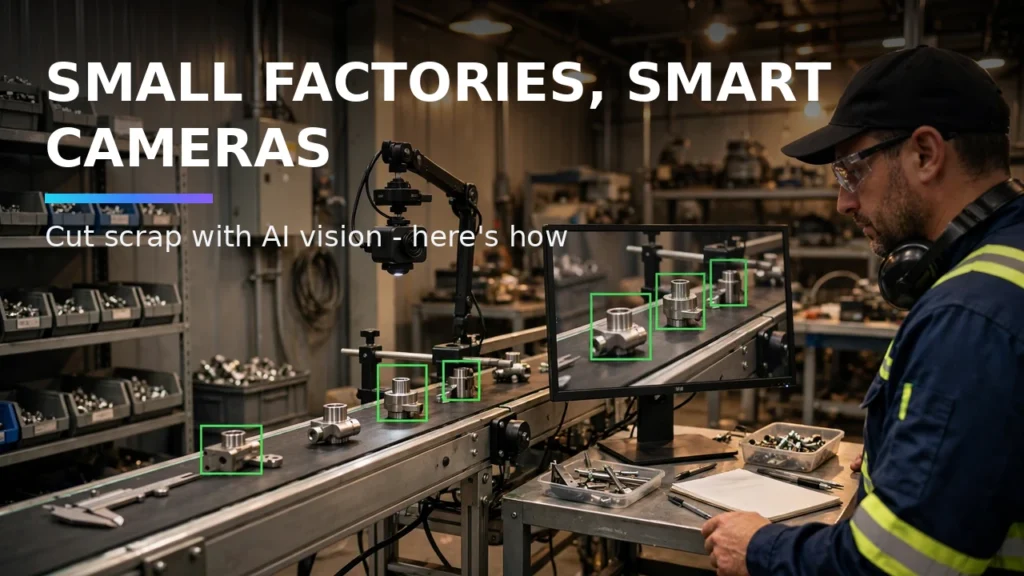
For decades, automated visual inspection and advanced robotic sorting were luxuries reserved exclusively for multi-billion-dollar automotive conglomerates, semiconductor fabrication cleanrooms, and massive consumer electronics manufacturing plants. Small-to-mid-sized manufacturers (SMMs)—the precision machine shops, custom metal fabricators, regional injection-molding facilities, and boutique food packaging plants that form the backbone of the industrial economy—were priced out. Installing a legacy computer vision system required six-figure capital expenditures for proprietary industrial cameras, complex custom programmable logic controller (PLC) programming, and retaining specialized systems integration consultants whose retainers drained small operational budgets.
In 2026, the industrial automation landscape has undergone a radical democratization. Driven by the convergence of low-cost industrial edge computing modules (such as NVIDIA Jetson Orin and Raspberry Pi 5 AI kits), synthetic training data generation, and no-code/low-code vision AI platforms, small factories are deploying computer vision systems in days rather than quarters. Today, a 30-person machining shop can automate 100% of its final quality control inspections for less than the cost of a single factory worker's monthly wages. Based on verified manufacturing case studies, industrial hardware benchmarks, and operational ROI data, this in-depth editorial report reveals exactly how small factories are utilizing computer vision AI to compete with global manufacturing giants in 2026.
Industrial Computer Vision in 2026: Small Factory Applications
To demonstrate the practical ways small manufacturing facilities deploy vision AI across the production floor, the structured matrix below outlines core industrial use cases, typical hardware implementations, and measured operational outcomes. Note that industrial hardware pricing, lens configurations, and edge compute module costs vary; prices may change — check official site on industrial automation distributors before purchasing.
Manufacturing Use Case | Vision AI Technology | Typical Hardware Setup | Defects & Anomalies Detected | Measurable Operational Impact |
Automated Surface Defect Inspection | Unsupervised visual anomaly detection (Autoencoders, PatchCore) | Overhead industrial GigE camera + ring light + NVIDIA Jetson edge box | Scratches, microscopic cracks, surface pitting, uneven paint coating | Reduces customer return rates (RMA) by up to 88% |
Assembly & Missing Component Verification | Real-time object detection and spatial keypoint tracking (YOLOv10/v11) | Workstation-mounted webcams or USB3 industrial sensors | Missing O-rings, unseated screws, misplaced wiring harnesses, inverted brackets | Prevents defective assemblies from proceeding down the production line |
Packaging, Barcode & OCR Verification | High-speed optical character recognition (OCR) + boundary segmentation | Conveyor belt optical trigger + high-speed global shutter camera | Smudged lot numbers, illegible expiration dates, crooked product labels | Eliminates manual label spot-checks at 300+ units per minute |
Worker Safety & PPE Compliance | Edge-based pose estimation and bounding box classification | Standard factory ceiling-mounted IP security cameras (RTSP feed) | Workers entering active robotic zones without hardhats, goggles, or hi-vis vests | Triggers automated safety audio alarms and stops machinery instantly |
Inventory & Raw Material Ingestion | Volumetric 3D depth estimation + material segmentation | Stereo-depth cameras (Intel RealSense / OAK-D) at loading bays | Counting lumber stacks, assessing metal sheet gauges, measuring raw bin volume | Automates real-time ERP inventory reconciliation with zero manual counting |
1. Zero-Defect Surface Inspection Without Massive Datasets
The single greatest historical barrier to vision AI for small job shops was the "defect paradox." Traditional machine learning models required thousands of images of broken parts to learn what a defect looked like. But in a high-precision CNC machine shop that prides itself on 99.5% quality, producing 5,000 defective aerospace brackets just to train an AI algorithm was economically unthinkable.
One-Class Anomaly Detection and Few-Shot Learning
Modern industrial computer vision in 2026 relies on unsupervised anomaly detection frameworks, such as PatchCore and vision-transformer autoencoders. Instead of needing thousands of defect photos, these algorithms only need 50 to 100 photos of perfect, flawless parts. The AI learns the exact mathematical distribution of a normal surface finish, tool path pattern, and dimensional outline. When a freshly machined component passes beneath the inspection camera with a 0.2mm scratch, an un-deburred edge, or a porosity pit, the AI flags it immediately as a statistical anomaly. Small factories can train and deploy a custom inspection model for a new client run in under two hours.
2. Pocket-Sized Edge Compute: Moving AI to the Conveyor Belt
In high-speed manufacturing, transmitting high-resolution 4K video feeds from dozens of factory conveyor belts to cloud servers is impractical. Latency is too high to trigger physical pneumatic rejection arms, cloud bandwidth fees quickly become exorbitant, and factory internet outages would halt production lines entirely.
The Rise of Industrial Edge AI
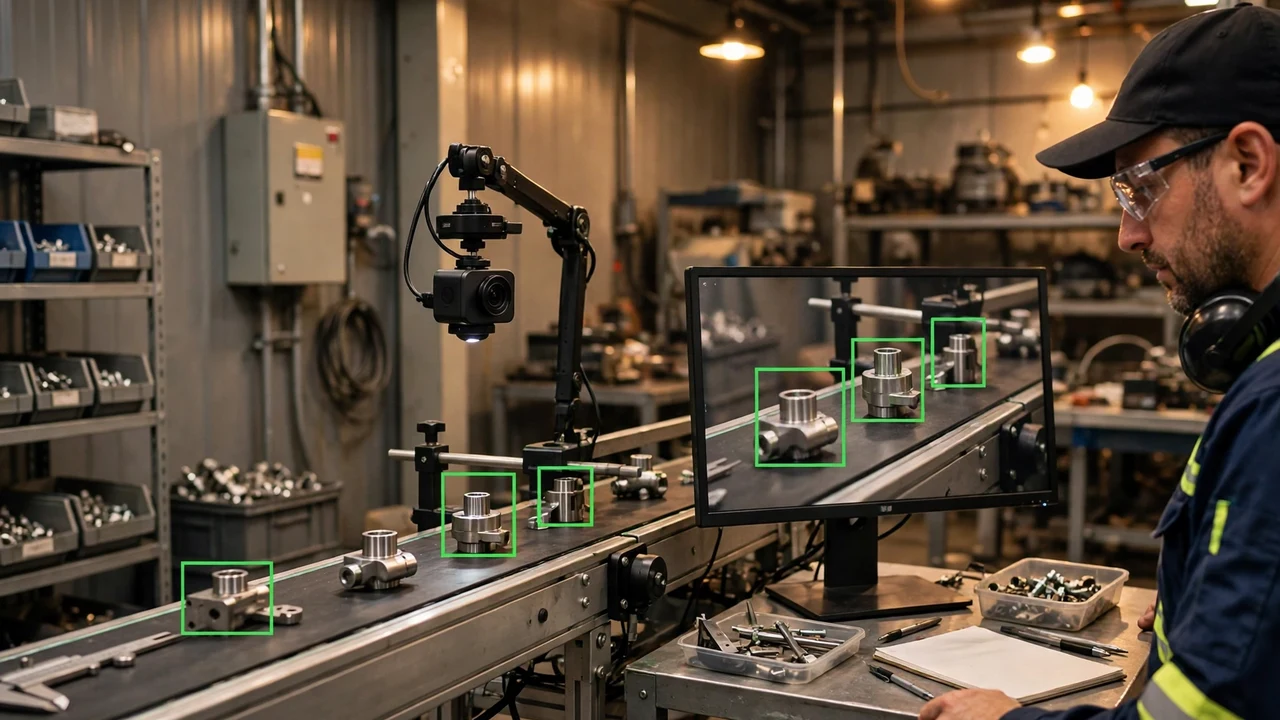
Today, computer vision inference runs 100% locally on compact edge hardware mounted directly inside NEMA electrical enclosures on the shop floor. Modules like the NVIDIA Jetson Orin Nano, Seeed Studio reComputer, and Hailo-8 AI accelerators cost a fraction of traditional industrial PCs while delivering up to 40 to 70 TOPS (trillion operations per second) of neural processing power. These edge devices connect directly to factory PLCs via standard industrial protocols like Modbus TCP, EtherNet/IP, or dry-contact digital I/O relays. When a camera detects an incorrectly assembled part, the edge computer signals a solenoid valve in less than 15 milliseconds, kicking the defective unit off the conveyor before it reaches packaging.

3. Assembly Assistance and "Poka-Yoke" Error Proofing
Japanese manufacturing philosophy has long celebrated Poka-Yoke—mistake-proofing production steps so that errors are physically impossible. However, in custom, high-mix/low-volume assembly environments (like electrical control panels or medical devices), physical jigs cannot accommodate every product variation.
Vision-Guided Manual Assembly
Small factories now mount AI cameras directly over manual assembly workbenches. As a technician assembles an electrical junction box, the computer vision system tracks each step against digital work instructions. If the technician attempts to fasten a wire before inserting the rubber grommet, the workstation flashes a gentle amber warning light on the tabletop and pauses the automated torque screwdriver. This eliminates assembly defects at the source, dramatically reducing the cognitive fatigue on skilled workers and accelerating onboarding times for new hires.
4. Predictive Maintenance Through Machine Vision Telemetry
Computer vision is not limited to inspecting finished products; it is increasingly used to monitor the health of the production machinery itself.
Visual Thermal and Vibration Monitoring
By pairing low-cost edge AI processors with thermal imaging sensors and optical vibration magnification algorithms, small factories can continuously monitor critical spindle bearings, hydraulic pumps, and conveyor motors. The AI algorithm detects subtle changes in mechanical vibration frequencies or thermal hotspots long before a catastrophic bearing seizure occurs. Machine operators receive an automated SMS alert recommending scheduled lubrication during the next shift change, avoiding catastrophic unplanned production downtime.
Economic ROI Breakdown: The Real Cost of Deploying a Vision AI Cell in 2026
To demystify the financial investment required for a small manufacturer to deploy an automated vision inspection station, let us review an itemized bill of materials and payback timeline based on a real 35-person precision metal stamping shop:
Component & Hardware Item | Technical Specification | Estimated One-Time Cost |
Industrial Edge AI Processor | NVIDIA Jetson Orin Nano 8GB in IP67 fanless industrial housing | ~$650 |
Machine Vision Sensor & Lens | 5MP Global Shutter GigE camera with 16mm C-mount low-distortion lens | ~$750 |
Industrial Lighting System | Polarized diffuse LED ring light with constant-current strobe controller | ~$400 |
Mounting Hardware & Sensor Brackets | Extruded aluminum framing, optical proximity trigger, and cabling | ~$300 |
Pneumatic Ejector & Relay Interface | High-speed solenoid air valve + Opto-isolated 24V PLC relay module | ~$250 |
Total Hardware Capital Expenditure | Complete turnkey edge inspection station | ~$2,350 |
Prior to installing this $2,350 inspection cell, the metal stamping facility suffered an average of $3,200 per month in customer return penalties and scrap rework costs due to missed stamping burrs and dimensional misalignments. Following installation, defective parts were rejected instantly on the conveyor before packaging. The entire hardware investment paid for itself in less than 28 days of production operation.
Bridging Vision AI to Enterprise ERP and Manufacturing Execution Systems (MES)
Automated visual inspection is most powerful when it does not exist as an isolated island on the factory floor. By connecting edge vision devices to factory MES and Enterprise Resource Planning (ERP) databases, small manufacturers unlock continuous operational intelligence:
- Real-Time Statistical Process Control (SPC): When an edge camera detects that a machined bore hole's diameter has drifted by 0.05mm toward the outer tolerance limit over ten consecutive parts, the system automatically alerts the CNC operator that the cutting tool insert is wearing down. The operator replaces the tool before non-compliant scrap parts are manufactured.
- Digital Certificate of Conformance (CoC): For aerospace, medical, and defense contracts, every manufactured component can have its high-resolution inspection image, timestamp, and AI quality score automatically linked to its unique serial number in the factory ERP. Providing clients with 100% photographic proof of inspection creates an unshakeable competitive differentiator against overseas competitors.
- Automated Scrap Accounting: Defect classifications (e.g., "cracked weld," "missing rivet," "scratched anodization") are logged directly into inventory management systems, allowing plant managers to identify exactly which supplier raw material lots or machines are driving production waste.
Step-by-Step Implementation Guide for Small Factory Managers
If you manage an industrial facility and want to deploy your first computer vision cell, follow this proven low-risk methodology:
- Identify Your Most Costly Quality Bottleneck: Do not attempt to automate the entire factory at once. Choose a single high-mix station with high scrap rates or frequent customer warranty claims.
- Standardize Lighting Before Spending on Cameras: In computer vision, lighting represents 80% of success. Before buying expensive 4K sensors, invest in diffuse, polarized ring lights or backlights that eliminate harsh reflections and shadows on metal or plastic surfaces.
- Start with Edge-Ready No-Code Platforms: Utilize accessible vision platforms like LandingAI (LandingLens), Roboflow, or Cognex VisionPro. These tools allow your existing quality control inspectors to label images and deploy models without writing a line of Python code.
- Implement Human-in-the-Loop Shadow Mode: Run the vision system in "shadow mode" for the first two weeks—recording detections and alerting operators without physically stopping the conveyor. Once model precision and recall exceed 99%, connect the output relay to automated sorting mechanisms.
Frequently Asked Questions
What is the typical return on investment (ROI) timeframe for a small factory?
Most small-to-mid-sized manufacturers achieve complete payback on their first vision AI inspection cell within three to six months. Cost savings stem from eliminated customer return penalties, reduced scrap material, and redeploying quality inspectors from manual squinting to higher-value operational tasks.
Do small factories need dedicated computer vision engineers on staff?
No. In 2026, modern industrial AI platforms feature intuitive web interfaces designed specifically for manufacturing technicians and plant managers. If your staff can operate an iPhone and understand what constitutes a good versus bad part, they can train and maintain contemporary vision models.
Can computer vision work in dirty, dusty, or oil-mist factory environments?
Yes. Industrial cameras and edge computers are readily available in IP65, IP67, and IP69K sealed stainless-steel enclosures that withstand direct water washdowns, airborne coolant mist, and heavy industrial dust. Air-purge camera windows and protective optical coatings prevent oil accumulation on lenses.
How fast can modern edge AI inspect moving parts on a conveyor belt?
Equipped with global shutter sensors and high-speed edge AI inference (like TensorRT on NVIDIA Jetson hardware), modern systems easily inspect components moving at speeds exceeding 200 to 500 parts per minute with sub-20-millisecond latency.
Does computer vision AI eliminate manufacturing jobs?
In practice across small factories, vision AI addresses severe industrial labor shortages rather than replacing workers. Manual visual inspection is exhausting and prone to human eye fatigue after 20 minutes. Automating inspection allows small manufacturers to elevate their existing workforce into higher-paying machine setup, programming, and continuous improvement roles.
Can computer vision AI inspect transparent or highly reflective parts?
Yes, but inspecting transparent plastics, glass, or polished chrome requires specialized optical lighting setups. Using cross-polarized lighting filters, ultraviolet (UV) illumination, or structured-light laser triangulation eliminates blinding glare and highlights subsurface fractures, allowing vision AI to inspect reflective metal and clear plastics with high fidelity.
How does a factory handle power surges and electrical noise on the shop floor?
Industrial edge computers and cameras are engineered to handle harsh industrial environments. They incorporate wide-range DC power inputs (9V–36V) with surge protection, opto-isolated digital inputs and outputs to prevent ground loop electrical noise from heavy motors, and rugged aluminum chassis that dissipate heat without delicate cooling fans.
Conclusion: The Competitive Imperative for Modern Job Shops
The democratization of computer vision artificial intelligence has permanently leveled the playing field between small manufacturers and global industrial conglomerates. By combining accessible edge compute hardware, sample-efficient anomaly detection algorithms, and intuitive deployment software, small factories can now achieve zero-defect quality standards, optimize operational throughput, and secure lucrative contracts that once required multi-million-dollar automated facilities. For industrial job shops seeking to protect margins and scale sustainably in 2026, adopting vision AI is no longer an experimental luxury—it is an operational necessity.