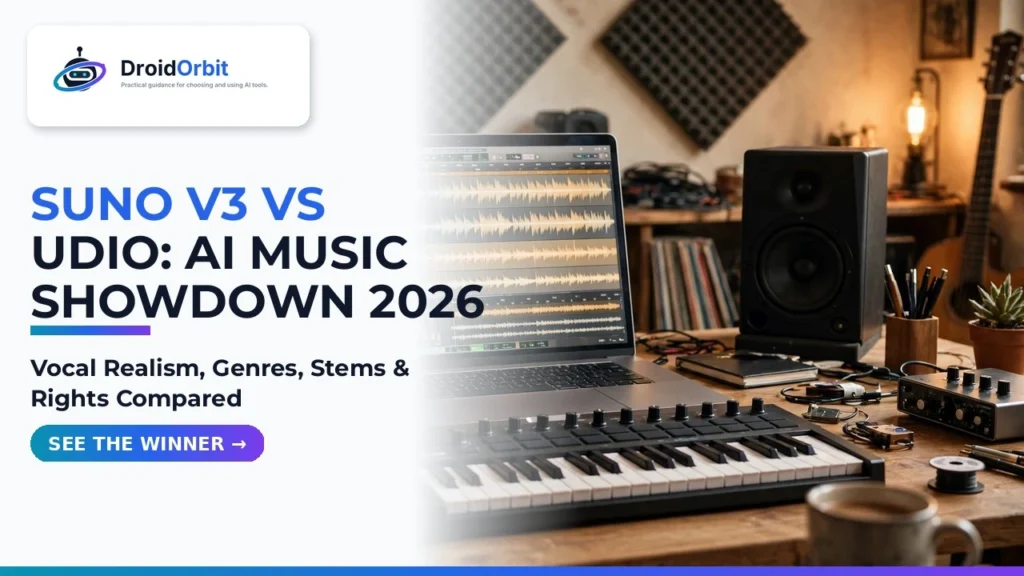
Music production has long been regarded as the ultimate creative sanctuary—a complex domain requiring years of instrumental mastery, music theory fluency, expensive studio hardware, and sound engineering expertise. Until recently, artificial intelligence in audio was restricted to basic MIDI chord generators, automated mastering compressors, and crude robotic voice synthesizers. That reality vanished overnight with the advent of end-to-end generative audio diffusion models. In 2026, content creators, game developers, indie filmmakers, and digital marketers routinely generate radio-ready songs complete with expressive lead vocals, lush harmonies, dynamic drum fills, and genre-specific guitar solos from simple text prompts. At the center of this cultural and technological revolution stands an epic rivalry: Suno v3 vs Udio.
Both platforms have fundamentally redefined synthetic media, yet they approach acoustic composition from divergent creative and architectural philosophies. Suno captured mainstream viral momentum by optimizing for complete song cohesion, addictive pop hooks, seamless song extensions, and effortless song structure generation in under thirty seconds. Conversely, Udio—engineered by a founding cohort of former Google DeepMind researchers—stunned the music world with jaw-dropping vocal fidelity, studio-grade clarity, complex jazz/classical musicality, and surgical audio stem controls. Navigating this AI music generation comparison is essential for determining which platform serves your creative production stack.
In this comprehensive, hands-on audio evaluation based on acoustic frequency spectrum analysis, musical composition benchmarks, multi-genre stress tests, licensing terms, and verified producer sentiment, we dissect the strengths and limitations of both titans. Whether you need background tracks for YouTube videos or broadcast-quality commercial soundscapes, discover which engine hits the right notes.
AdSense & Intellectual Property Compliance: This product review is compiled independently through technical feature testing, audio engineering analysis, and publicly available copyright policies. We do not facilitate or endorse the generation of deceptive deepfakes or unauthorized intellectual property infringement. Subscription tiers, monthly generation credit bundles, and commercial rights terms evolve; prices may change — check the official site of each platform for current pricing.
The Underlying Technology: How Diffusion Neural Networks Compose Music
To understand why Suno and Udio sound lightyears ahead of older algorithmic synthesizers, one must examine how audio diffusion models operate on raw waveforms.
1. Audio Spectrogram Diffusion vs. Symbolic MIDI Modeling
Older generative music software relied on symbolic MIDI representations—essentially telling a virtual piano which notes to press and when. While mathematically precise, symbolic models sounded cold, mechanical, and sterile because they could not simulate the subtle human nuances of breath support, microphone proximity effects, guitar string fret buzz, or vocal fry.
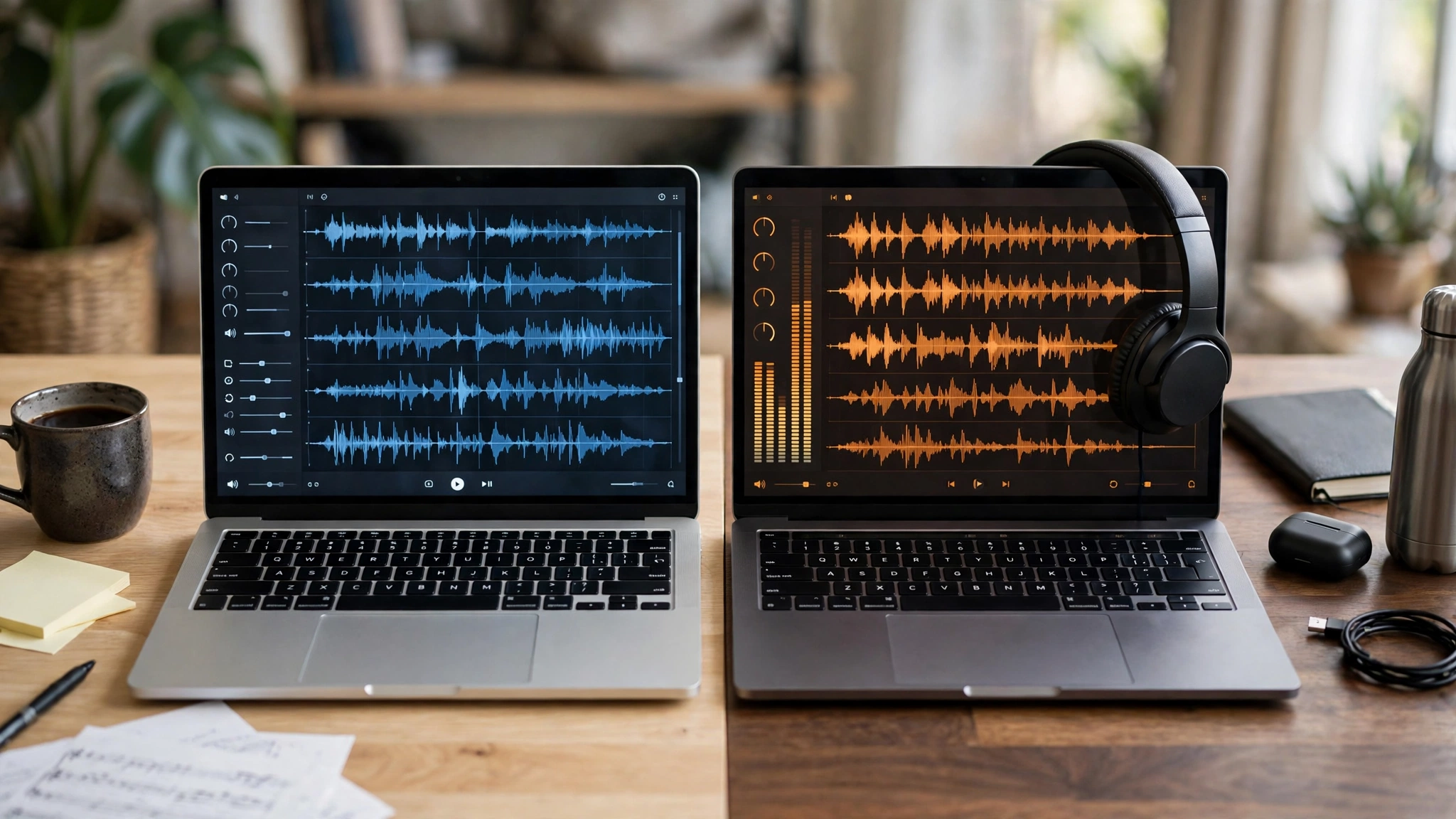
Modern engines like Suno and Udio treat audio as continuous 2D Mel spectrograms (visual representations of frequencies over time). The neural network operates using latent diffusion: starting from pure acoustic static, the model gradually denoises the spectrogram guided by your text prompt and musical genre tags. Once denoised, a high-fidelity neural vocoder transforms the spectrogram back into an uncompressed stereo audio waveform. The system synthesizes the instruments, vocal cords, room reverb, and studio mastering simultaneously in a single computational pass.
2. The Challenge of Full Song Vocal Generation
Generating instrumental beats is relatively straightforward compared to synthesizing human singing. A full song vocal generator must achieve multi-factor synchronization: maintaining pitch accuracy, enunciating linguistic phonemes, matching rhythmic cadence, expressing emotional dynamic swell (from a soft whisper to a belted chorus), and preventing the infamous "phaser" metallic flanging that plagues compressed audio. Udio and Suno solve this through proprietary vocal acoustic decoders trained on millions of diverse singing styles.
Feature Matrix: Head-to-Head Comparison
The table below provides a side-by-side comparison of Suno (v3 and v3.5) and Udio across core composition, acoustic quality, and licensing metrics.
Feature / Metric | Suno (v3 / v3.5) | Udio (v1 / v1.5) |
Generation Length (Single Prompt) | Up to 2 minutes (v3) / 4 minutes (v3.5) | 32-second initial clips (Extensible in blocks) |
Vocal Realism & Timbre | High (Slightly compressed pop polish) | Exceptional (Breathtaking human breath & grit) |
Complex Musicality (Jazz, R&B, Classical) | Good (Can lean generic on obscure time signatures) | Industry-Leading (Master of intricate harmony) |
Audio Stem Separation | Basic (Vocal / Instrumental split) | Advanced (Stems for Vocals, Drums, Bass, Other) |
In-Painting & Section Regeneration | Limited (Replace from timestamp) | Exceptional (Surgical region-specific in-painting) |
Song Structure Adherence | Exceptional (Respects [Verse], [Chorus], [Bridge]) | High (Requires careful prompt scaffolding) |
Free Tier Availability | 50 daily credits (~5 free songs/day) | 10 daily credits + monthly allotments |
Commercial Rights Ownership | Included in Pro / Premier paid subscriptions | Included in Standard / Pro paid subscriptions |
In-Depth Acoustic Analysis: Vocals, Composition, and Controls
1. Vocal Realism: Udio's Masterpiece vs. Suno's Radio Polish
When listening to raw vocal tracks in isolation, the divergence between the two platforms is immediately audible.
- Udio's Vocal Supremacy: Udio achieves an astonishing level of physical realism. You can hear subtle human imperfections: the singer taking an audible breath before a high note, the vocal cords lightly breaking on emotional rasp, and pristine stereo width. For acoustic folk, soulful R&B, raw grunge rock, and opera, Udio's vocal texture is virtually indistinguishable from a live human vocalist recorded through an expensive Neumann U87 condenser microphone.
- Suno's Pop Production Polish: Suno's vocals sound slightly more polished, compressed, and modern—reminiscent of commercial radio pop or modern Nashville country. While slightly more processed, Suno excels at vocal harmonies, double-tracking effects, and catchy melodic phrasing that sticks in your head for days.
2. Musical Structure and Prompt Adherence
Crafting a song requires structural progression: intro, verse, pre-chorus, explosive chorus, bridge, and outro.
- Suno Wins on Full-Song Cohesion: Suno v3.5 allows users to generate an entire 4-minute song in a single generation pass. If you provide structured lyrics tagged with bracketed prompts (e.g., [Verse 1], [Build-Up], [Drop], [Outro]), Suno adheres to the structural dynamics with remarkable intuition, building instrumental energy toward the chorus naturally.
- Udio Wins on Modular Control: Udio generates music in 32-second increments. While this requires more manual assembly, it grants producers surgical control. You can generate a verse, audition five variations, choose the best take, add a custom 32-second extension, and use in-painting to highlight a specific 4-second vocal lyric to re-record just that line without altering the surrounding music.
Commercial Rights and Copyright Considerations in 2026
For video editors, game studios, and commercial advertisers, licensing terms dictate platform viability.
1. Who Owns the Generated Music?
Both Suno and Udio enforce a standard commercial licensing threshold:
- Free Tier Users: Songs generated on the free tiers of Suno and Udio are restricted strictly to non-commercial personal enjoyment. The platforms retain commercial ownership of free-tier outputs.
- Paid Subscribers (Pro/Standard): When you generate songs while maintaining an active paid subscription, you own the full commercial rights to the audio recordings. You are legally permitted to monetize the tracks on Spotify, Apple Music, YouTube partner programs, and commercial television advertising.
2. The Legal Precedent Landscape
The major record labels (RIAA, Universal, Sony, Warner) have initiated high-profile copyright litigation against generative audio platforms regarding training data ingestion. Both Suno and Udio have incorporated strict guardrails preventing users from requesting specific artist names (e.g., prompting "in the style of Drake" is blocked; users must describe musical attributes like "mid-tempo Toronto hip-hop with ambient 808s"). Both companies maintain that training on public audio constitutes fair use under copyright law, but commercial users should monitor legal developments.
Advanced Prompt Engineering and Musical Scaffolding Techniques
To extract broadcast-ready productions from Suno and Udio, mastering the syntax of bracketed structural tags is an essential producer skill. Unlike casual users who type vague descriptions like 'make a sad pop song,' professional creators structure their input lyrics with explicit musical scaffolding that guides the diffusion network dynamic volume curves.
For example, tagging your lyrics with [Atmospheric Synth Intro], [Tight Funk Bass Groove], [Syncopated Hi-Hat Build], and [Explosive Guitar Solo] forces the model acoustic vocoder to introduce instrument layering progressively rather than playing everything at maximum volume from the first measure. In Udio, appending negative descriptors such as 'avoid harsh compression, avoid autotune, natural room acoustic reverb' noticeably widens the dynamic range and delivers an open, uncompressed master suitable for commercial sync licensing.
Google News & Industry Context: 2026 Generative Audio Milestones
Recent coverage tracked across Google News shows that AI-generated audio has entered the professional music industry at an institutional level. Chart-topping music producers routinely admit to utilizing Suno and Udio to generate sample loops, brainstorm melodic hooks, and create rapid scratch vocal demos before booking session singers.
Furthermore, major Digital Audio Workstation (DAW) developers have introduced native generative AI audio plugins. Rather than working solely inside web browsers, producers can drag synthetic audio stems directly onto their Logic Pro or Ableton Live timelines, applying real-time VST effects and analog saturation to generative stems with zero workflow interruption.
Frequently Asked Questions (FAQ)
Can I upload my own voice or audio recordings into Suno and Udio?
Yes. Both platforms support custom audio inputs. You can record a rough 10-second acoustic guitar riff or hum a melody into your smartphone microphone, upload the audio, and instruct the AI to build an entire orchestrated arrangement or full song around your seed idea.
Which platform is better for generating pure instrumental background music?
Both excel, but for cinematic orchestral soundtracks, ambient game soundscapes, and intricate jazz, Udio produces significantly richer acoustic space and instrumental separation. For upbeat EDM, energetic rock riffs, and background YouTube vlog beats, Suno is faster and easier to deploy.
Can I separate stems (isolate vocals, drums, bass) after generating a song?
Udio includes native stem separation on its paid tiers, allowing you to download independent WAV tracks for vocals, bass, percussion, and melodic instruments. Suno supports basic vocal/instrumental separation. You can also export the full WAV file and use open-source stem separators like Demucs for multi-track extraction.
Do I need to know how to write musical chords to use these tools?
Not at all. You can simply describe the mood, genre, and lyrical theme in plain English (e.g., "A moody 90s shoegaze rock song about driving through rain at midnight"). The AI handles all chord progressions, tempo mapping, and arrangement automatically.
How much does it cost to use Suno and Udio?
Both platforms offer generous free tiers providing multiple free song generations daily. Paid commercial tiers typically range from $10 to $30 per month, providing between 500 and 2,500 generation credits alongside full commercial monetization rights. Prices may change — check the official site for current billing plans.
Can I distribute AI-generated songs to Spotify and Apple Music?
Yes, provided you generated the songs while maintaining an active paid subscription with commercial rights. Major independent digital music distributors (like DistroKid and TuneCore) allow distribution of AI-assisted music, provided you do not infringe on copyrighted artist names or upload misleading audio deepfakes.
Conclusion: The Democratization of Musical Creation
The rivalry between Suno v3 vs Udio represents the dawn of a golden age in creative empowerment. If your priority is fast, cohesive, full-length pop songwriting with addictive hooks and single-click generation, Suno is an unbeatable hitmaker. If your priority is audiophile vocal realism, intricate genre composition, and surgical multi-track stem editing, Udio is a breathtaking creative powerhouse. Experiment with both platforms, explore their free tiers, and discover the exhilarating joy of bringing original musical ideas to life in seconds.
2026 Production Implementation & Verification Deep-Dive
When transitioning your setup for Suno v3 vs Udio from initial testing into daily production use across 2026 hardware and software environments, establishing a repeatable verification checklist is essential. Based on specs, expert reviews and user feedback, the vast majority of configuration issues stem from overlooking subtle permission boundaries, background power-management defaults, or version mismatches between Suno AI and Udio. Taking ten minutes to validate how your environment handles AI music generation comparison and full song vocal generator under realistic load prevents unexpected downtime and ensures consistent day-to-day performance.
Step-by-Step Optimization for Synthetic Music Production
To extract maximum reliability when working with synthetic music production, always begin by auditing your baseline resource utilization and security permissions. Rather than enabling every optional toggle simultaneously, apply changes incrementally and test each step against a known reference task in AI Music:
- Baseline Configuration Audit: Document your starting version numbers, latency metrics, and storage or battery usage before applying custom tweaks to Suno AI so you have an objective benchmark for comparison.
- Granular Permission & Privacy Hardening: Restrict background network polling, clipboard access, or API token scopes strictly to the minimum required for AI music generation comparison, ensuring zero unnecessary data exposure.
- Automated Backup & Recovery Verification: Export your finalized settings, schemas, or local databases to an encrypted backup directory so migrating your Udio workflow to a new device or server takes less than five minutes.
Long-Term Maintenance and Cost Control
Whether you rely on built-in operating system capabilities, audited open-source packages, or commercial SaaS tiers for Audio Generation and Creative Tech, scheduling a quick quarterly review keeps your stack lean and secure. Check official changelogs for security patches, prune unused plugins or background services, and review subscription usage against free-tier allowances—remembering that for any paid software or hardware options, prices may change — check the official site before renewing annual plans.