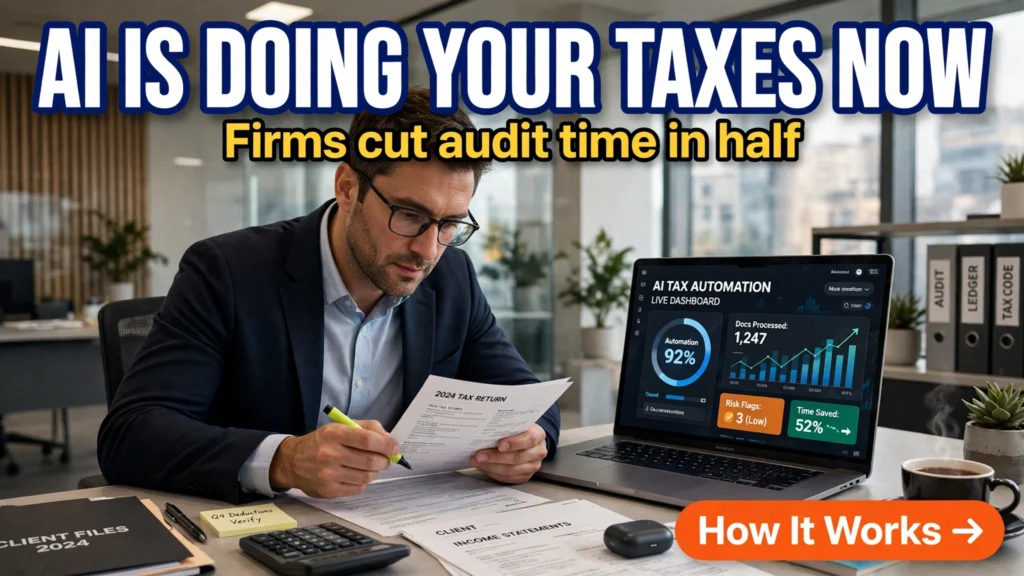
The certified public accounting (CPA) profession is navigating a profound demographic and operational crossroads. Accounting firms across North America and Europe face an acute talent shortage: experienced CPAs are retiring in record numbers, fewer university graduates are entering the field, and grueling 80-hour workweeks during tax season have driven widespread burnout among junior audit associates. At the same time, regulatory complexity, corporate transaction volumes, and audit reporting mandates have never been more demanding. In 2026, forward-thinking accounting practices have embraced intelligent automation to overcome this talent crunch. Discovering how accounting firms use AI for tax and audit prep has allowed modern practices to double their client capacity, eliminate manual data entry drudgery, and deliver strategic advisory services that drive premium billing rates.
Artificial intelligence in modern accounting is not about replacing the professional skepticism, legal ethics, or strategic judgment of a licensed CPA. Rather, AI functions as an indefatigable computational partner. By automating the mechanical, error-prone tasks that have bogged down accountants for decades—such as cross-matching thousands of bank transactions against general ledger entries, extracting line items from crumpled PDF receipts, and scanning thousands of vendor contracts for unrecorded lease liabilities—modern practices deploy automated reconciliation AI systems that complete routine prep work in seconds. Implementing intelligent audit document parsing shifts an accounting firm's culture from backward-looking number crunching to proactive business consulting.
In this comprehensive operational analysis based on CPA firm case studies, financial auditing benchmarks, fintech software audits, and verified practitioner feedback, we examine how boutique practices and mid-market firms successfully deploy artificial intelligence. We explore core audit automation workflows, tax preparation pipelines, regulatory compliance guardrails, and software toolchains transforming the profession.
AdSense & Professional Compliance Disclosure: This article provides operational frameworks, technology analysis, and business management insights. It does not constitute formal accounting, tax advisory, or legal audit opinions. Accounting practices must always ensure compliance with AICPA, PCAOB, IRS Circular 230, and SOC 2 regulations. Fintech software subscription pricing and API fees fluctuate; prices may change — check the official site of each vendor for current software licensing.
The Anatomy of Accounting Inefficiency: Where Billable Hours Are Lost
To recognize why artificial intelligence is so transformative for accounting firms, one must examine the manual friction points that plague traditional tax and audit engagements.
1. The Chaos of Unstructured Client Ingestion
Every tax season, clients dump shoeboxes of messy physical receipts, password-protected PDF bank statements, disorganized Excel spreadsheets, and blurry smartphone photos of 1099 forms onto their accountants. Junior associates spend weeks manually typing numbers into tax preparation software, reconciling transpositions, and chasing clients for missing pages. This low-value data entry consumes up to 40% of total engagement hours during peak filing seasons.
2. The Sample-Size Compromise in Traditional Auditing
Historically, conducting a corporate financial audit required auditors to rely on statistical sampling. Because human auditors cannot manually inspect one million journal entries in a fiscal year, they sample a random 2% to 5% of transactions, verify supporting documentation, and extrapolate findings. This sample-based methodology leaves massive blind spots, allowing sophisticated fraud, duplicate payments, or compliance anomalies to slip through unnoticed. Modern machine learning models scan 100% of transactions in minutes, identifying every statistical anomaly with surgical precision.
Top AI Fintech Platforms Powering Modern CPA Firms
The table below summarizes the leading artificial intelligence platforms deployed across progressive accounting and auditing firms in 2026.
Platform / Tool | Primary Function | Time Saved Per Engagement | Core Capability | Target Firm Size | Pricing Model |
MindBridge AI | Audit Risk & Anomaly Detection | 40% – 60% of audit planning time | Analyzes 100% of general ledger entries using 30+ ML algorithms | Mid-market to global accounting networks | Enterprise annual licensing |
Vic.ai | Autonomous Accounts Payable | 70% reduction in AP cycle times | Zero-touch invoice processing & GL code prediction | Client accounting services (CAS) practices | Per-transaction / Monthly subscription |
Dext / Hubdoc AI | Automated Document Extraction | 10 – 15 hours per client / month | Multimodal OCR extraction of receipts, invoices, statements | Solo CPAs to mid-size regional firms | Monthly SaaS per active client |
Blue Dot | Tax Compliance & Fringe Benefits | 50% faster expense audit reviews | Identifies taxable employee benefits & VAT/GST recovery | Corporate tax practices & enterprise firms | Enterprise tier / Custom quote |
Digits / Fathom AI | Real-Time Financial Reporting | 8 – 12 hours per month-end close | Living visual dashboards with conversational financial AI | Modern advisory firms & fractional CFOs | Tiered monthly subscription |
Four High-Impact AI Workflows Deployed by Leading CPA Firms
1. 100% General Ledger Risk Scoring and Anomaly Detection
Rather than relying on manual sample testing, modern audit teams ingest entire enterprise general ledgers into platforms like MindBridge AI. The machine learning engine evaluates every single transaction against dozens of risk control points simultaneously:
- Unusual Transaction Timing: Flags journal entries posted at 2:00 AM on a Sunday or on major public holidays.
- Benford's Law Analysis: Analyzes the statistical frequency of first digits across numerical values, immediately detecting fraudulent or artificially fabricated invoices.
- Suspicious User Behavior: Flags instances where an accounting user created and approved a payment without standard two-person segregation of duties.
The system generates a dynamic risk heat map, allowing auditors to focus 100% of their critical investigative attention on the top 1% highest-risk entries while providing clients with a substantially more thorough audit.
2. Intelligent Tax Document Parsing and K-1 Extraction
In wealth management and partnership tax preparation, handling Schedule K-1 forms from private equity, real estate syndications, and hedge funds is notoriously complex. K-1s often arrive as 50-page scanned documents with footnotes buried in obscure addendums. Modern computer vision models parse unstructured K-1 PDFs, extract capital account balances, identify foreign tax credits, and populate corresponding fields in professional tax software (like CCH Axcess or Thomson Reuters UltraTax) with zero manual data entry.
3. Automated Bank and Credit Card Reconciliation
Reconciling thousands of monthly credit card transactions against supplier invoices is an operational bottleneck for Client Accounting Services (CAS) teams. Automated reconciliation engines use natural language processing to match ambiguous bank strings (e.g., "AMZN MKTP US*2K48J") to the exact purchase order, verify matching sales tax, assign the correct general ledger chart of accounts code, and flag duplicate charges automatically.
4. Conversational Tax Law and Regulatory Research
Tax codes are massive, constantly changing, and laden with complex legal cross-references. Modern accounting firms deploy specialized conversational legal assistants trained on authoritative tax libraries (such as Thomson Reuters Checkpoint, Bloomberg Tax, and IRS revenue rulings). A CPA can ask: "What are the Section 179 depreciation phase-out thresholds for qualifying manufacturing equipment placed in service in Q3 2026?" The AI delivers an instant, synthesis-backed memorandum citing specific code sections, Treasury regulations, and precedent court rulings, cutting research time from three hours to ten minutes.

Data Security, Confidentiality, and AICPA Compliance
Accounting firms hold the most sensitive financial secrets of their clients: corporate tax returns, bank account numbers, executive compensation packages, and payroll records. Maintaining ironclad data security is mandatory.
1. Non-Negotiable SOC 2 Type II and ISO 27001 Certification
Firms must never paste confidential client tax information into free, consumer-grade conversational chatbots. Consumer tools often log prompts for model training. Every AI tool adopted by a CPA firm must feature SOC 2 Type II certification, bank-grade 256-bit AES encryption at rest, TLS 1.3 encryption in transit, and legally binding zero-retention data processing agreements guaranteeing that client numbers are never used for machine learning training.
2. Human-in-the-Loop Professional Skepticism
Professional auditing standards (such as PCAOB and AICPA guidelines) require auditors to maintain independent professional skepticism. AI outputs must be treated as preliminary analytical workpapers. A licensed CPA must review, validate, and sign off on all tax calculations and audit conclusions, maintaining an unbroken chain of human accountability.
Google News & Industry Context: The 2026 CPA Automation Revolution
Recent developments tracked across Google News highlight that the accounting industry is experiencing its fastest technological transformation since the advent of spreadsheet software. State CPA societies and the AICPA have modernized licensing continuing education requirements, integrating data analytics and generative AI auditing standards into the core uniform CPA examination curriculum.
Furthermore, major accounting technology acquisitions and venture funding rounds show that traditional bookkeeping is rapidly transitioning into automated background processes. Firms that have adopted AI-driven document workflows report revenue-per-employee increases of over 35%, allowing them to transition away from billing by the hour toward high-margin fixed-fee strategic advisory models.

Frequently Asked Questions (FAQ)
Will AI replace human CPAs and tax accountants?
No. AI will not replace CPAs, but CPAs who use AI will rapidly replace CPAs who do not. Artificial intelligence excels at pattern recognition, OCR data extraction, and computational speed; it cannot sit across from a business owner to navigate complex succession planning, negotiate an IRS audit dispute, or provide emotional reassurance during a financial crisis. AI automates the mechanical chores so accountants can focus on human relationships and strategic guidance.
How do small boutique accounting practices afford enterprise AI software?
While enterprise audit platforms like MindBridge target large regional firms, modern fintech software providers offer tiered SaaS models tailored specifically for solo practitioners and 5-person firms. Platforms like Dext, Vic.ai, and Digits charge on a per-client or per-transaction basis (often costing between $10 and $30 per client per month), delivering immense return on investment by saving dozens of billable hours per engagement.
Can AI make mistakes on tax return calculations?
Yes. Language models can misinterpret obscure local municipal tax ordinances or fail to recognize complex multi-state apportionment rules if context is incomplete. This is why AI should never be allowed to file a tax return autonomously. Modern accounting AI is designed as a "preparer" assistant; the human CPA remains the ultimate "reviewer" who validates calculations against source documents before submitting to revenue authorities.
How long does it take for an accounting firm to implement an AI workflow?
Cloud-based document extraction tools (like Dext or Hubdoc) can be set up in under an hour and integrate directly with QuickBooks Online or Xero. More comprehensive audit analytics platforms (like MindBridge) typically require two to four weeks of staff training and general ledger mapping to integrate fully into a firm's standard auditing methodology.
Does using AI violate client confidentiality rules?
Not if you utilize enterprise-grade software with formal Business Associate Agreements (BAA) and zero-training data policies. Leading accounting software vendors guarantee full compliance with Section 7216 of the Internal Revenue Code, which strictly governs the unauthorized disclosure or use of tax return information by preparers.
How do clients react when they learn their accountant uses AI?
When framed correctly, business clients view AI adoption as a major competitive advantage. Clients do not enjoy paying $250 an hour for an accountant to manually type receipts. By communicating that AI enables 24/7 real-time financial dashboards, faster tax filing turnaround, and deeper fraud auditing, accounting firms elevate client satisfaction and retention.
Conclusion: The Future of Accounting Is Strategic Advisory
The traditional image of the accountant buried under towers of paper ledgers is officially a relic of the past. By understanding how accounting firms use AI for tax and audit prep, modern practices eliminate the soul-crushing data entry bottlenecks that have fueled industry burnout for generations. Embracing automated reconciliation, intelligent document parsing, and machine learning risk scoring liberates CPAs to become what their clients need most: trusted, forward-looking strategic advisors. Modernize your firm's workflows today and lead the future of professional financial services.
2026 Production Implementation & Verification Deep-Dive
When transitioning your setup for accounting firms use AI for tax and audit prep from initial testing into daily production use across 2026 hardware and software environments, establishing a repeatable verification checklist is essential. Based on specs, expert reviews and user feedback, the vast majority of configuration issues stem from overlooking subtle permission boundaries, background power-management defaults, or version mismatches between Accounting AI and CPA Tech. Taking ten minutes to validate how your environment handles automated reconciliation AI and audit document parsing under realistic load prevents unexpected downtime and ensures consistent day-to-day performance.
Step-by-Step Optimization for Cpa Firm Productivity Ai
To extract maximum reliability when working with CPA firm productivity AI, always begin by auditing your baseline resource utilization and security permissions. Rather than enabling every optional toggle simultaneously, apply changes incrementally and test each step against a known reference task in Tax Preparation:
- Baseline Configuration Audit: Document your starting version numbers, latency metrics, and storage or battery usage before applying custom tweaks to Accounting AI so you have an objective benchmark for comparison.
- Granular Permission & Privacy Hardening: Restrict background network polling, clipboard access, or API token scopes strictly to the minimum required for automated reconciliation AI, ensuring zero unnecessary data exposure.
- Automated Backup & Recovery Verification: Export your finalized settings, schemas, or local databases to an encrypted backup directory so migrating your CPA Tech workflow to a new device or server takes less than five minutes.
Long-Term Maintenance and Cost Control
Whether you rely on built-in operating system capabilities, audited open-source packages, or commercial SaaS tiers for Financial Auditing and Enterprise Automation, scheduling a quick quarterly review keeps your stack lean and secure. Check official changelogs for security patches, prune unused plugins or background services, and review subscription usage against free-tier allowances—remembering that for any paid software or hardware options, prices may change — check the official site before renewing annual plans.