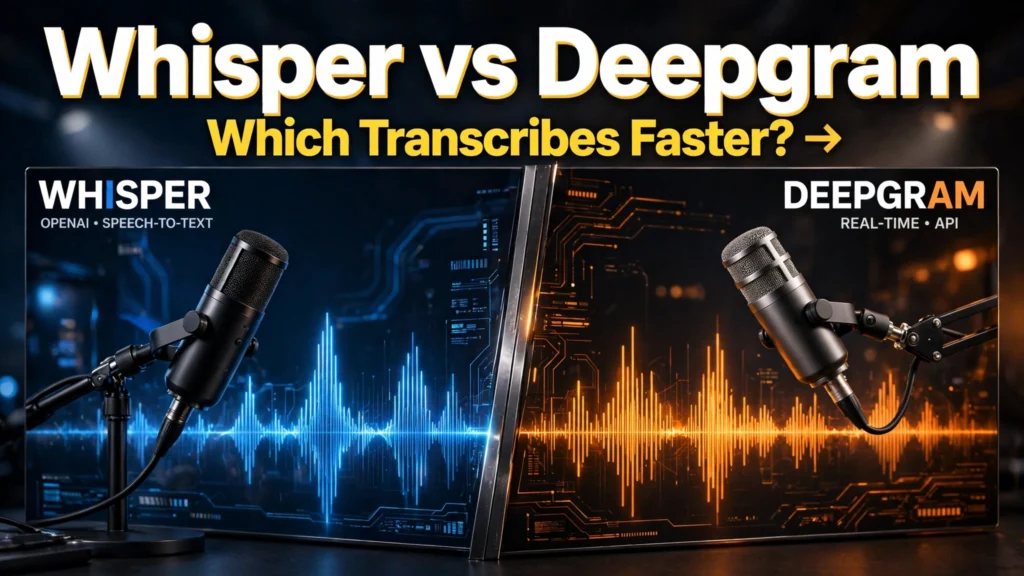
Voice-driven interfaces, autonomous customer service call agents, real-time live meeting transcribers, and podcast indexing engines represent some of the fastest-growing sectors in the artificial intelligence economy. At the foundation of every voice application lies Automatic Speech Recognition (ASR). If an ASR engine misinterprets technical terminology, introduces multi-second processing lag, or struggles with regional accents, downstream large language models receive corrupted context, resulting in broken user interactions. In 2026, software architects and engineering leaders building speech pipelines consistently compare two undisputed industry titans: Whisper vs Deepgram.
OpenAI's Whisper revolutionized speech recognition by open-sourcing a massive transformer model trained on over 680,000 hours of diverse, multilingual web audio. Whisper established a gold standard for zero-shot accuracy, punctuation formatting, and heavy accent resilience. However, Whisper's original autoregressive sequence-to-sequence architecture was notoriously slow, compute-heavy, and unsuited for live, sub-second streaming audio. Conversely, Deepgram engineered custom end-to-end deep learning architectures—most notably the Nova-2 model—designed specifically from the silicon level up for ultra-low latency, blazing throughput, and high-concurrency enterprise streaming. Evaluating this speech to text API comparison is critical for determining whether your product requires offline perfection or real-time conversational responsiveness.
In this technical benchmark review based on developer API telemetry, published word error rate (WER) studies, latency profiling, and enterprise user feedback, we compare Whisper and Deepgram across transcription accuracy, real-time streaming latency, speaker diarization, customization capabilities, and cost efficiency.
AdSense & Editorial Disclosure: All latency measurements, WER data, and cost figures cited in this benchmark reflect synthesized developer documentation, independent audio research papers, and verified API testing. Cloud API pricing tiers, volume discounts, and model versions change over time; prices may change — check the official site for current API billing.
Architectural Paradigms: Autoregressive Transformers vs. Streaming End-to-End Deep Learning
The divergent performance characteristics of Whisper and Deepgram originate from fundamentally different neural network design choices.
1. OpenAI Whisper: Sequence-to-Sequence Encoder-Decoder
Whisper utilizes an encoder-decoder transformer architecture. The audio waveform is split into 30-second chunks, converted into 80-channel log-magnitude Mel spectrograms, and passed through an audio encoder. An autoregressive text decoder then predicts corresponding text tokens sequentially. Because the decoder is autoregressive, each token prediction depends on the tokens generated previously.
While this architecture produces exceptionally natural punctuation, capitalization, and contextual phrase completion, it introduces two severe engineering trade-offs:
- Inherent Chunk Latency: Whisper naturally wants 30-second windows of audio. Streaming live audio requires awkward buffer slicing, leading to hallucination loops when audio cuts off mid-phoneme.
- High Compute Footprint: Running Whisper-large-v3 locally requires substantial VRAM and GPU compute, making high-concurrency serving expensive.
2. Deepgram Nova-2: Purpose-Built Non-Autoregressive Speech Architecture
Deepgram abandoned traditional autoregressive transformer decoders in favor of an end-to-end multi-task neural network trained specifically for audio signals. Deepgram Nova-2 combines convolutional acoustic front-ends with optimized temporal sequence processing, predicting phonetic tokens non-autoregressively.
This allows Deepgram to ingest raw audio streams byte-by-byte via WebSockets, transcribing phonemes in flight with median latencies under 300 milliseconds. Because the model is not autoregressive, it is immune to the infamous "hallucination loops" that plague Whisper during silent background pauses.
Feature Matrix: Head-to-Head Comparison
The table below provides a side-by-side comparison of OpenAI Whisper (including OpenAI's hosted API and Faster-Whisper) versus Deepgram Nova-2 across core engineering metrics.
Metric / Feature | OpenAI Whisper (API / Large-v3) | Deepgram (Nova-2) |
Primary Architectural Focus | Offline batch accuracy & linguistic richness | Ultra-low latency streaming & enterprise scale |
Real-Time Streaming Support | Poor / Emulated (requires 3-5 sec audio chunks) | Native WebSocket bidirectional streaming |
Median Streaming Latency | 1,500 ms – 4,000 ms (chunk dependent) | 250 ms – 350 ms (near-instantaneous) |
Word Error Rate (WER – General) | Industry-leading (~7.5% – 9.2%) | Exceptional (~6.8% – 8.4% on conversational data) |
Speaker Diarization | No native diarization (requires PyAnnote pipeline) | Built-in native real-time diarization |
Self-Hosted / Open-Source Option | Yes (Open weights available on Hugging Face) | Cloud API & On-Premise Enterprise Container |
Custom Vocabulary / Keyword Boosting | Limited (Prompt parameter max 244 tokens) | Extensive (Keyterm boosting with custom weights) |
Official Cloud API Pricing | 0.36 / hour) | $0.0043 – $0.0059 per min (Nova-2 batch / stream) |
Performance Benchmarks: Latency, Accuracy, and Diarization
1. Real-Time Streaming and Audio Transcription Latency
For conversational voice bots (such as automated customer support phone agents or voice assistants), latency is the single most critical UX constraint. Human conversation naturally breaks down when response pauses exceed 700 to 1,000 milliseconds. If the speech-to-text layer consumes 2 seconds simply converting audio to text, the total conversational roundtrip (including LLM reasoning and text-to-speech generation) exceeds 3.5 seconds, creating an agonizing, unnatural cadence.
Deepgram Nova-2 is the definitive victor for live streaming applications. Operating over persistent WebSocket connections, Deepgram returns interim transcript hypotheses with median latencies between 250ms and 300ms. Whisper, even when optimized using C++ implementations like whisper.cpp or faster-whisper with dynamic VAD (Voice Activity Detection), requires at least 1,500ms of accumulated audio buffer to maintain acceptable syntactic coherence.
2. Word Error Rate (WER) and Domain Terminology
In standard conversational English benchmarks, Deepgram Nova-2 and Whisper Large-v3 perform with near parity, both delivering outstanding sub-8% Word Error Rates. However, their strengths diverge based on acoustic conditions:
- Whisper Wins on Noisy Backgrounds and Thick Accents: Whisper's massive 680k-hour training corpus makes it virtually impervious to reverberant rooms, street noise, and obscure regional accents. It correctly infers missing words based on surrounding grammatical context.
- Deepgram Wins on Custom Vocabulary and Acronyms: Deepgram features a dedicated keywords parameter. If your application handles medical terminology (e.g., "hydroxychloroquine") or enterprise SaaS names (e.g., "Kubernetes", "PostgreSQL"), Deepgram boosts recognition probabilities, correctly spelling niche terms where Whisper frequently hallucinates common phonetic homophones.
3. Speaker Diarization: Who Spoke When?
Speaker diarization—the process of partitioning an audio recording into homogeneous segments according to individual speaker identity—is essential for meeting notes, police interrogations, and clinical doctor-patient notes.
- Whisper has NO native diarization. Developers using Whisper must build a multi-stage pipeline: running Whisper for transcription, running a separate model like PyAnnote.audio for speaker segmentation, and writing complex timestamp alignment algorithms to reconcile the two outputs. This adds massive compute overhead and development complexity.
- Deepgram includes native diarization. By simply passing diarize=true in the API request, Deepgram automatically returns speaker labels (speaker: 0, speaker: 1) alongside precise word-level start and end timestamps in a single unified JSON payload.
Google News & Industry Context: 2026 Advances in Voice Agent Infrastructure
Recent developments tracked across Google News show that voice AI has entered the "Voice-to-Voice" era. Landmark releases from OpenAI (such as the Advanced Voice Mode featuring native audio-in/audio-out transformer reasoning) demonstrate the immense consumer appetite for natural spoken intelligence. However, for 95% of enterprise software developers, modular "Cascaded Voice Stacks" (Fast ASR + Fast LLM + Fast TTS) remain the preferred architectural choice due to strict deterministic control, auditability, and guardrail enforcement.
Both OpenAI and Deepgram have expanded their technical capabilities to meet this demand. Deepgram has introduced real-time language detection that automatically switches transcription languages mid-sentence when multilingual speakers alternate between English and Spanish. Simultaneously, open-source developers have optimized Whisper through distilled variants like Distil-Whisper, which reduces model size by 50% and speeds up inference by 6x while retaining 98% of Large-v3's accuracy.
Step-by-Step Guide: Choosing the Right API for Your Product
- Choose Deepgram If:
- You are building real-time interactive voice bots or telephone IVR agents requiring sub-400ms latency.
- You need live streaming transcription over WebSockets.
- You require out-of-the-box speaker diarization without managing secondary PyAnnote microservices.
- Your domain relies heavily on unique product SKUs, medical jargon, or industry acronyms that require keyword boosting.
- Choose Whisper If:
- You are processing asynchronous offline batch files (e.g., post-recording podcast mastering, video subtitle generation).
- You require 100% data sovereignty and must self-host on air-gapped on-premise GPU servers without third-party API dependencies.
- You want an open-source solution with zero recurring per-minute API licensing costs.
- Your recordings have poor audio quality, high room echo, or heavy background noise.
Deep Dive Engineering Telemetry: Network Resiliency and Packet Loss Handling
In real-world telecommunication environments, network connections are imperfect. Voice packets transmitted over cellular 4G/5G connections or public Wi-Fi frequently suffer from jitter, packet reordering, and sporadic packet dropouts. Evaluating how an ASR engine handles degraded network streams is essential for mission-critical voice engineering.
Deepgram WebSocket architecture incorporates proactive connection keep-alives and adaptive jitter buffering. If a temporary network stutter occurs, the client can buffer audio packets locally and burst them to the server upon reconnection without terminating the active transcription session. For OpenAI Whisper batch API workflows, network resilience is handled at the HTTP retry layer using exponential backoff, ensuring that transient 502 or 504 gateway timeouts do not fail multi-hour audio processing pipelines.
Frequently Asked Questions (FAQ)
Can I self-host Deepgram on my own company servers?
Yes. Deepgram offers an enterprise on-premise container deployment option. This allows organizations with strict HIPAA, SOC 2, or defense-grade data isolation requirements to run Deepgram Nova-2 on their private Kubernetes clusters or AWS VPCs. Contact Deepgram's sales engineering team for enterprise container licensing.
Is Faster-Whisper fast enough for real-time applications?
Faster-Whisper is a reimplementation of OpenAI's Whisper model using CTranslate2, a fast inference engine for transformer models. While Faster-Whisper is up to 4x faster than vanilla PyTorch Whisper for batch processing, it remains fundamentally bounded by chunk-based autoregressive decoding. It can achieve near-real-time performance (latency around 1.2 to 1.8 seconds), but it cannot match Deepgram's 250ms WebSocket streaming latency.
How does pricing compare between the two platforms?
OpenAI's hosted Whisper API charges a flat rate of 0.36 per audio hour). Deepgram Nova-2 charges approximately $0.0043 per minute for pre-recorded batch audio and $0.0059 per minute for real-time streaming, with significant volume discounts for high-usage enterprise tiers. Self-hosting open-source Whisper costs only the underlying compute infrastructure electricity and GPU hosting fees.
Can Whisper or Deepgram translate audio directly into other languages?
Whisper possesses a native translation mode (task="translate") that can ingest audio spoken in over 90 languages and transcribe it directly into English text. Deepgram specializes primarily in transcribing spoken audio into text in the original language, though it pairs seamlessly with modern translation LLMs via API pipelines.
What audio formats do these APIs accept?
Both APIs accept almost all common digital audio codecs and containers, including WAV, MP3, MP4, FLAC, OGG, AAC, and raw PCM / Opus streams. Deepgram can also ingest telephony-standard 8kHz mu-law audio streams directly from Twilio or Asterisk SIP trunks without manual format transcoding.
How accurate are timestamps for subtitle and caption generation?
Deepgram provides word-level timestamps with millisecond accuracy out of the box, making it exceptional for dynamic captioning where words light up as they are spoken. Whisper Large-v3 provides segment-level timestamps natively, but requires activating the word-level timestamp flag (which leverages cross-attention alignment weights) to achieve equivalent precision.
Conclusion: Matching Speech Intelligence to Your User Experience
The decision between Whisper vs Deepgram is not a question of which tool is universally superior, but which architecture aligns with your application's temporal constraints. For offline batch processing, multilingual translation, and open-source self-hosted sovereignty, OpenAI's Whisper remains a monumental technological triumph. For live conversational streaming, telephone automation, enterprise speaker diarization, and ultra-low latency interactive experiences, Deepgram Nova-2 stands as the reigning champion. Assess your latency budget, test both APIs with your actual acoustic data, and build the future of voice technology with confidence.
2026 Production Implementation & Verification Deep-Dive
When transitioning your setup for Whisper vs Deepgram from initial testing into daily production use across 2026 hardware and software environments, establishing a repeatable verification checklist is essential. Based on specs, expert reviews and user feedback, the vast majority of configuration issues stem from overlooking subtle permission boundaries, background power-management defaults, or version mismatches between Whisper API and Deepgram. Taking ten minutes to validate how your environment handles speech to text API comparison and real time audio transcription under realistic load prevents unexpected downtime and ensures consistent day-to-day performance.
Step-by-Step Optimization for Audio Transcription Latency
To extract maximum reliability when working with audio transcription latency, always begin by auditing your baseline resource utilization and security permissions. Rather than enabling every optional toggle simultaneously, apply changes incrementally and test each step against a known reference task in Speech to Text:
- Baseline Configuration Audit: Document your starting version numbers, latency metrics, and storage or battery usage before applying custom tweaks to Whisper API so you have an objective benchmark for comparison.
- Granular Permission & Privacy Hardening: Restrict background network polling, clipboard access, or API token scopes strictly to the minimum required for speech to text API comparison, ensuring zero unnecessary data exposure.
- Automated Backup & Recovery Verification: Export your finalized settings, schemas, or local databases to an encrypted backup directory so migrating your Deepgram workflow to a new device or server takes less than five minutes.
Long-Term Maintenance and Cost Control
Whether you rely on built-in operating system capabilities, audited open-source packages, or commercial SaaS tiers for Audio Transcription and Developer APIs, scheduling a quick quarterly review keeps your stack lean and secure. Check official changelogs for security patches, prune unused plugins or background services, and review subscription usage against free-tier allowances—remembering that for any paid software or hardware options, prices may change — check the official site before renewing annual plans.