Nothing’s First AI-Native Product Ships in December: No Screen, No App, No Details Yet
Nothing is about to ship its strangest product. On November 4, 2026, CEO Carl Pei announced that the London company’s first AI-native product will ship in December — and in the same breath confirmed almost nothing about it. It has no name, no price, no specifications, and no exact release date. What Pei did say is more interesting than what he withheld: the device has “no new screen” and “couldn’t have been an app.” It is a physical tool built around AI, not another chatbot in a pocket rectangle. Here is everything confirmed so far, what the clues actually point to, and the hard questions Nothing still has to answer before December.
What Carl Pei Actually Announced
The announcement came on November 4 in an essay titled “Toolmakers,” published by Pei on X. It was not a launch event, a spec sheet, or a render reveal — it was a short statement of intent, amplified by Nothing’s official account, with a teaser image showing only a corner of a matte, dark body with rounded edges and the words “Coming Soon.”
Pei’s own wording is the hardest evidence available, and it is worth quoting exactly: “Our first AI-native product ships next month. It’s a tool, but one built with the personality and care that have come to define a Nothing product. It has no new screen, and it couldn’t have been an app.”
Three facts sit inside that one paragraph. First, the timing: shipping in December 2026, with no day inside the month named. Second, the form: a physical product with no new screen, which rules out a phone, a tablet, smart glasses with a display, or anything you look at to use. Third, the justification: it exists as hardware because the job it does could not be done by an app on a phone you already own. Everything else — name, price, battery, connectivity, launch countries, whether it needs a Nothing phone — is undisclosed.
What We Know vs What We Don’t
Teaser stories invite speculation, and this one has plenty. The honest way to cover it is to separate the confirmed from the guessed. Here is the full picture as of November 8, 2026.
| Detail | Status | Source |
|---|---|---|
| Ships December 2026 | Confirmed | Pei’s “Toolmakers” post, Nov. 4 |
| First “AI-native” product | Confirmed | Pei’s post |
| No new screen | Confirmed | Pei’s post |
| “Couldn’t have been an app” | Confirmed | Pei’s post |
| A productivity tool, not a companion | Confirmed framing | Pei’s post; TechRepublic |
| Teaser: matte dark body, rounded corners | Confirmed (image only) | Nothing teaser image |
| Name | Not announced | — |
| Price | Not announced | — |
| Specifications / battery / connectivity | Not announced | — |
| Exact release date | Not announced | — |
| Launch countries | Not announced | — |
| Whether it needs a Nothing phone | Not announced | — |
That table is the whole story, and it is remarkably thin for a product shipping within a month. Nothing is betting that the mystery itself is the marketing — and that Pei’s framing, “a tool, not a companion,” is enough to hold attention until the reveal.
Reading the Teaser: What “No New Screen” Really Means
“No new screen” is a deliberate phrase. It does not say “no screen at all” — it says this product does not add another display to your life. The interaction model is therefore voice, touch, or ambient sensing rather than tapping and reading. Combine that with “couldn’t have been an app” and the shape of the product starts to emerge: it must do something a phone cannot do, and that something depends on being dedicated hardware that is present in a way a phone is not.
That points in two directions. One is continuous capture: a device that is always there, listening or sensing, turning the real world into notes, tasks, and summaries without you having to open anything. The other is presence: hardware that sits on a desk or clips to clothing and acts without being asked, the way a good assistant does. Both fit Pei’s word “tool” — something you use to get work done — and both fit Nothing’s existing software, Essential Space, the on-phone tier that already turns captured context into tasks and summaries.
What it rules out is equally useful. It is not a phone, not a tablet, not a smartwatch, and almost certainly not smart glasses with a display — which fits separate reporting that Nothing’s AI smart glasses are tipped for later, not for this December launch. It is also not a speaker, or Pei would have had little reason to insist it could not have been an app: a smart speaker is, functionally, an app with a microphone attached.
The Most Likely Form Factors — and What Is Still Just Guessing
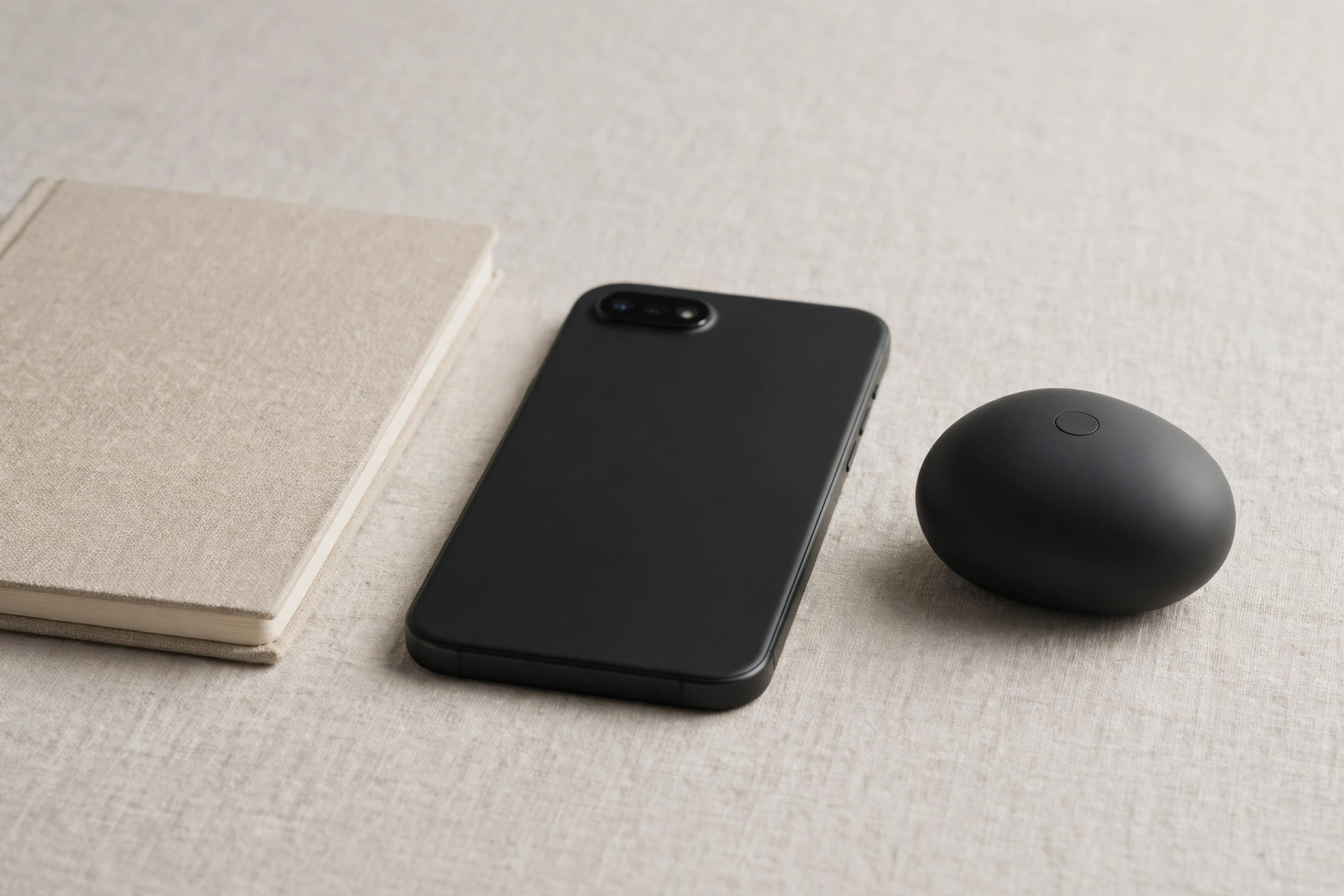
The honest answer is that nobody outside Nothing knows the form factor. But the market has already produced the candidates, and the comparison is instructive because it shows exactly what Nothing has to beat.
| Device | What it does | Price signal | Lesson for Nothing |
|---|---|---|---|
| Plaud NotePin | Wearable AI note-taker; records and transcribes | Premium wearable pricing | Capture works; the trick is what happens after |
| Omi | Ambient companion that listens and summarizes | Low-cost wearable | Always-listening raises the privacy bar |
| Friend | AI companion pendant | Companion positioning | Companionship is the positioning Pei rejects |
| Humane AI Pin | Screenless AI wearable (discontinued) | $699 + subscription | The cautionary tale — see below |
| Nothing (December 2026) | Unknown; “tool,” no screen, not an app | Not announced | Must prove hardware earns its existence |
The evidence points most strongly toward an AI recorder or ambient capture device — a tool that records, transcribes, and turns conversation into action. That is an inference from Pei’s clues and the shape of the market, not a confirmed fact, and several reports have explicitly cautioned that Nothing has not confirmed voice recording, automated note-taking, or meeting summaries. Treat the recorder theory as the leading hypothesis, not the answer.
Why “a tool, not a companion” is the whole strategy
Pei’s distinction matters. The AI hardware graveyard is full of companions: devices that promised to be your friend, listen to your day, and keep you company. They failed because companionship is a software problem — a phone app does it as well as a pendant — and because people do not want to pay a subscription to be listened to. A tool is different. A tool does a job, and if the job is real — capture the meeting, file the idea, brief you before the call — dedicated hardware can be justified: better microphones than a phone in a pocket, a battery that lasts the day, a button that records without unlocking anything. Nothing is positioning itself on the tool side of that line on purpose.
The Humane AI Pin Warning
Every screenless AI device is now judged against the Humane AI Pin, and Nothing knows it. Humane’s pin launched with enormous hype, a $699 price, and a monthly subscription — then stumbled on slow performance, overheating, and a simple problem: almost everything it did, a phone did better. Humane later shut down its cloud services, and HP acquired its assets for $116 million. The pin became the textbook example of AI hardware that could have been an app.
Pei’s announcement reads like a point-by-point answer to that failure. “It couldn’t have been an app” is a direct claim that this device clears the bar Humane tripped on. “A tool” rejects the companion framing that made the pin feel like a gimmick. And the December ship date — weeks after the announcement, not months of pre-order limbo — suggests Nothing wants the product judged as a shipping thing, not a promise. Whether it actually clears the bar depends on the one thing Pei has not disclosed: what the tool does.
| Humane AI Pin | Nothing AI-native product | |
|---|---|---|
| Positioning | AI companion / phone replacement | Productivity tool, explicitly not a companion |
| Screen | Laser projection onto the palm | No new screen at all |
| Price | $699 + $24/month subscription | Not announced |
| Core claim | Your phone, without the phone | A job that “couldn’t have been an app” |
| Outcome | Cloud services shut down; assets sold to HP for $116M | Ships December 2026 — to be judged |
Why December Matters
The timing is not an accident. Pei first floated the idea of an AI-native device in September 2025, and in March 2026 Bloomberg’s Mark Gurman reported that Nothing’s first AI-focused hardware would arrive before the end of 2026. A December ship date keeps that promise with days to spare — and puts the product in the holiday window, where a small, giftable piece of hardware has a real chance.
It also puts Nothing in the race on its own terms. The company has spent 2026 building Essential Space, the software tier on its phones that processes captured context into tasks and summaries. A dedicated capture device is the obvious hardware companion to that software: the phone organizes what the device hears. If the integration is real — capture on the device, organize on the phone, act in your apps — then “couldn’t have been an app” starts to make sense, because the value is in the pairing, not the app alone.
| Date | What happened |
|---|---|
| September 2025 | Pei first signals an AI-native device is coming |
| March 2026 | Bloomberg’s Mark Gurman reports Nothing’s first AI hardware arrives before end of 2026 |
| November 4, 2026 | Pei confirms in “Toolmakers”: first AI-native product ships in December; no new screen; “couldn’t have been an app” |
| December 2026 | Product ships — name, price, and specs still to be revealed |
The Questions Nothing Still Has to Answer
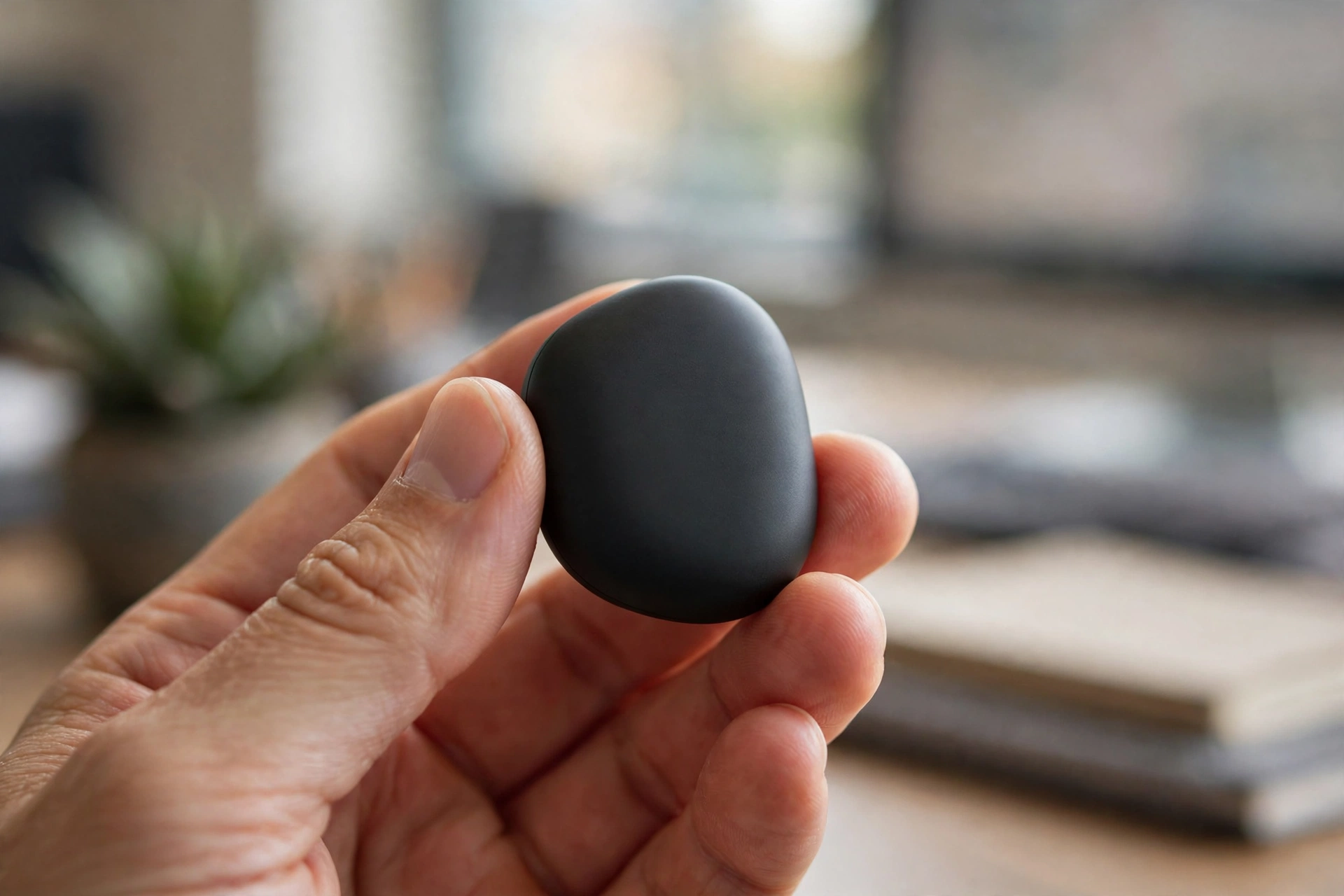
A teaser can only carry a product so far. Before anyone should buy this device, Nothing has to answer the questions that killed its predecessors — and so far it has answered none of them.
Privacy: what does it record, and where does it go?
An ambient, screenless AI tool almost certainly listens. Nothing has published no terms, no recording indicator policy, and no statement about local versus cloud processing. Buyers will need clear answers: a visible recording indicator, controls to delete data, and a policy on sharing with model providers. Omi and Friend faced the same questions; Nothing will face them louder, because it is a bigger brand.
Price: tool pricing, or companion pricing?
The Humane pin died partly on $699 plus a subscription. A productivity tool that costs as much as a phone and charges monthly will be judged as a luxury; a device priced like a good pair of earbuds will be judged as an experiment worth trying. Nothing has said nothing, and the price will tell us who the product is for.
Does it need a Nothing phone?
Nothing has not said whether the device requires one of its phones, or whether it works with any Android phone or iPhone. That answer decides whether this is an ecosystem play for existing Nothing owners or a genuine standalone product. It also decides the size of the market on day one.
What happens if it fails?
Humane’s shutdown stranded its buyers with dead hardware. Anyone buying a cloud-dependent AI device in 2026 should ask what happens to it if the company pivots, gets acquired, or shuts the service down. Nothing is a real company with shipping phones and revenue — a much stronger position than Humane ever had — but the question is now standard for this category, and the answer should be public before the first sale.
FAQs
When does Nothing’s first AI-native product ship?
In December 2026, according to CEO Carl Pei’s November 4 announcement. No exact date has been given, and Nothing has not confirmed launch countries.
What is Nothing’s AI-native product?
Nothing has not named it or described what it does. Confirmed facts: it is a physical productivity tool, it has no new screen, and Pei says it “couldn’t have been an app.” Its name, design, specifications, and price are all undisclosed.
Is it a pair of AI smart glasses?
Almost certainly not. Pei confirmed the December device has no new screen, and separate reporting has tipped Nothing’s AI smart glasses — with and without cameras — for later, reportedly 2027. The December product is something else.
Is it an AI voice recorder like the Plaud NotePin?
That is the leading theory, but it is not confirmed. Nothing has not confirmed voice recording, note-taking, or meeting summaries. The recorder hypothesis fits Pei’s clues and the market, but it remains speculation until Nothing says so.
How much will it cost?
Nothing has not announced a price. The price matters more than usual here: the Humane AI Pin failed partly on a $699 price plus subscription, so whether Nothing prices this as an accessible tool or a premium gadget will shape the whole verdict.
Bottom Line
Nothing has announced a product and told us almost nothing about it — and that is the point. Carl Pei’s three clues (ships in December, no new screen, couldn’t have been an app) frame a deliberate bet: that AI hardware only earns its existence when it does a real job a phone cannot, and that the job is productivity, not companionship. It is a direct answer to the Humane AI Pin’s failure and a natural extension of Nothing’s Essential Space software. But a frame is not a product. Until Nothing reveals the name, the price, the privacy terms, and — above all — what the tool actually does, the December launch is a promise, not a verdict. Watch the reveal, not the teaser: the first real test comes the day someone can hold it and ask it to do a job.