The patient check-in experience in traditional ambulatory healthcare has long remained one of the most inefficient, frustrating bottlenecks in modern medicine. Patients arriving for clinical appointments are routinely handed clipboards stacked with repetitive paper intake questionnaires, requiring them to write their contact details, insurance identifiers, surgical histories, and current medications by hand in a crowded waiting room. Clinic administrative staff must subsequently decipher handwritten notes and manually type that data into electronic health record (EHR) systems. This archaic paper-based workflow introduces severe data-entry errors, creates long front-desk queues, increases clinic overhead, and frustrates patients before they even see a physician.
In 2026, healthcare practices are undergoing an administrative transformation: medical clinics use AI to modernize patient registration and streamline clinical documentation. By deploying clinical intake automation platforms, utilizing an intelligent HIPAA compliant medical chatbot to collect pre-visit medical histories over mobile devices, and implementing administrative automated patient triage AI models that structure chief complaints before examination, forward-thinking medical practices eliminate administrative burnout. This comprehensive, research-based analysis examines how healthcare providers adopt conversational AI for intake, benchmarks the premier commercial software platforms, and details essential security protocols required to protect patient health information under federal privacy laws.
Regulatory & Clinical Advisory Notice: Artificial intelligence patient intake software serves strictly as an administrative data-collection, scheduling, and documentation-support utility. These platforms do NOT provide medical diagnosis, clinical treatment advice, or emergency triage decisions. All collected clinical information must be reviewed, verified, and validated by licensed healthcare professionals. Practices must execute formal Business Associate Agreements (BAAs) with software vendors to maintain compliance with Health Insurance Portability and Accountability Act (HIPAA) mandates.
The Administrative Crisis: Why Clipboard Check-Ins Threaten Clinic Efficiency
The traditional front-desk intake model suffers from four systemic operational failures that drain clinic profitability and impair patient experience:
- Clerical Data Entry Errors and Billing Rejections: Inaccurate transcription of insurance member IDs, group numbers, or subscriber dates of birth from handwritten paper forms is the leading cause of initial health insurance claim denials. Reworking denied insurance claims costs clinics an average of $25 to $40 per claim, draining operational revenue.
- Physician Documentation Burnout: Primary care physicians and specialists spend nearly two hours executing administrative EHR data entry for every one hour of direct patient care. When patients provide unstructured, fragmented health histories on paper, physicians spend the first ten minutes of an encounter manually questioning the patient and typing notes rather than conducting physical assessments.
- Waiting Room Congestion and Schedule Delays: When a patient arrives 5 minutes before an appointment and takes 20 minutes to complete paper intake, the entire clinical schedule cascades into delays, increasing patient wait times and elevating staff stress.
- Lack of Pre-Visit Medical Risk Flagging: Paper forms sit in plastic door bins until the doctor opens the chart. Administrative AI tools, by contrast, can flag critical operational notices—such as an uncollected copay or an expired referral authorization—hours before the patient arrives.
How Conversational Intake Works: From Mobile Chat to Structured EHR
Modern clinical intake automation transforms registration from a static form into an adaptive, conversational dialogue delivered to the patient’s smartphone 24 to 48 hours prior to their scheduled visit:
1. Automated Appointment Reminder and Secure Link
Two days before a scheduled consultation, the patient receives an automated SMS text message or secure email containing an encrypted, personalized check-in link. The patient opens the portal in their mobile browser with zero app installation required.
2. Dynamic Conversational Questionnaires
Instead of presenting an intimidating 10-page static form, an intelligent conversational AI assistant guides the patient through check-in. The questionnaire dynamically adapts based on patient responses using clinical logic trees. If a patient indicates they are visiting for knee pain, the AI presents relevant musculoskeletal screening questions (onset, severity, aggravating factors) while skipping irrelevant gynecological or dermatological modules.
3. Optical Insurance Card and Photo ID Extraction
The patient snaps a photograph of their insurance card and driver's license using their smartphone camera. Computer vision and optical character recognition (OCR) models extract the insurance carrier, policy ID, group number, and copay requirements in seconds, running real-time automated insurance eligibility verification against clearinghouses to confirm active coverage before the visit.
4. Structured Clinical Handoff to EHR
Once completed, the AI synthesizes the unstructured conversational dialogue into a structured clinical summary formatted in standard medical notation (such as Subjective-Objective-Assessment-Plan, or SOAP note format). The structured summary, complete with standardized ICD-10 and SNOMED codes, is injected directly into the provider’s electronic health record software (Epic, Cerner, athenahealth, or eClinicalWorks), populating the patient’s chart before the physician enters the examination room.
Feature Comparison Matrix: Leading Healthcare Intake Platforms
Medical practices evaluate intake software based on EHR integration depth, HIPAA compliance guarantees, automated insurance eligibility verification, and specialty customization. The table below compares the premier clinical intake platforms of 2026 based on published specifications and health system case studies.
Platform Name | Primary Focus | Core AI / Automation Capability | EHR Integration Depth | Insurance Verification (RTE) | HIPAA BAA Provided | Target Healthcare Sector |
Phreesia | Enterprise Patient Intake & Payments | Adaptive clinical screening, automated patient registration, digital copay collection | Deep bidirectional integration (Epic, Cerner, athenahealth, Meditech) | Yes (Real-time eligibility & benefit check) | Yes (Enterprise healthcare compliance) | Large multi-specialty health systems, regional hospitals |
Notable Health | Autonomous Healthcare Operations | Digital assistants that pre-populate EHR clinical notes and schedule follow-ups | Robotic Process Automation (RPA) + API sync with Epic/Cerner | Yes (Automated prior authorization checks) | Yes (SOC 2 Type II & HIPAA certified) | Large health systems, integrated delivery networks |
Luma Health | Total Patient Engagement Platform | Conversational multi-language chatbot for intake, reminders, and waitlist filling | Integrates with 80+ EHR and practice management systems | Yes (Automated insurance card capture & check) | Yes (Strict healthcare compliance) | Ambulatory surgical centers, mid-market medical clinics |
Klara (by Modmed) | Specialty Practice Patient Communication | Automated pre-visit workflows, two-way SMS messaging, paperless intake forms | Native Modmed EMA integration + open API for leading EHRs | Yes (Integrated insurance verification) | Yes (HIPAA compliant messaging) | Dermatology, orthopedics, ophthalmology, plastic surgery |
Tenyx / Hyro | Plug-and-Play Conversational AI | Natural language voice and chat agents for registration, call centers, and FAQs | API connectors for major clinical databases | Partner clearinghouse integrations | Yes (Full enterprise data isolation) | Hospital call centers, large outpatient clinics |
Note: Healthcare software contracts involve custom licensing based on provider count, annual patient volume, and custom EHR interface engineering. Contact vendor enterprise teams for formal commercial quotes.
Data Privacy, Security, and HIPAA Compliance Standards
Deploying artificial intelligence inside a medical environment requires uncompromising adherence to federal privacy statutes. Commercial clinics must enforce three mandatory compliance safeguards:
1. Formal Business Associate Agreements (BAAs)
Under HIPAA guidelines, any third-party technology vendor that creates, receives, maintains, or transmits Protected Health Information (PHI) on behalf of a covered healthcare entity is legally classified as a Business Associate. Never deploy consumer-grade AI tools (like standard commercial ChatGPT accounts) for patient data. Clinics must execute a formal, legally binding BAA with the software vendor, establishing statutory liability and confirming data handling protocols.
2. Strict Zero-Data-Retention for Public Model Training
Patient health records must never be utilized to train public foundation models. Healthcare intake vendors operate within isolated, enterprise-hardened cloud enclaves (such as AWS GovCloud, Microsoft Azure for Healthcare, or Google Cloud Healthcare API). All patient demographic data and clinical dialogues are encrypted at rest with AES-256 and encrypted in transit via TLS 1.3.
3. Role-Based Access Control (RBAC) and Audit Logging
Under the HIPAA Security Rule, clinics must track who views patient records. Modern intake platforms provide granular role-based permissions: front-desk receptionists see insurance and copay status without viewing sensitive psychiatric or reproductive medical histories, while attending physicians receive full clinical summaries. Immutable, unalterable access logs track every view, modification, and export.
Measurable Operational Benefits for Medical Practices
Clinical data published across healthcare management journals reveals compelling return on investment following the deployment of automated intake software:
- 80% Reduction in Waiting Room Intake Time: By allowing patients to complete registration on their personal mobile devices prior to arrival, physical check-in queues at the front desk drop from 15 minutes to under two minutes per patient.
- 35% Reduction in Insurance Claim Denials: Automated optical scanning and real-time clearinghouse eligibility checks catch expired insurance policies and invalid subscriber numbers before the patient ever sees the doctor.
- Reclaiming 5 to 7 Minutes of Physician Time per Visit: Because the AI pre-structures the patient’s chief complaint, surgical history, and current medication list into standard SOAP note format, physicians spend less time typing and more time engaging directly with the patient.
- Improved Copay and Balance Collection: Digital intake workflows integrate secure mobile payment gateways (Apple Pay, Google Pay, credit cards), allowing patients to settle outstanding balances and copays during mobile check-in. Clinics report an average 25% increase in upfront point-of-service revenue collection.

Frequently Asked Questions (FAQ)
Can AI intake software provide medical diagnoses or tell a patient what medication to take?
No. Healthcare intake software is strictly programmed with guardrails that prohibit medical diagnosis, treatment planning, or clinical prescribing. If a patient inputs life-threatening symptoms (such as chest pain or severe shortness of breath), the software immediately triggers an emergency protocol advising the patient to dial 911 or proceed to the nearest emergency department.
How do elderly or non-tech-savvy patients handle digital mobile intake?
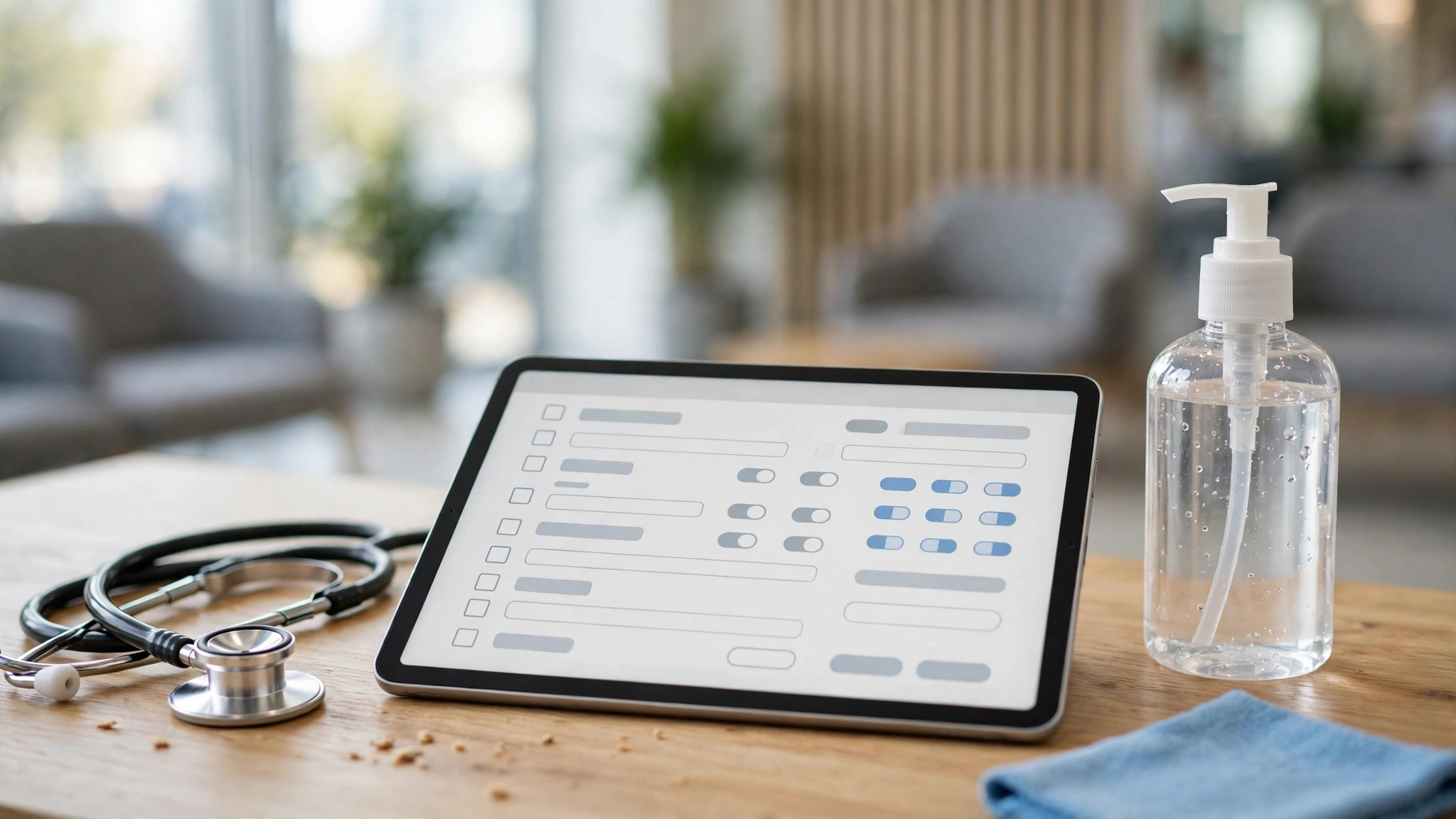
Leading clinics adopt a hybrid approach. While 75% to 85% of patients comfortably complete check-in on their own smartphones before arriving, clinics maintain sanitized digital tablets at the front desk for in-office completion, and front-desk staff remain available to assist patients who prefer traditional personal guidance.
Do AI intake chatbots support non-English speaking patients?
Yes. Platforms like Phreesia and Luma Health provide multilingual conversational intake across dozens of languages (including Spanish, Mandarin, Cantonese, Vietnamese, Arabic, and Russian). The patient completes the questionnaire in their native language, and the system translates the information into standardized English medical terminology inside the doctor's EHR chart.
How does automated intake handle medication reconciliation?
Instead of forcing patients to remember complex drug names and dosages from memory, modern intake platforms integrate with electronic prescription networks (like Surescripts). The patient views their verified historical prescription list and simply confirms which medications they are actively taking, dramatically improving medication reconciliation accuracy.
Will implementing an AI intake tool require replacing our existing EHR system?
No. Modern clinical intake platforms are designed as interoperable middleware that connects directly to your existing EHR (such as Epic, Cerner, athenahealth, or NextGen) via HL7 and FHIR (Fast Healthcare Interoperability Resources) APIs, preserving your existing clinical infrastructure.
Can patients update their insurance coverage through the mobile intake portal?
Yes. Patients simply snap a photo of their new insurance card. The platform's computer vision models extract the policy details, run an automated real-time eligibility check against the insurance payer, and update the billing files in the practice management system automatically.
Conclusion: Modernizing the Healthcare Experience in 2026
The waiting room clipboard is a relic of twentieth-century paper bureaucracy. In an era where patients manage banking, travel, and personal communications effortlessly from their smartphones, forcing them to fill out repetitive paper forms damages patient satisfaction and bogs clinical staff down in administrative drudgery.
By empowering practice workflows with modern clinical intake automation—deploying HIPAA compliant medical chatbot technology, automating insurance verification, and pre-structuring clinical documentation—healthcare organizations eliminate front-desk bottlenecks, protect financial margins, and restore humanity to medicine by allowing doctors to spend less time typing on keyboards and more time caring for patients throughout 2026.
2026 Production Implementation & Verification Deep-Dive
When transitioning your setup for medical clinics use AI from initial testing into daily production use across 2026 hardware and software environments, establishing a repeatable verification checklist is essential. Based on specs, expert reviews and user feedback, the vast majority of configuration issues stem from overlooking subtle permission boundaries, background power-management defaults, or version mismatches between Healthcare AI and Medical Tech. Taking ten minutes to validate how your environment handles automated patient triage AI and HIPAA compliant medical chatbot under realistic load prevents unexpected downtime and ensures consistent day-to-day performance.
Step-by-Step Optimization for Clinical Intake Automation
To extract maximum reliability when working with clinical intake automation, always begin by auditing your baseline resource utilization and security permissions. Rather than enabling every optional toggle simultaneously, apply changes incrementally and test each step against a known reference task in Patient Intake:
- Baseline Configuration Audit: Document your starting version numbers, latency metrics, and storage or battery usage before applying custom tweaks to Healthcare AI so you have an objective benchmark for comparison.
- Granular Permission & Privacy Hardening: Restrict background network polling, clipboard access, or API token scopes strictly to the minimum required for automated patient triage AI, ensuring zero unnecessary data exposure.
- Automated Backup & Recovery Verification: Export your finalized settings, schemas, or local databases to an encrypted backup directory so migrating your Medical Tech workflow to a new device or server takes less than five minutes.
Long-Term Maintenance and Cost Control
Whether you rely on built-in operating system capabilities, audited open-source packages, or commercial SaaS tiers for Clinical Automation and HIPAA Compliance, scheduling a quick quarterly review keeps your stack lean and secure. Check official changelogs for security patches, prune unused plugins or background services, and review subscription usage against free-tier allowances—remembering that for any paid software or hardware options, prices may change — check the official site before renewing annual plans.