The widespread deployment of large language models (LLMs) across enterprise software, autonomous agent loops, and real-time conversational assistants has exposed a fundamental computational bottleneck: autoregressive token generation latency. When foundation models like Llama 3.1 70B, DeepSeek-V2.5, or Claude generate text, they predict output strictly token-by-token. To generate a single word, the graphics processing unit (GPU) must read billions of model parameters from high-bandwidth memory (HBM) into compute cores, execute matrix math, and write the resulting token to the Key-Value (KV) cache. In typical interactive applications serving a single user stream, modern GPUs operate under extreme memory bandwidth constraints, utilizing barely 10% to 20% of their theoretical tensor floating-point compute capacity.
To overcome this computational barrier, machine learning researchers pioneered speculative decoding (also known as speculative sampling). By pairing a lightweight, ultra-fast draft model with a massive, high-parameter target verifier, developers can achieve dramatic acceleration in low latency token generation. Understanding how speculative decoding works is essential for AI engineers: it unlocks a 2x to 3x speedup in wall-clock inference speed with mathematically zero degradation in output distribution or reasoning accuracy. Through draft model LLM acceleration, speculative execution has become a cornerstone of modern high-performance inference engines like vLLM, TensorRT-LLM, and llama.cpp. This comprehensive technical guide unpacks the mathematical foundations, verification sampling algorithms, hardware economics, and real-world implementation strategies of speculative decoding in 2026.
Technical & Hardware Notice: Latency benchmarks, token acceptance rates, and speedup ratios discussed in this analysis reflect standard enterprise GPU configurations (such as NVIDIA H100, A100, and RTX 4090/5090 accelerators) and modern inference runtimes. Real-world speedup depends heavily on task predictability, temperature sampling, and the architectural alignment between draft and target models.
The Memory Bandwidth Bottleneck: Why Autoregressive Generation Is Slow
To grasp why speculative decoding is revolutionary, one must inspect the physical architecture of GPU hardware during neural network inference. Deep learning workloads fall into two computational regimes:
- Compute-Bound (Prompt Processing / Prefill Phase): When an LLM ingests an initial user prompt of 2,000 tokens, it processes all 2,000 tokens concurrently in a single forward pass. Matrix multiplications utilize the GPU’s Tensor Cores at near 100% saturation, maximizing memory reuse.
- Memory-Bound (Token Generation / Decode Phase): Once the prompt is processed, the model enters generation mode. It must predict token N+1 conditioned on the preceding tokens. To output this single token, the GPU must transfer all 70 billion parameters (140 gigabytes in FP16, or 35 gigabytes in 4-bit quantization) across the memory bus from VRAM to the compute processors. Because modern GPUs boast immense compute power (e.g., hundreds of teraflops) relative to their memory bandwidth, the compute cores spend most of their clock cycles sitting idle, waiting for parameter bytes to arrive.
This operational reality yields a counter-intuitive truth in modern machine learning: verifying multiple candidate tokens in parallel takes virtually the exact same execution time as generating a single token sequentially. Speculative decoding exploits this fundamental hardware characteristic to bypass the sequential memory bottleneck.
The Core Mechanics: The Draft-and-Verify Two-Step Paradigm
Speculative decoding restructures the linear generation loop into an asynchronous collaboration between two distinct models: a small, nimble Draft Model (e.g., Llama 3.2 1B or 3B) and a large, intelligent Target Model (e.g., Llama 3.1 70B).
The process operates across three continuous cycles:
1. Speculative Drafting (Low Cost, High Speed)
Because the draft model contains only a fraction of the target model's parameter volume (often 1B to 3B parameters versus 70B), its parameters reside in an ultra-compact memory footprint. The draft model runs autoregressively for K steps (typically 3 to 6 tokens) at blinding speed, guessing a sequence of future tokens:
Draft Sequence: [token_1, token_2, token_3, token_4, token_5]
Because the draft model is tiny, generating this 5-token speculative burst consumes negligible GPU time.
2. Parallel Target Verification (One Forward Pass)
The target model takes the draft sequence and evaluates all K tokens simultaneously in a single parallel forward pass. Just like the compute-bound prefill phase, verifying five candidate tokens concurrently requires fetching the massive 70B parameter weights from VRAM only once, taking the exact same wall-clock time as fetching them to generate a single token.
3. Modified Rejection Sampling (Preserving Exact Math)
The target model calculates its own probability distribution for each candidate token. A specialized rejection sampling algorithm compares the draft probabilities against the target probabilities. If the target model agrees with the draft tokens, they are accepted into the output stream in bulk. The instant the target model rejects a token, generation halts at that position, the target model emits its own corrected token, and the draft model restarts speculation from the new validated point.
Mathematical Rigor: Why Output Quality Never Degrades
A common misconception among software engineers is that speculative decoding is an approximate or lossy compression technique—similar to model quantization or pruning. It is not. Speculative decoding is mathematically lossless.
Under speculative sampling, the final accepted token sequence follows the exact same probability distribution as if the large target model had generated every token sequentially on its own. The rejection sampling criteria guarantees this invariance:
For candidate token x generated by draft model q(x):
If target probability p(x) >= draft probability q(x):
Accept token x with probability 1.0
Else:
Accept token x with probability p(x) / q(x)
If rejected: sample replacement token from normalized difference max(0, p(x) – q(x))
This elegant mathematical formulation guarantees that:
- Common, predictable tokens (e.g., syntax boilerplate, common idioms, punctuation, HTML tags) are drafted quickly and accepted with near 100% probability.
- Unpredictable, highly creative, or critical reasoning tokens are vetted by the target model, ensuring the output retains the target model's full analytical intelligence.
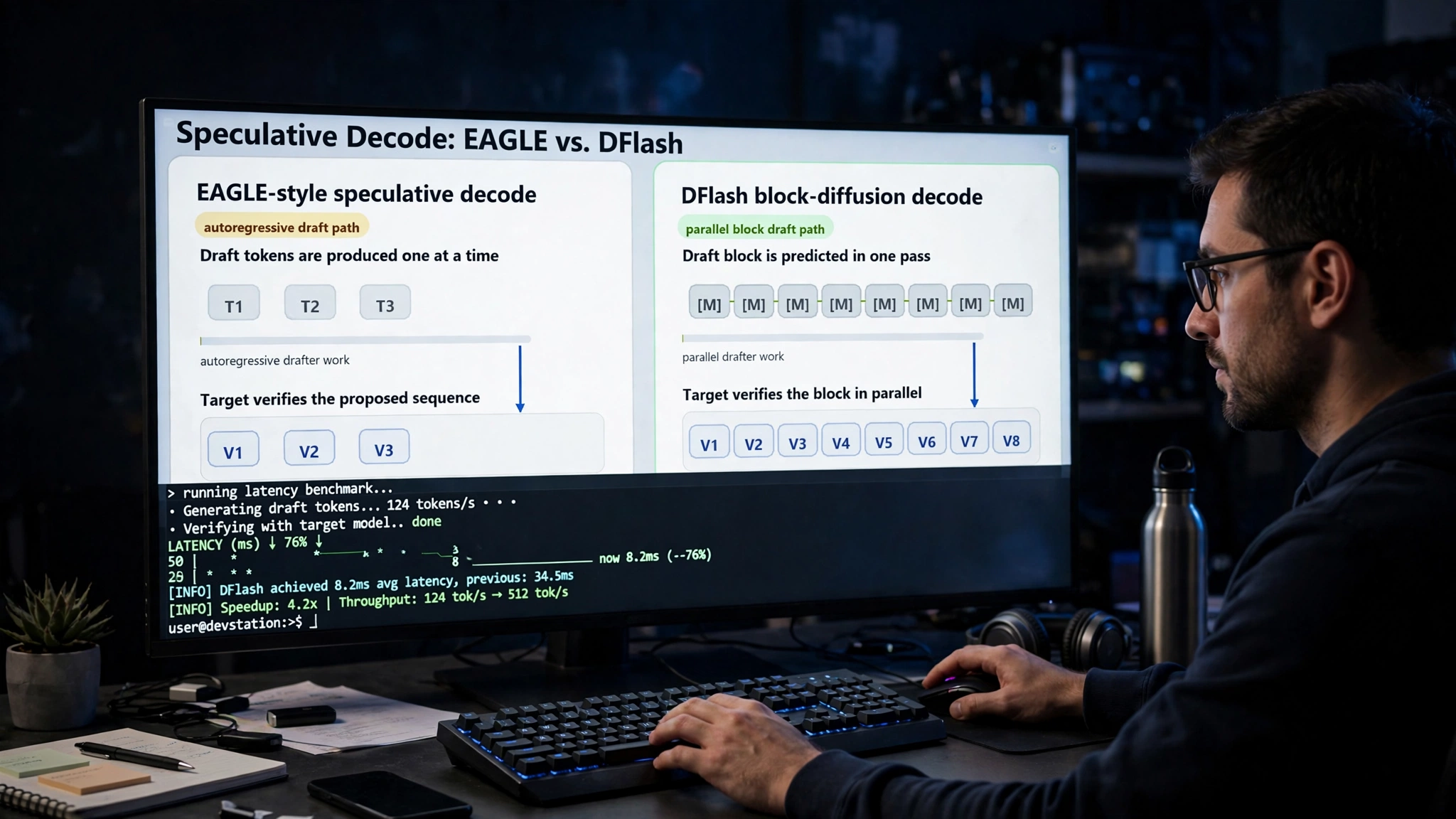
Comparison of Speculative Decoding Topologies
The machine learning ecosystem in 2026 has developed diverse architectural variations of speculative execution. The table below compares the primary speculative topologies based on performance benchmarks and infrastructure complexity.
Speculative Topology | Mechanism / Architecture | Typical Wall-Clock Speedup | GPU Memory Overhead | Implementation Complexity | Ideal Production Use Case |
Standard Draft Model (e.g., 1B + 70B) | Independent smaller model trained on similar data corpus | 1.8x – 2.5x | Low (requires loading additional ~2GB–6GB weights) | Moderate (Supported natively in vLLM / Hugging Face) | General conversational chat, creative writing, enterprise APIs |
Medusa (Multi-Head Heads) | Adds multiple feed-forward prediction heads atop base model | 2.0x – 2.8x | Minimal (<5% parameter increase over base target) | High (Requires fine-tuning Medusa heads on target model) | High-volume fixed enterprise models, dedicated datacenter serving |
EAGLE / EAGLE-2 | Autoregressive feature-level extrapolation heads | 2.5x – 3.2x | Minimal (<1GB VRAM for lightweight plugin head) | Moderate (Drop-in weight adapters for open models) | Coding copilots, complex math reasoning, low-latency agent loops |
Prompt Lookup Decoding (N-gram / Cache) | Extracts recurring n-gram patterns directly from input prompt | 1.5x – 3.5x (Context-dependent) | Zero additional VRAM (No secondary model required) | Low (Pure algorithmic string matching) | Document summarization, multi-turn RAG, code editing, translation |
Lookahead Decoding | Parallel Jacobi-style multi-branch candidate trees | 1.4x – 1.8x | Zero additional VRAM | High (Complex attention mask scheduling) | Constrained edge devices lacking memory for draft models |
What Dictates the Acceptance Rate? Task Entropy and Alignment
The speedup achieved by speculative decoding is fundamentally governed by the token acceptance rate (α)—the percentage of candidate tokens proposed by the draft model that are accepted by the target model. If α = 0.80, the system accepts an average of 4 out of 5 drafted tokens per cycle, yielding massive acceleration. If α = 0.20, the overhead of draft speculation negates the benefits.
Three core variables dictate the acceptance rate:
1. Task Entropy (Predictability)
Speculative decoding thrives in low-entropy environments where subsequent tokens follow predictable syntactic or semantic trajectories. In tasks like code generation (where language syntax, variable declarations, and structural indentation follow rigid rules), acceptance rates routinely exceed 85%, delivering 3x speedups. In document summarization and translation, where text patterns are heavily anchored in the source prompt, acceptance is similarly high. Conversely, in high-entropy creative poetry or chaotic brainstorming, acceptance rates drop to 50%–60%.
2. Architectural and Tokenizer Alignment
For standard speculative decoding to function efficiently, the draft model and target model must share the exact same tokenizer vocabulary. If the draft model breaks a word into three sub-tokens while the target model breaks it into two, candidate alignment collapses. The most effective pairings occur within model families: for example, pairing Llama-3.2-1B-Instruct as a draft model for Llama-3.1-70B-Instruct.
3. Sampling Temperature
Greedy decoding (temperature = 0.0) yields the highest possible acceptance rates because the target model selects the single argmax token at each step. As generation temperature increases to 0.7 or 1.0 (introducing deliberate randomness for creative diversity), the stochastic overlap between draft and target distributions decreases, slightly lowering the effective speedup.
Prompt Lookup Decoding: The Zero-Memory Wonder for RAG and Code
One of the most practical innovations in modern inference is Prompt Lookup Decoding (pioneered by open-source contributor Apurv Verma). Traditional speculative decoding requires loading a secondary draft model into GPU memory, which is impossible if your target model already consumes 100% of available VRAM.
Prompt Lookup Decoding eliminates the draft model entirely. It observes that in tasks like code refactoring, JSON document extraction, and RAG question answering, the vast majority of output tokens already exist verbatim inside the user prompt. When generating text, the engine inspects the last two generated tokens (e.g., user_id =), searches the input prompt for identical n-grams, extracts the subsequent 5 tokens directly from the prompt text, and speculates them as candidate tokens to the target model. Because string matching consumes virtually zero CPU cycles and requires no extra VRAM, Prompt Lookup Decoding delivers 2x speedups in RAG pipelines with zero memory overhead.

Production Implementation: Deploying Speculative Decoding in vLLM
Modern high-throughput inference engines make deploying speculative decoding straightforward. Below is an example configuration for serving a 70B target model paired with a 1B draft model using the open-source vLLM engine:
# Serve Llama 3.1 70B accelerated by Llama 3.2 1B draft model
vllm serve meta-llama/Llama-3.1-70B-Instruct –tensor-parallel-size 4 –speculative-model meta-llama/Llama-3.2-1B-Instruct –num-speculative-tokens 5 –gpu-memory-utilization 0.95 –max-model-len 8192
In this architecture:
- –speculative-model: Designates the lightweight draft partner sharing the Llama tokenizer.
- –num-speculative-tokens 5: Instructs the draft model to generate 5 speculative tokens per cycle before triggering target verification.
- vLLM automatically handles rejection sampling, KV cache management, and multi-GPU tensor synchronization under the hood.
Frequently Asked Questions (FAQ)
Does speculative decoding change or degrade the quality of LLM answers?
No. Speculative decoding is mathematically equivalent to running the target model alone. The rejection sampling algorithm strictly preserves the target model's probability distribution. Every output generated with speculative decoding is identical in quality to an output generated without it.
Can speculative decoding slow down inference in certain scenarios?
In rare edge cases, yes. If the draft model is severely misaligned with the target model, or if the task is extremely high-entropy (causing the acceptance rate to drop below 20%), the time spent generating rejected draft tokens introduces a slight computational overhead. However, modern engines monitor acceptance rates dynamically, automatically disabling speculation if the acceptance rate drops below an efficiency threshold.
Can I use an open-source draft model with a proprietary target API like GPT-4o?
Not over standard external REST APIs. Speculative decoding requires white-box access to the target model's raw output logits and token probabilities to execute the rejection sampling math in a single forward pass. However, proprietary API providers implement speculative decoding internally behind their endpoints to reduce operational server costs.
What is the ideal draft model parameter size?
Empirical research indicates that an optimal draft model should possess roughly 1% to 5% of the target model's parameter volume. For a 70B parameter target model, a 1B to 3B draft model provides the ideal balance: small enough to generate tokens almost instantaneously, yet intelligent enough to achieve a 70% to 80% acceptance rate.
Does speculative decoding work on consumer GPUs?
Yes. Tools like llama.cpp and Ollama support speculative decoding on consumer hardware. For example, users running an 8-bit quantized 70B model on an Apple Mac Studio or dual RTX 4090 workstation can pair it with a 4-bit 1B draft model, dramatically increasing tokens-per-second generation speeds on local machines.
How does speculative decoding interact with Key-Value (KV) caching?
Speculative decoding relies heavily on adaptive KV cache slicing. When the draft model proposes candidate tokens, their temporary KV states are written to cache. The moment the target model rejects token K-2, the KV cache pointers are instantly rolled back to the rejected index, ensuring that invalid speculative tokens never corrupt the persistent conversation history.
Conclusion: The Standard for Modern Real-Time AI
As artificial intelligence shifts from asynchronous batch processing toward autonomous real-time agent loops, voice assistants, and interactive coding environments, single-token latency has become the critical benchmark of user experience. Continuing to run multi-billion parameter foundation models through brute-force sequential generation leaves immense GPU compute idle on memory buses.
By leveraging speculative decoding—whether through dedicated draft models, Medusa multi-head architectures, or prompt lookup heuristics—machine learning engineers unlock massive throughput gains while preserving absolute mathematical fidelity. In 2026, speculative decoding is no longer an experimental research curiosity; it is the definitive engineering standard for high-speed, cost-effective language model inference.